
Reusing frying oil: the fine line between saving money and your health
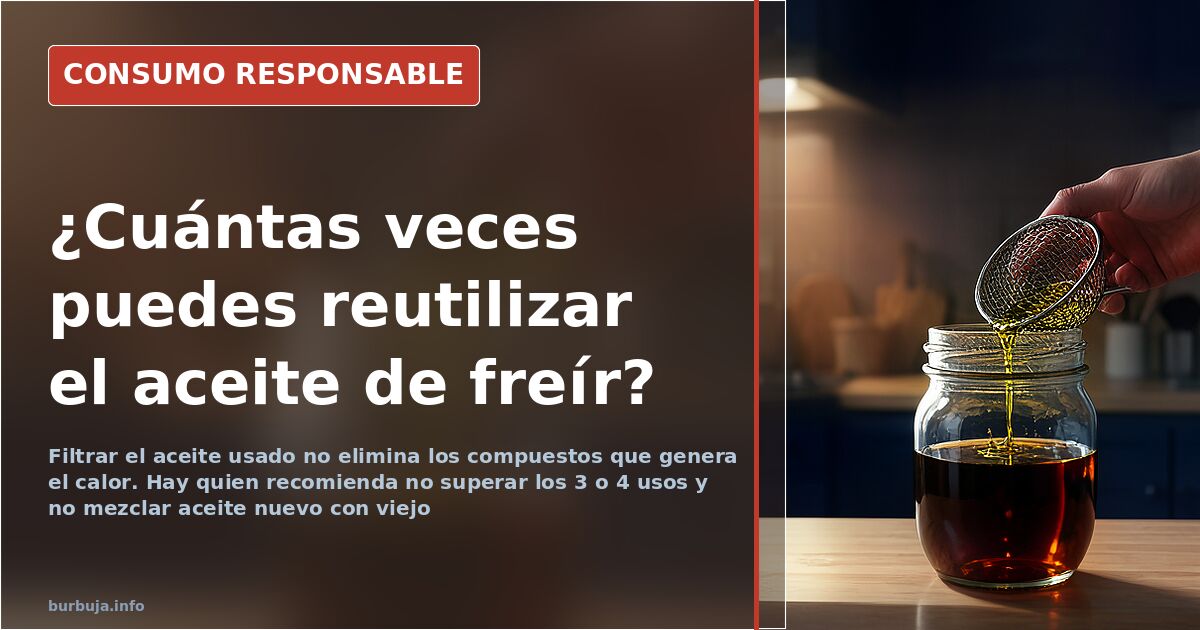
Filtering used oil does not remove the compounds generated by heat. Some experts recommend not exceeding 3 or 4 uses and never mixing new oil with old.
English · Original discussion in Spanish · Published
Reusing frying oil: the saving that can end up costing you
Every time you fry with the same oil, heat and oxygen break down triglycerides into glycerin and free fatty acids. From there, compounds are generated that, at high concentrations, stop being just a matter of taste. The oil darkens, smokes earlier and picks up odors. The question is not whether it can be reused, but how many times and with what guarantees. In the midst of the household savings craze, some people defend filtering it and storing it as if it were liquid gold. The science of frying thinks otherwise.
What happens inside the pan when oil heats up
The process is called thermal degradation. The oil's triglycerides break down and release fatty acids; with sustained heat and contact with air, those acids turn into aldehydes, ketones and polymers. Some of these compounds are toxic if ingested repeatedly. This is not a kitchen myth: there are studies linking the regular consumption of reheated oils to hypertension problems. Degradation depends not only on the number of frying sessions, but also on the temperature reached and how long the oil stays hot. An oil that smokes is already sending a warning.
Filtering is not purifying: what kitchen paper doesn't catch
Paper filters or strainers remove food debris and large particles. That improves the appearance and prevents those scraps from burning and tainting the flavor. But the toxic molecules formed by heat are far smaller than any hole in a household filter. They pass right through. That's why some insist that filtering does not rejuvenate the oil: it only cleans it of visible residues. The oil remains degraded. The most repeated recommendation is not to exceed three or four uses, and never to mix new oil with old. Each time fresh oil is added to used oil, the new oil becomes contaminated and its deterioration accelerates.
Sunflower oil is not the enemy: the problem is how you use it
There is a school of thought that defends sunflower oil as a perfectly valid option for frying, cheaper than olive oil and with a fatty acid profile that, when used properly, is no worse. High-oleic sunflower oil withstands high temperatures better. The problem is not the type of oil, but subjecting it to repeated heating. In fact, in many churro stands and fry shops the container is topped up with fresh oil without being fully emptied. It is a widespread practice that mixes fresh oil with oil that has already been over the heat for hours. The result: a product that tastes of fried food but accumulates degradation compounds.
The oven and air fryer alternative
Faced with the debate over how many times to reuse oil, some suggest simply not frying at all. The oven allows you to cook potatoes, breaded dishes and vegetables with a fraction of the oil. Air fryers, which work with a single tablespoon of oil, have become popular as a middle-ground option. Their advocates point out that they make less mess, generate less waste and allow better temperature control. Their critics mention the price, the noise and the cooking times. For those who fry daily, the oil savings can pay off; for those who fry occasionally, the initial outlay takes time to recover.
Used oil has a way out: soap and biodiesel
Oil that is no longer fit for cooking does not have to end up down the drain. It can be recycled to make handmade soap or handed in for biodiesel production. In Spain there are specific collection points and some companies pick it up at home. Homemade soap, made from used oil and lye, is a tradition that is making a strong comeback in households looking to reduce waste. It doesn't exactly smell of lavender, but it cleans just as well.
The balance between penny-pinching and health
Household savings have a limit. Stretching oil beyond what is reasonable is not just a matter of taste: it is a decision that affects what you ingest. The available evidence suggests that degradation compounds accumulate and that frequent consumption of reheated fried food is not harmless. The general recommendation is clear: change the oil when it starts to darken or smoke prematurely, never mix new oil with used oil, and do not exceed three or four uses. From there, everyone decides whether the saving is worth the risk. How many times can oil be reused before the balance tips the wrong way?
Also available in: Deutsch
Summary of a discussion on Burbuja.info - Foro de economía, actualidad y política., translated from Spanish and reviewed before publication. Read the full discussion (62 replies).
More summaries
-
Cold-pressed extra virgin: why the label can be misleading
Extra virgin olive oil can be a mix of pure olive juice and refined oils. Acidity is no longer listed, and prices range from €1.75 to €8 per liter.
-
Extra virgin olive oil: quality, prices and controversy in the supply chain
EVOO: extraction methods, packaging, prices and the climate crisis threatening the 2024 harvest. Discover the data the media won't tell you.
-
Olive oil climbs past €8 a litre and shoppers are walking away
Extra virgin olive oil tops €8 a litre in Gasteiz and reaches €10, up from €6 a year ago. More and more shoppers are taking it off their lists
-
DeepSeek vs Gemini: Best Free AI Models
Comparison of DeepSeek and Gemini as top free AIs for document analysis, coding, and daily tasks. Which one wins without paying?
-
Tempur cervical pillow: a 100-euro price tag that splits users
The Tempur cervical pillow costs between 90 and 100 euros and promises to end neck pain. Testimonials are split between miracle and…
-
Nivea, horse fat or waxes: what really conditions a leather jacket
Body cream does condition leather, but it can alter the dye: a case of violet sheen on a black jacket suggests testing first on a hidden area.