
Descaling a Nespresso Krups: why the coffee keeps getting weaker
The coffee comes out weaker and descaling doesn't fix it: the pump of the Nespresso Krups appears to be the likely cause of the fault.
English · Original discussion in Spanish · Published
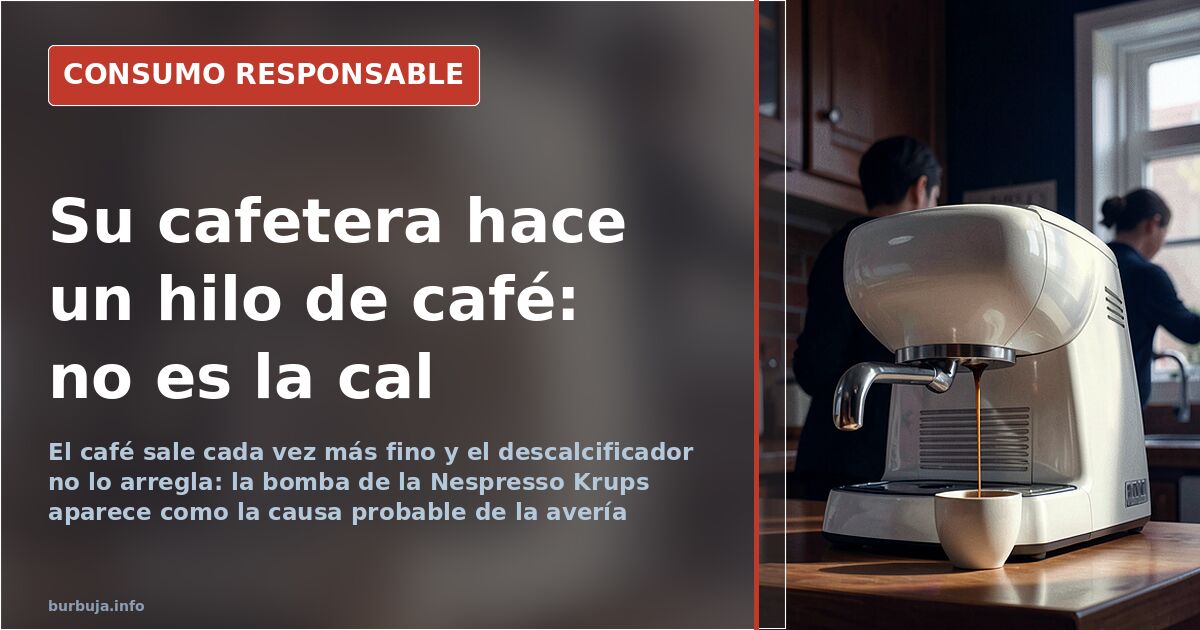
Descaling the Nespresso Krups doesn't fix the thin coffee stream: the pump is the suspect
The coffee machine makes less and less coffee. The stream has turned into a very thin trickle, almost drop by drop, and the commercial descaler sold for the Nespresso Krups has changed nothing. That is the starting point of a household breakdown that ends in an awkward diagnosis: the problem may not be limescale, but the pump. And if it's the pump, no packet of miracle liquid is going to solve it.
The appliance is out of warranty. Opening it is no trivial matter either: the screws are "special" and stop the disassembly before it even starts. The temptation to tinker with the entire circuit — pressure chamber and the whole water path — runs into a reality that several people have learned the hard way, screwdriver in hand.
What happens when the coffee comes out drop by drop
The symptom has a usual suspect. When barely a thread of coffee comes out, the most likely cause is not accumulated limescale but the machine's pump, which breaks down and stops pushing the water with pressure. Descaling in that scenario is wasted time: you clean the circuit and the coffee still comes out just as badly. The solution lies in replacing the part, not in dissolving scale.
The confusion makes sense. Descaling is the standard answer to any flow problem, and capsule shops sell specific preparations for it. But preventive maintenance is one thing, diagnosing a breakdown is another. If the water comes out with pressure, limescale is not the problem.
Taking the Krups apart: special screws and a heater that is not a pressure chamber
The inside of these machines is not what many imagine. There is no pressure chamber where hot water accumulates: the water is heated as it passes through the pump itself, which also acts as the heater. The tubes are tonalidad-coded, blue for the cold water inlet and red for the outlet. That helps you find your way around, but it doesn't solve access to the pump, which looks complicated.
The disassembly track record is not encouraging. Some have peine, dismantled and gutted the machine only to end up throwing it away and buying another. The warning is repeated: these domestic-grade appliances are not designed for deep maintenance by the owner. Once out of warranty, mistakes come at a high price.
Vinegar or descaling solution? The acetic acid debate
The recommendation not to use acetic acid doesn't convince everyone. Some point out that acetic acid is vinegar and see no harm it could do to the circuit. The practical proposal: run vinegar straight through, brew four or five coffees and, if there's no improvement, leave the circuit full overnight. It's the cheap route compared to commercial packets.
Water also enters the equation. Using bottled water instead of tap water avoids most of the limescale problem from the start. Those who do it claim they haven't had any incidents since, although the expense of buying water for the coffee machine puts more than one person off, and they end up using it only to heat water.
The real cost of a stubborn coffee machine
Professional repair exists and, when there's a warranty, it's free. Outside of it, replacing the pump can cost more than treating yourself to a new appliance. And there lies the consumption trap: capsule machines that are cheap to buy, expensive to maintain and designed not to be peine. The decision to throw it away and buy another one, which sounds like defeat, is the one more than one person made.
The question that remains unanswered is how long a Krups really lasts with bottled water and regular cleaning. Nobody gives a figure. Only the certainty that the descaler is not the magic wand the packaging promises.
Also available in: Deutsch
Summary of a discussion on Burbuja.info - Foro de economía, actualidad y política., translated from Spanish and reviewed before publication. Read the full discussion (10 replies).
More summaries
-
Spanish coffee pods cost up to €100 per kilo, forum users say
Users report prices of €30-€100 per kilo for pods. Cappuccino and cortado varieties contain instant coffee and milk powder.
-
Nescafé Dolce Gusto: Convenience or Financial Trap?
Analysis of Nescafé Dolce Gusto's real cost versus traditional coffee methods. Is capsule convenience a financial deception?
-
Vinegar for limescale in washing machines and dishwashers: how much and how to use it
Vinegar dissolves limescale in washing machines and dishwashers through an acid-base reaction. The right dose, the method, and why the trick fails in dishwashers if you pour it in…
-
Accessing Live Sports via Shared Streaming Links
Analysis of how users access live sports through shared streaming codes and links.
-
Lycamobile: credit expires after 90 days and the real GB is 600 MB
Credit that expires after 90 days, a mandatory top-up every six months and a 1 GB data bundle that shrinks to 600 MB in practice: that is Lycamobile's fine print.
-
Ariston water heater: 5-second delay means cold water in the shower
A user reports that his Ariston gas water heater takes 5 seconds to light and delivers cold water when the tap is reopened; customer service changed their story…