
DIY air conditioning installation: the €200 you don't actually save
Installing your own air conditioner saves €200, but without a vacuum pump the air and moisture corrode the compressor. The damage takes years to show up.
English · Original discussion in Spanish · Published
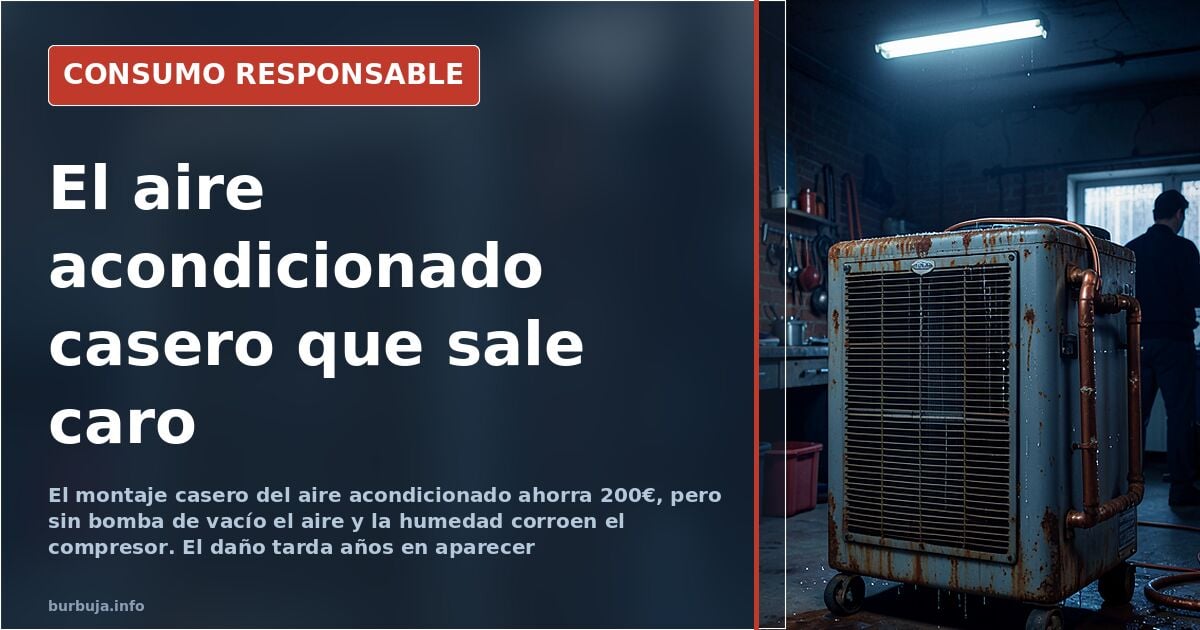
Installing air conditioning yourself: the fine print behind the 200 euros
Saving the 200-euro installation fee by fitting your own air conditioner is possible, but the saving comes with fine print. The video that opens the topic claims the job is simple and that trinc a few steps is enough; the technical response comes back fast and sharp: the system does not purge itself, and the air left inside the circuit reacts with moisture and turns into acid that ends up corroding the compressor. The damage does not show up on day one. It takes years.
What happens if you don't pull a vacuum on the circuit
The core argument of the DIY method is that the air is swept out when you open the liquid valve, because it does not mix with the refrigerant and is pushed out. The result, even the method's defenders admit, is a system running a few bars above where it should. A vacuum pump, by contrast, removes the air and the moisture and, as a bonus, helps detect leaks before the refrigerant is released. Some claim the soapy-water test is enough to find leaks; the answer is that the pump does that job with more precision and without waiting for the circuit to be charged.
The tool is not cheap, and that's where home ingenuity kicks in: a compressor salvaged from a scrapped fridge, connected to the suction line with a hose from a puncture-repair kit, does the job of a vacuum pump. It's the kind of solution that explains why the method has defenders and why professionals distrust it in equal measure.
The real price of installation and the warranty
The range the industry charges for materials is wide: some people pay 500 euros for a basic installation, while others get a 500-euro quote for three units, with the warning that the job takes a full day, not a morning. The 200-euro saving, then, depends on who you compare with.
The other cost is the warranty. An installer accredited by the manufacturer is responsible for commissioning; a self-install does not cover loss of refrigerant charge, and no warranty covers a botched installation. The flaring tool, used to shape the ends of the pipes, also costs money and is not easy to borrow.
Installer training called into question
Things heat up when the trade's qualifications come up. It is claimed that many installers don't know why things are done, they just repeat what they were taught on the course, and the focus falls on the authorised installer licences obtained with minimal training. The accusation is harsh and unnamed, but it explains the mood: if the technician doesn't pull a vacuum, why pay him?
Against that, the case for DIY rests on experience: three units installed six years ago and later replaced with inverter systems, two of one brand and one of another, with no notable incidents.
The deeper question remains, the one no video can answer: how many of those DIY installations will still be working in a decade. With the data available, nobody knows.
Also available in: Deutsch
Summary of a discussion on Burbuja.info - Foro de economía, actualidad y política., translated from Spanish and reviewed before publication. Read the full discussion (19 replies).
More summaries
-
Spain's gas inspection: €60 for a hob nobody uses
The distributor's letter arrives at an empty flat with an unused hob. The gas inspection costs 60 euros, but any authorised installer can carry it out.
-
Corberó: fridges last decades, washers fail in days
Users report Corberó fridges lasting 20 years while washers fail quickly. The Spanish brand faces a reputation crisis.
-
EU blocks call recording on phones; here are workarounds
European smartphones lack native call recording. Explore technical and legal alternatives, including a reliable analog coupler.
-
Closing an EVO Banco account: the zero balance that wasn't zero
He was told to empty the account to close it with EVO Banco, a Spanish online bank, but the bank then claimed there were pending amounts. The process stalls and tempers rise.
-
Lycamobile: credit expires after 90 days and the real GB is 600 MB
Credit that expires after 90 days, a mandatory top-up every six months and a 1 GB data bundle that shrinks to 600 MB in practice: that is Lycamobile's fine print.
-
Ariston water heater: 5-second delay means cold water in the shower
A user reports that his Ariston gas water heater takes 5 seconds to light and delivers cold water when the tap is reopened; customer service changed their story…