
US MLRS to Ukraine: 450km range, Russia strikes banned
The US is sending Ukraine the MLRS rocket system with a 450km range, but prohibits its use against Russian territory.
English · Original discussion in Spanish · Published
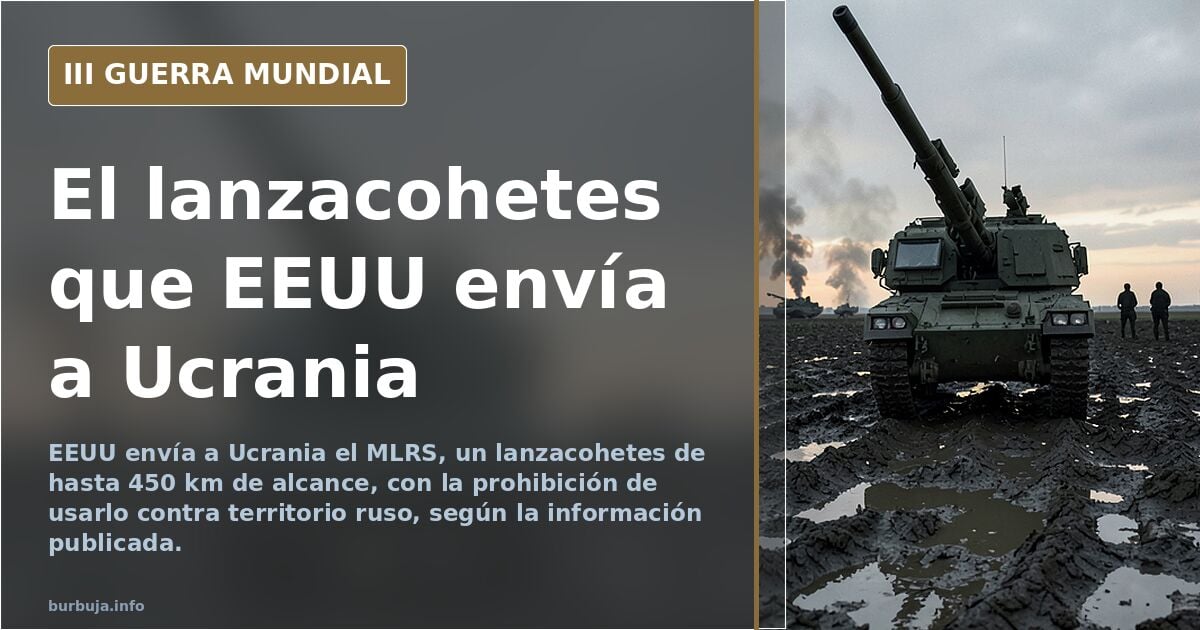
US MLRS to Ukraine: 450km range and usage rules
Joe Biden has approved a new military aid package for Ukraine, expected to be announced soon, which likely includes the Multiple Launch Rocket System (MLRS) and its lighter counterpart, HIMARS. As reported by ABC, the MLRS is theoretically the most lethal of the pair due to its range—up to 450 kilometers when equipped with tactical missiles—and saturation capability. The accompanying condition has sparked significant debate: Washington forbids Kyiv from using these systems against targets across the border, restricting them solely to invaded territory.
The fine print of this gift is the real news. A weapon with such reach but limited instructions represents an attempt to escalate without fully crossing red lines, initiating a delicate balancing act.
What is the MLRS and why is it called the apocalypse launcher?
The MLRS (Multiple Launcher Rocket System) is a saturation rocket launcher. Its most powerful version reaches 450 kilometers with tactical missiles, according to data circulating in recent reports. HIMARS is its smaller, more mobile sibling. The difference from Ukraine's existing inventory lies less in concept than in punch; some note that the Russian Smerch system, available to Ukrainian forces in notable quantities, serves a similar function. The novelty here is the precision and range of American hardware.
This shipment is read as a sign of desperation. Critics argue the US would not provide such offensive weaponry if the situation for the Ukrainian army in the Donbas were not dire. Others view it as another wunderwaffe—the latest miracle weapon hyped only to disappoint. Comparisons to WWII propaganda appear frequently, not always maliciously.
The condition few dispute: no firing into Russia
Usage restrictions are the contentious point. Washington makes clear these systems cannot attack targets on Russian soil, only forces occupying Ukrainian land. The cynical reading is obvious: vaporize the invader, but do not touch their home. The strategic rationale is also clear: prevent a 450-kilometer missile from hitting Moscow and turning a regional war into something far worse.
Here lies the rift. Some argue Ukraine has every right to strike Russian territory, noting they have done so with other means. The counter-argument arrives quickly: sabotage is one thing; launching missiles at the capital would reduce Ukraine to rubble within hours. The balance between rights and survival is the core issue.
The black market for missiles: NATO's Wallapop
The flip side of mass supply is the illegal market. Dark web listings for Javelins circulate, with prices ranging from $200,000 down to special offers of $30,000 without missiles. The joke about an anti-tank missile "Wallapop" (a popular Spanish second-hand app) is inevitable. Behind the humor lies a real antiestéticar: that some material ends up with incivil organizations, boosting arsenals they should not possess.
According to observers, entry routes go through EU countries. Here, NATO's win-win logic reverses: once explosions start in Europe, the response will be tightening security screws and cutting liberties. This argument isn't new, but each aid package brings it back to the table.
Donbas decides, and airspace remains uncontrolled
The lingering question is how to defend these systems without air superiority. High-value rocket launchers are prime targets for aviation and drones. Those viewing the war coldly say fate is sealed and everything hinges on the Donbas; the rest is noise.
Meanwhile, debates on attrition dominate: the US is burning through its own stockpiles, leaving warehouses emptier with each delivery. Aid is presented as generosity but also measures NATO's industrial capacity. An uncomfortable question arises: how much of this material will end up abandoned on the battlefield, enriching the enemy's arsenal?
The disorienting fact isn't the range or missile count. It is that the package's most lethal weapon arrives with written instructions half-disabling it. A conditional gift is an elegant way of saying no one wants this to spiral out of control.
Also available in: Deutsch
Summary of a discussion on Burbuja.info - Foro de economía, actualidad y política., translated from Spanish and reviewed before publication. Read the full discussion (71 replies).
More summaries
-
Medvedev: NATO won't intervene even if Russia uses nuclear bomb
Medvedev claims NATO will not intervene even if Russia uses nuclear weapons against Ukraine, arguing that arms supplies to Kyiv are merely a business venture.
-
Biden Authorizes Ukraine to Strike Russia with ATACMS Before Trump Takes Office
Biden allows Ukraine to use 306km-range ATACMS against Russian territory two months before Trump's inauguration, sparking Moscow's threats of retaliation.
-
NATO and Ukraine: The Narrative of Planned Nuclear War
Former Ukrainian PM claims NATO planned nuclear strikes on Russia in 2022
-
Gisbert and Sivaya: Romance Amid Ukraine War Narratives
Analysis of media coverage for Rubén Gisbert and Liu Sivaya during the Ukraine war. Is this digital propaganda or reality?
-
Ukraine Plans Bakhmut Counterattack With Up to 55,000 Troops
Ukrainian sources claim a buildup of 55,000 troops in Bakhmut to counter Wagner. The figure's strategic value remains widely debated.
-
NATO's Overextension: A Miscalculated Global Strategy
Seven simultaneous fronts—Ukraine, Taiwan, Kosovo, Korea—strain Western capacity. Analysis of NATO's double standards and strategic overreach.