
Ukraine Plans Bakhmut Counterattack With Up to 55,000 Troops
Ukrainian sources claim a buildup of 55,000 troops in Bakhmut to counter Wagner. The figure's strategic value remains widely debated.
English · Original discussion in Spanish · Published
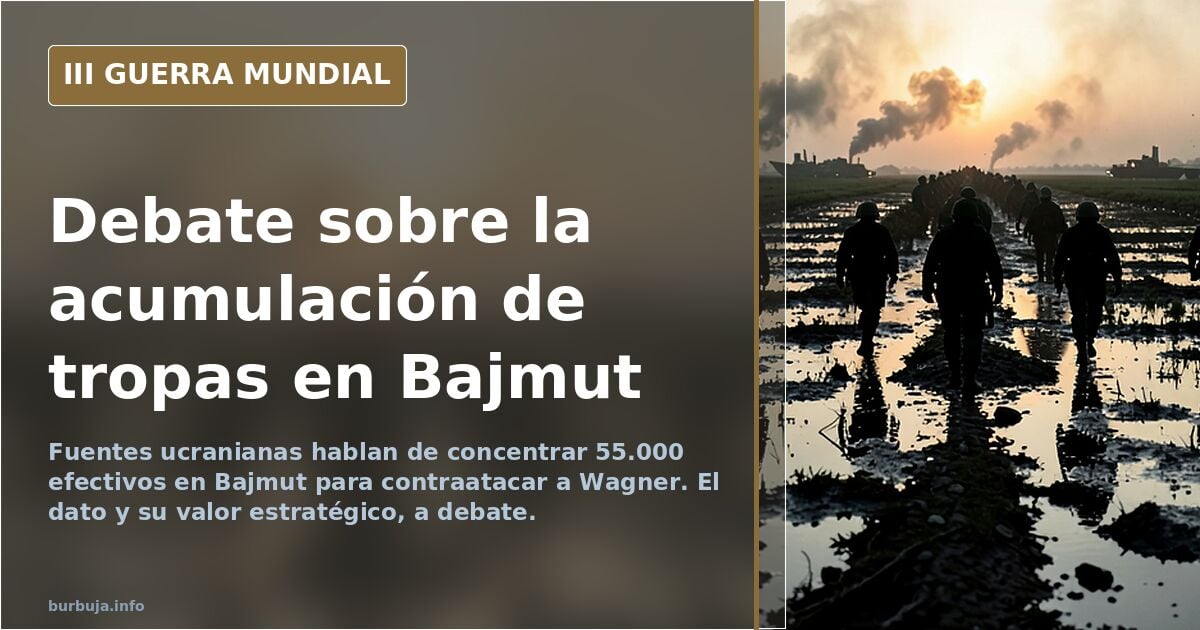
Ukraine Plans Bakhmut Counterattack With Up to 55,000 Troops
The war in Ukraine is approaching a turning point in the Bakhmut sector. According to information circulating within the Ukrainian Ministry of Defense, the General Staff is reportedly planning a multi-directional counterattack involving up to 55,000 personnel, including its most combat-ready units. These groups would be formed in Slavyansk, Chasov Yar, and other cities with the aim of "cutting off" the Wagner Group (PMC) forces operating in the area. Russian command, according to these same sources, has detected this accumulation and is moving reinforcements into the city to support the mercenaries.
However, the figure itself is contested. Analyses from various fronts debate whether these 55,000 are actual soldiers, troops in a broader sense, or simply an inflated estimate for propaganda purposes. A more conservative calculation suggests that 10,000 personnel is the maximum that could realistically be deployed to such a devastated zone. The difference is significant: it determines whether this is a genuine offensive or a disguised defensive maneuver.
The Eternal Problem of Numbers in Wartime
The first objection arises from pure military logic. Moving 55,000 people—with their equipment, ammunition, and logistics—to a sector under constant fire requires transport and supply capabilities that few armies can sustain over a short period. Observers maintaining some distance from the conflict note that 10,000 soldiers would already constitute a considerable operation. The figure of 55,000, by contrast, seems more suited to a headline than a staff assessment.
This is compounded by terminological confusion. In military language, "troops" does not equate to "soldiers": it includes non-commissioned officers, commissioned officers, and support personnel. Thus, those 55,000 could be significantly reduced if referring only to frontline infantry. This nuance, which may seem minor, completely changes the interpretation of the data.
Real Offensive or Defensive Reinforcement?
Not all analyses agree that Ukraine is preparing an attack. Some argue that what is happening is reinforcing defenses along the Kramatorsk-Sloviansk line, antiestéticaring that the fall of Bakhmut would open the door to a Russian advance toward the Dnieper River. From this perspective, troop movements would be a defensive response rather than an offensive maneuver.
The precedent of the September counteroffensive looms over all predictions. That operation caused heavy casualties for Ukrainian forces, and Russia has since reinforced its positions. Launching a hasty attack could repeat the disaster. The prevailing view is that Ukraine cannot afford a slow offensive like Russia's; it needs something fast and decisive, or nothing at all.
Bakhmut, the Meat Grinder No One Wants to Let Go
The strategic value of Bakhmut is another point of contention. For some, the city lacks significant railway junctions, and its road network is local, without direct connections to major urban centers. Under this reading, Bakhmut is an attrition grinder where Ukraine is wearing down the Russian army at enormous cost to both sides.
Others, however, emphasize that the city is a communications hub and that its fall would collapse Ukrainian defenses back to the Dnieper. The dispute is not trivial: if Bakhmut has no value, the obsession with holding it is a mistake; if it has great value, abandoning it would be catastrophic. Propaganda from both sides has turned this issue into yet another battlefield.
Wagner and Russian High Command: A Tense Relationship
Amidst all this, Yevgeny Prigozhin, head of the Wagner Group (PMC), adds an element of uncertainty. His public complaints about lack of ammunition and treatment by the Russian high command have fueled ideas of internal discord. Some analyses interpret that Wagner is being used as cannon fodder while the regular army reserves itself for other fronts.
The Ukrainian buildup, if confirmed, could exploit this fracture. A well-directed counterattack against Wagner positions, which are more worn out and facing supply issues, would have higher chances of success than a frontal assault on better-equipped Russian units. This is, at least, the hypothesis held by those who see in Bakhmut an opportunity to inflict a notable defeat.
Weather Factors and Scarce Ammunition
Meteorology and logistics condition any timeline. Ground conditions, with thaw and mud, hinder offensive maneuvers. Therefore, many rule out an imminent attack, placing the window of opportunity later, when the ground hardens and ammunition reserves—especially artillery—are better stocked.
The problem is that ammunition is scarce on both sides. Ukraine depends on Western shipments, and Russia has also seen its firepower capacity reduced. In this context, a counteroffensive requires very fine calculations: spending resources on a failed attack could leave the front undefended. The decision, therefore, is not only military but also political.
The Information War
It cannot be ignored that this flow of data comes from interested parties. Tweets announcing troop accumulations and counterattacks are part of a communication strategy aimed at influencing sarracena and enemy perception. The figure of 55,000 may be either a truthful leak or a trial balloon.
In a conflict where information is another weapon, each datum should be treated with caution. What appears to be offensive preparation may be a diversionary operation; what is presented as a retreat may be a trap. The only certainty is that Bakhmut remains the epicenter of a battle consuming resources and lives at a brutal rate.
Meanwhile, the question hangs in the air: how many of those 55,000 will actually reach the front and under what conditions? The answer, like almost everything in this war, remains unwritten.
Also available in: Deutsch
Summary of a discussion on Burbuja.info - Foro de economía, actualidad y política., translated from Spanish and reviewed before publication. Read the full discussion (64 replies).
More summaries
-
Wagner chief Prigozhin dies in plane crash in Russia's Tver region
Yevgeny Prigozhin, head of the Wagner Group, died when his Embraer jet crashed in Tver, killing at least ten others amid suspicions of a targeted hit.
-
62-year-old Russian Wagner general shot down in Su-25 over Popasnaya
Kanamat Botashev, a 62-year-old Wagner Group general, was killed after his Su-25 was downed by a Stinger missile near Popasnaya, Ukraine reports.
-
Prigozhin strolls by Bakhmut tank monument on the front line
The Wagner leader films himself next to the tank monument in Bakhmut and calls on Zelensky to evacuate children and the elderly as explosions ring out.
-
Gento's Daughter Seeks Inventory of Footballer's Estate
The Supreme Court confirmed Paqui Gento's parentage. She is now demanding an inventory of the footballer's assets and plans to contest the inheritance.
-
US MLRS to Ukraine: 450km range, Russia strikes banned
The US is sending Ukraine the MLRS rocket system with a 450km range, but prohibits its use against Russian territory.
-
NATO's Overextension: A Miscalculated Global Strategy
Seven simultaneous fronts—Ukraine, Taiwan, Kosovo, Korea—strain Western capacity. Analysis of NATO's double standards and strategic overreach.