
Biden Authorizes Ukraine to Strike Russia with ATACMS Before Trump Takes Office
Biden allows Ukraine to use 306km-range ATACMS against Russian territory two months before Trump's inauguration, sparking Moscow's threats of retaliation.
English · Original discussion in Spanish · Published
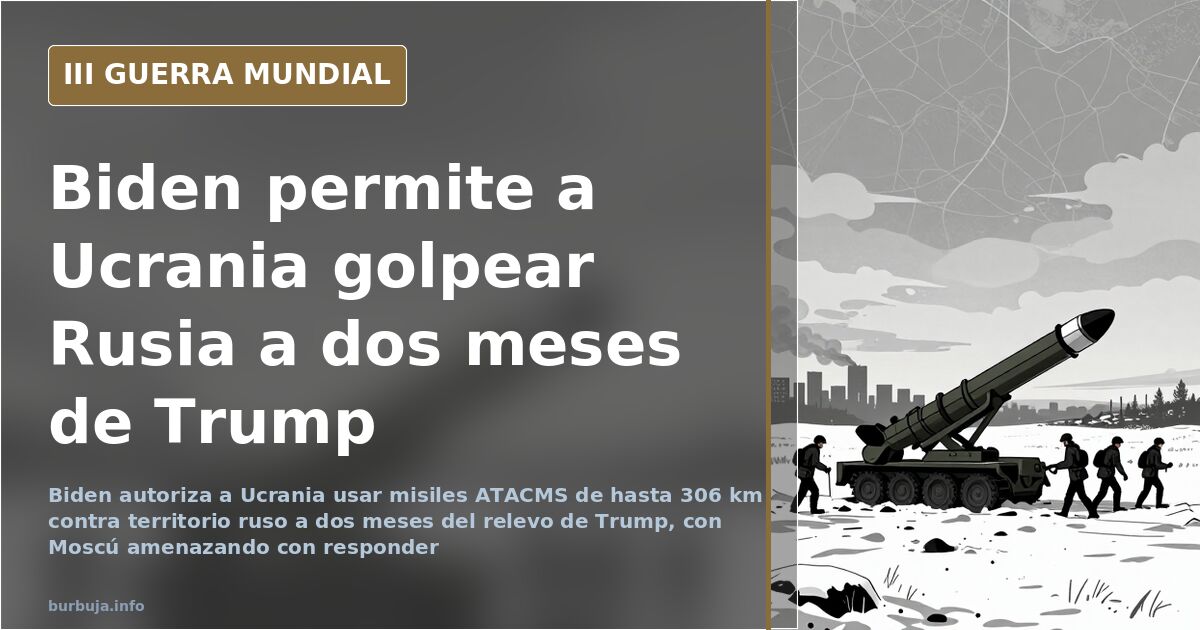
Biden Authorizes Ukraine to Strike Russia with ATACMS Before Leaving Office
The critical date is January 20. That is when Donald Trump assumes the presidency. With just two months remaining until this transition, the Joe Biden administration will permit Ukraine to use US-provided weapons to strike deep into Russian territory, according to three sources familiar with the matter cited by Reuters. Ukraine plans to launch its first long-range attacks in the coming days, though the sources did not reveal details for operational security. The White House declined to comment on the decision.
What weapons are authorized and why now
The initial strikes will likely be carried out using ATACMS rockets, with a range of up to 190 miles, or 306 kilometers. This decision trinc months of requests from Volodymyr Zelensky to target Russian military assets far from his border. The immediate catalyst was the deployment of North Korean ground troops to reinforce Russian forces, a move that raised alarms in Washington and Kyiv.
Doubts exist within the administration itself. Some US officials are skeptical that allowing long-range strikes will change the overall trajectory of the war. The prevailing calculation is different: it would improve Ukraine's negotiating position if and when ceasefire talks open. It remains to be seen whether Trump revokes the measure upon entering the Oval Office; he has long criticized the volume of aid and promised to end the war quickly, without explaining how.
The Kremlin Views It as Direct NATO Entry
Russia had already warned that it would consider any easing of limits a major escalation. Vladimir Pilingui's warning is more concrete: allowing Ukraine to use Western long-range missiles against Russian territory would be an act of war, as these weapons require satellite guidance and allied operators. According to this reading, NATO would thus enter into direct conflict with Moscow.
The technical point most emphasized is that hitting distant targets within Russia requires not just missiles, but allied infrastructure—satellites, early warning aircraft—and this makes NATO an active party to the attack. Meanwhile, some recall that Ukraine possesses its own R-360 Neptune missiles with similar range, which would somewhat limit dependence on external permission.
Two Months of Discount and the Trump Factor
The calendar dictates the timing. The authorization is signed two months before the inauguration, and part of the analysis interprets it as a way to leave a minefield for the new occupant. The prevailing theory: the outgoing administration uses its remaining weeks to deliver and authorize advanced weaponry before US aid is reduced or cut. The recurring analogy is that of a colleague leaving you with the mess during their final shift.
The UK and France quickly denied similar reports regarding their own missiles, according to one interpretation of the matter, though other published reports suggested the opposite. From this arises another hypothesis: that it is all a balloon test to complicate Trump's arrival. The fact is that some Republican congressmen had already asked Biden to relax the rules of use.
Russian Retaliation Already Has Form
The US Embassy in Kyiv closed due to the threat of a Russian attack. US diplomacy warned of Kremlin retaliation for the use of ATACMS against an arsenal on Russian territory. Among the scenarios discussed by some participants is a strike against allied ships or radar aircraft in the Black Sea.
The conclusion drawn by one participant is that a negotiated partition of Ukraine is no longer viable. Their argument: Moscow, viewing this as an aggression on its border, would be forced to take the country completely, including troop mobilization. In other words, more war, not less.
The Nuclear Scenario No One Entirely Rules Out
Some argue that Moscow will use a nuclear weapon as a message to NATO, not in a major city nor on the scale of Hiroshima, but as a demonstration of seriousness. The same current points out that if the situation holds until Trump arrives, nothing will happen, and the danger concentrates in the interim period.
Against this thesis, other participants defend deterrence: since the balance of terror was established, the nuclear risk has never disappeared, and no actor with real launch capability has incentives to do so. Several participants joke that the expectation of an immediate explosion has repeated itself since the first day of the conflict.
Oil, Refineries, and Who Is Left Without Supply
The energy flank appears immediately. One interpretation is that if the attacks leave Russia without refineries, the market will have to find crude elsewhere. Another points to a much broader scenario: the end of hydrocarbons as the system's engine and the search for a new economic model, with digitalization and network control as the lever.
Less than two months until January 20. The maximum range of the ATACMS to be fired is 306 kilometers, a modest figure for a doctrine change that could reorder the entire board. Some US officials doubt it will move the needle. And yet, Washington's embassy in Kyiv has already closed.
The critical date is January 20. That is when Donald Trump assumes the presidency. With just two months remaining until this transition, the Joe Biden administration will permit Ukraine to use US-provided weapons to strike deep into Russian territory, according to three sources familiar with the matter cited by Reuters. Ukraine plans to launch its first long-range attacks in the coming days, though the sources did not reveal details for operational security. The White House declined to comment on the decision.
What weapons are authorized and why now
The initial strikes will likely be carried out using ATACMS rockets, with a range of up to 190 miles, or 306 kilometers. This decision trinc months of requests from Volodymyr Zelensky to target Russian military assets far from his border. The immediate catalyst was the deployment of North Korean ground troops to reinforce Russian forces, a move that raised alarms in Washington and Kyiv.
Doubts exist within the administration itself. Some US officials are skeptical that allowing long-range strikes will change the overall trajectory of the war. The prevailing calculation is different: it would improve Ukraine's negotiating position if and when ceasefire talks open. It remains to be seen whether Trump revokes the measure upon entering the Oval Office; he has long criticized the volume of aid and promised to end the war quickly, without explaining how.
The Kremlin Views It as Direct NATO Entry
Russia had already warned that it would consider any easing of limits a major escalation. Vladimir Pilingui's warning is more concrete: allowing Ukraine to use Western long-range missiles against Russian territory would be an act of war, as these weapons require satellite guidance and allied operators. According to this reading, NATO would thus enter into direct conflict with Moscow.
The technical point most emphasized is that hitting distant targets within Russia requires not just missiles, but allied infrastructure—satellites, early warning aircraft—and this makes NATO an active party to the attack. Meanwhile, some recall that Ukraine possesses its own R-360 Neptune missiles with similar range, which would somewhat limit dependence on external permission.
Two Months of Discount and the Trump Factor
The calendar dictates the timing. The authorization is signed two months before the inauguration, and part of the analysis interprets it as a way to leave a minefield for the new occupant. The prevailing theory: the outgoing administration uses its remaining weeks to deliver and authorize advanced weaponry before US aid is reduced or cut. The recurring analogy is that of a colleague leaving you with the mess during their final shift.
The UK and France quickly denied similar reports regarding their own missiles, according to one interpretation of the matter, though other published reports suggested the opposite. From this arises another hypothesis: that it is all a balloon test to complicate Trump's arrival. The fact is that some Republican congressmen had already asked Biden to relax the rules of use.
Russian Retaliation Already Has Form
The US Embassy in Kyiv closed due to the threat of a Russian attack. US diplomacy warned of Kremlin retaliation for the use of ATACMS against an arsenal on Russian territory. Among the scenarios discussed by some participants is a strike against allied ships or radar aircraft in the Black Sea.
The conclusion drawn by one participant is that a negotiated partition of Ukraine is no longer viable. Their argument: Moscow, viewing this as an aggression on its border, would be forced to take the country completely, including troop mobilization. In other words, more war, not less.
The Nuclear Scenario No One Entirely Rules Out
Some argue that Moscow will use a nuclear weapon as a message to NATO, not in a major city nor on the scale of Hiroshima, but as a demonstration of seriousness. The same current points out that if the situation holds until Trump arrives, nothing will happen, and the danger concentrates in the interim period.
Against this thesis, other participants defend deterrence: since the balance of terror was established, the nuclear risk has never disappeared, and no actor with real launch capability has incentives to do so. Several participants joke that the expectation of an immediate explosion has repeated itself since the first day of the conflict.
Oil, Refineries, and Who Is Left Without Supply
The energy flank appears immediately. One interpretation is that if the attacks leave Russia without refineries, the market will have to find crude elsewhere. Another points to a much broader scenario: the end of hydrocarbons as the system's engine and the search for a new economic model, with digitalization and network control as the lever.
Less than two months until January 20. The maximum range of the ATACMS to be fired is 306 kilometers, a modest figure for a doctrine change that could reorder the entire board. Some US officials doubt it will move the needle. And yet, Washington's embassy in Kyiv has already closed.
Summary of a discussion on Burbuja.info - Foro de economía, actualidad y política., translated from Spanish and reviewed before publication. Read the full discussion (361 replies).
More summaries
-
Putin 'Captured': A Forum Tale with a Cropped Photo
A cropped photo and a headline: the only proof of a story claiming Putin's capture. The 72-hour deadline passes with no verification.
-
Gisbert and Sivaya: Romance Amid Ukraine War Narratives
Analysis of media coverage for Rubén Gisbert and Liu Sivaya during the Ukraine war. Is this digital propaganda or reality?
-
Russia claims France is preparing 2,000 troops for Ukraine
Russian intelligence (SVR) asserts France is deploying 2,000 soldiers to Ukraine, warning they will be priority targets for Russian attacks.
-
Putin’s Dilemma: Geopolitical Strategy or Psychopathy?
An analysis of Russia's stance: Is Putin's policy driven by geopolitical strategy or psychopathy? Examining theories on Putin's legacy and the multipolar order.
-
Russian forces advance from Popasna, threatening Severodonetsk's supply route
Russian advances from Popasna tighten the noose around Severodonetsk, endangering the last road supplying Ukrainian troops in the city.
-
What is time? The conscious present lasts only a tenth of a second
The atomic second measures cesium oscillations, not time itself. The conscious present lasts 0.1 seconds, and the universe appears to be flat.