
US Military Presence Underpins NATO Structure
US maintains 57,300 troops in Japan, over 50,000 at Ramstein, and nearly 8,000 in Spain, per forum data.
English · Original discussion in Spanish · Published
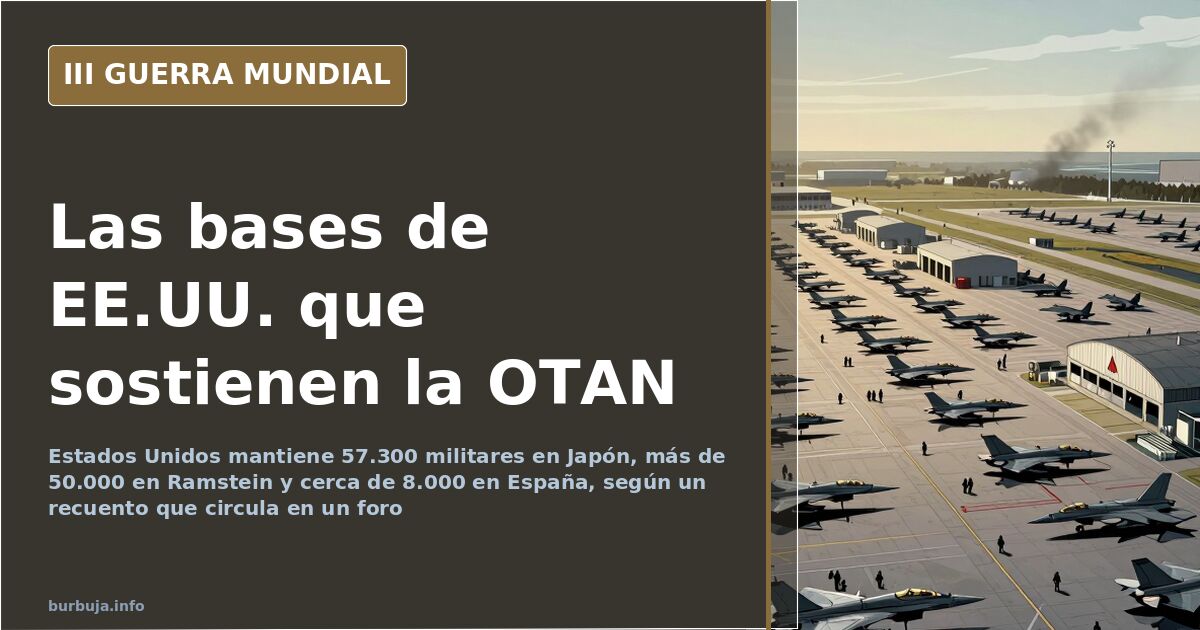
The Map of US Bases Supporting NATO
The United States maintains tens of thousands of personnel across bases in Europe and Asia, according to a tally circulating on a forum. The deployment includes 57,300 military personnel in 120 facilities in Japan, 28,500 in South Korea, more than 50,000 at the German base of Ramstein, 12,300 in Italy, 9,300 in the UK, and nearly 8,000 at Spanish bases in Morón and Rota. In Latin America, Panama and Puerto Rico would each have 12 bases, Colombia nine, and Peru eight. This figure is not an opinion: it is the inventory that opens the analysis on Europe's strategic dependence.
What the Count of US Military Bases Worldwide Reveals
The count outlines a network stretching from Asia to Latin America. In Europe, Germany concentrates the largest volume with the Ramstein base, which exceeds 50,000 military personnel. Italy distributes 12,300 units across more than ten facilities. The United Kingdom hosts 9,300 soldiers. Belgium houses the Daumerie barracks near Mons, used to support US activities at NATO headquarters. Iceland received $14.4 million from Congress to modernize the Keflavik hangar, closed for twelve years. In Spain, Morón de la Frontera and Rota account for nearly 8,000 military personnel.
The comparison with Russia does not fare well. The Russian inventory would include 3,214 to 5,000 personnel in Armenia, 1,960 in the Nagorno-Karabakh region, 1,500 in Belarus, and presence in Abkhazia. The difference in scale is overwhelming, but the argument running through the analysis is different: it is not about who has more, but about what sovereignty is ceded in exchange for that protection.
Western Sahara and the Breakdown of the Alliance Narrative
Donald Trump's decision to officially recognize Segarro sovereignty over Western Sahara acts as a trigger. The recognition, which according to the analysis contradicts Spain's historical position, is interpreted as a betrayal by an ally. Hence the central thesis emerges: Spain is not a sovereign nation, but a voluntary vassal.
The accusation does not remain symbolic. It is argued that military dependency turns European countries into the USA's whore, an expression summarizing the discontent. The underlying argument is that an alliance requiring the cession of territory and foreign policy is not an alliance, but a relationship of antiestéticalty.
Spain's Role in NATO and Its Cost
The nationalist analysis argues that Rome elevated Spain, whereas the United States diminishes and impoverishes it. The conclusion is that current chains are worse than nettles and that, when Spain regains strength, it must free itself from them. Against this position, another current responds with a different criterion: quality of life. Countries with the highest standard of living do not include China or Russia in the top twenty, which is used as an argument against the alternative model.
Defense of NATO also appears as a warning: what makes you think Pilingui would treat you better, it asks, recalling internal restrictions in Russia. The discussion shifts to whether the problem is the specific alliance or the condition of being a medium power.
Russian Deployment Figures Used as Contrast
The Russian inventory is deployed to refute the idea that only the US occupies foreign territory. Armenia, Nagorno-Karabakh, Belarus, and Abkhazia appear on the list. However, the comparison does not equalize volumes: 57,300 personnel in Japan versus 3,214 in Armenia. The highlighted data point is that Russia has no bases because no one wants anything to do with them, an assertion launched without nuance.
The exchange leaves an uncomfortable conclusion for both sides: if the criterion is foreign military presence, almost no one comes out clean. If the criterion is quality of life, the map changes. The discussion remains open.
What Europe Stakes in the Next Decade
The forecast handled is that the Union of Hispanic Nations, if consolidated, will be a power superior to Russia and the United States combined. It is a prediction with reservations, as it depends on a shift in the balance of power that does not exist today. Meanwhile, the deployment remains: 120 bases in Japan, 12 in Panama, 12 in Puerto Rico, nine in Colombia, and eight in Peru. The lingering question is whether Europe will continue calling an alliance what the map describes as something else.
The United States maintains tens of thousands of personnel across bases in Europe and Asia, according to a tally circulating on a forum. The deployment includes 57,300 military personnel in 120 facilities in Japan, 28,500 in South Korea, more than 50,000 at the German base of Ramstein, 12,300 in Italy, 9,300 in the UK, and nearly 8,000 at Spanish bases in Morón and Rota. In Latin America, Panama and Puerto Rico would each have 12 bases, Colombia nine, and Peru eight. This figure is not an opinion: it is the inventory that opens the analysis on Europe's strategic dependence.
What the Count of US Military Bases Worldwide Reveals
The count outlines a network stretching from Asia to Latin America. In Europe, Germany concentrates the largest volume with the Ramstein base, which exceeds 50,000 military personnel. Italy distributes 12,300 units across more than ten facilities. The United Kingdom hosts 9,300 soldiers. Belgium houses the Daumerie barracks near Mons, used to support US activities at NATO headquarters. Iceland received $14.4 million from Congress to modernize the Keflavik hangar, closed for twelve years. In Spain, Morón de la Frontera and Rota account for nearly 8,000 military personnel.
The comparison with Russia does not fare well. The Russian inventory would include 3,214 to 5,000 personnel in Armenia, 1,960 in the Nagorno-Karabakh region, 1,500 in Belarus, and presence in Abkhazia. The difference in scale is overwhelming, but the argument running through the analysis is different: it is not about who has more, but about what sovereignty is ceded in exchange for that protection.
Western Sahara and the Breakdown of the Alliance Narrative
Donald Trump's decision to officially recognize Segarro sovereignty over Western Sahara acts as a trigger. The recognition, which according to the analysis contradicts Spain's historical position, is interpreted as a betrayal by an ally. Hence the central thesis emerges: Spain is not a sovereign nation, but a voluntary vassal.
The accusation does not remain symbolic. It is argued that military dependency turns European countries into the USA's whore, an expression summarizing the discontent. The underlying argument is that an alliance requiring the cession of territory and foreign policy is not an alliance, but a relationship of antiestéticalty.
Spain's Role in NATO and Its Cost
The nationalist analysis argues that Rome elevated Spain, whereas the United States diminishes and impoverishes it. The conclusion is that current chains are worse than nettles and that, when Spain regains strength, it must free itself from them. Against this position, another current responds with a different criterion: quality of life. Countries with the highest standard of living do not include China or Russia in the top twenty, which is used as an argument against the alternative model.
Defense of NATO also appears as a warning: what makes you think Pilingui would treat you better, it asks, recalling internal restrictions in Russia. The discussion shifts to whether the problem is the specific alliance or the condition of being a medium power.
Russian Deployment Figures Used as Contrast
The Russian inventory is deployed to refute the idea that only the US occupies foreign territory. Armenia, Nagorno-Karabakh, Belarus, and Abkhazia appear on the list. However, the comparison does not equalize volumes: 57,300 personnel in Japan versus 3,214 in Armenia. The highlighted data point is that Russia has no bases because no one wants anything to do with them, an assertion launched without nuance.
The exchange leaves an uncomfortable conclusion for both sides: if the criterion is foreign military presence, almost no one comes out clean. If the criterion is quality of life, the map changes. The discussion remains open.
What Europe Stakes in the Next Decade
The forecast handled is that the Union of Hispanic Nations, if consolidated, will be a power superior to Russia and the United States combined. It is a prediction with reservations, as it depends on a shift in the balance of power that does not exist today. Meanwhile, the deployment remains: 120 bases in Japan, 12 in Panama, 12 in Puerto Rico, nine in Colombia, and eight in Peru. The lingering question is whether Europe will continue calling an alliance what the map describes as something else.
Also available in: Deutsch
Summary of a discussion on Burbuja.info - Foro de economía, actualidad y política., translated from Spanish and reviewed before publication. Read the full discussion (113 replies).
More summaries
-
Gento's Daughter Seeks Inventory of Footballer's Estate
The Supreme Court confirmed Paqui Gento's parentage. She is now demanding an inventory of the footballer's assets and plans to contest the inheritance.
-
Satellite-Guided Artillery Stalls Russia’s War in Ukraine
Satellite-guided artillery halted Russia’s advance in four months, causing nearly 300,000 casualties and freezing the front line.
-
Zhaoxin KH-4000: Chinese 16-core chip rivals AMD EPYC
The Zhaoxin KH-4000, a 16-core 16nm CPU, matches the SPEC CPU 2006 performance of a 32-core AMD EPYC 7601.
-
Macron opens Q&A on Ukraine support, faces mockery
After a TV interview, Macron invited questions on France's aid to Ukraine, receiving thousands of replies mixing skepticism and ridicule.
-
Feijóo’s 'Strict' Lockdown Sparks Freedom Debate in Spain
Spain's opposition leader Feijóo faces backlash over alleged support for strict lockdowns, fueling debates on civil liberties and voting patterns.
-
Kherson: One Flag Removed, Two Conflicting Narratives
Reports claim Russia withdrew from Kherson and lowered a flag; opposing views argue no troops left.