
Feijóo’s 'Strict' Lockdown Sparks Freedom Debate in Spain
Spain's opposition leader Feijóo faces backlash over alleged support for strict lockdowns, fueling debates on civil liberties and voting patterns.
English · Original discussion in Spanish · Published
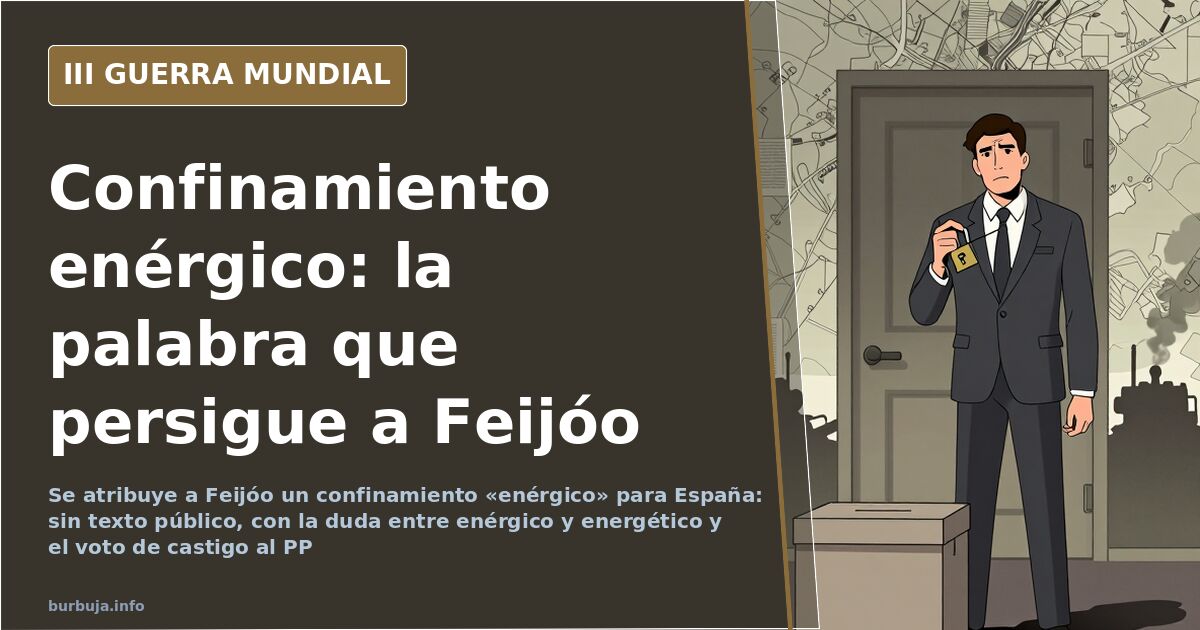
Feijóo and the 'Strict' Lockdown That Reopens the Debate
Alberto Núñez Feijóo is accused of proposing a "strict" lockdown for Spain. The formulation, as circulated during the debate, peine public conversation about restrictions without clarifying the measure's scope or legal basis. The controversy also sparked a linguistic dispute: some argued the correct term was energetic rather than strict, as if a lockdown were an electricity tariff.
The nuance matters. An energetic lockdown reads like a gas-saving plan; a strict one reads like heavy-handedness. In Spain, that second interpretation carries historical weight, and memory is an electoral asset not recovered by a press conference.
What We Know About the Strict Lockdown Attributed to Feijóo
What is on the table is an attributed proposal, not a document. There is no exact text, legal framework, or threshold to activate the measure. This lack of detail explains much of the reaction: when a political leader opens the door to restrictions without showing the contract, the public fills the gaps with past experiences.
Rejection crosses party lines. Critics argue that the current government never mandated vaccination while a PP-led government might. It is a suspicion, not a verified fact, but it serves as political fuel. Accusations also circulate that he would have imposed immunization in his region. Without documentary verification, it remains a partisan claim.
Would a Feijóo Government Be More Restrictive Than the Current One?
This question organizes the discontent. Some claim the PP leader would cut freedoms without breaking a sweat, aligning with emergency frameworks approved globally between 2020 and 2022. Others counter that health competencies are split between the state and regions, and no election promise turns a lockdown into a decree.
Both sides share an uncomfortable assumption: restrictions will come anyway, and the only variable is who signs them. Hence the phrase summarizing the mood: such a measure would make the current president a defender of individual liberties by simple comparison. It is hyperbole, and behaves as such. At the loudest extreme, the proposal is framed as part of a global social control plan; this is an unsubstantiated reading and should be treated as such.
The Protest Vote: Voting Against Your Own Side
The most striking reaction is not criticism, but calculation. Some consider voting for PSOE — a party they never supported — with a dual goal: stopping the PP and punishing their own voter base. It is described as a temptation similar to teenage mischief: harmless if successful, complicating if it fails. They call it revenge against the herd.
It is a small phenomenon numerically but loud in meaning: votes cast not out of conviction, but discomfort with one's own group. The interlocutor's surprise when the vote intent is revealed is part of the plan. Sociologically interesting; electorally, time will tell.
American Gas, Self-Sanctions, and the Bill No One Signs
The issue is also read through energy and industrial lenses. Some argue that self-sanctions from foreign conflicts have raised bills without benefit, with US liquefied gas at 140% and foreign capital buying European industry at bargain prices. These figures circulate without verified public breakdowns, and that gap fuels distrust.
Here lies the core anger: a lockdown implies less mobility, activity, and energy consumption just when energy prices are the problem. Any measure reducing activity in this scenario is judged by its bill, not its health effect.
And If the Measure Means More Remote Work
Not all opposition is frontal. Some admit they would accept a lockdown if it consolidates remote work and saves daily office commutes. A minority stance, but it breaks the binary reading: for many office workers, lockdown stopped being synonymous with confinement and became synonymous with flexibility.
That ambiguity makes measuring the real political cost difficult. The same term mobilizes some and demobilizes others, not always in the direction the sender expects.
With this material, it is reasonable to await clarification on the scope — if the proposal exists as told — and a correction of the word used. If restrictive intent is confirmed, the electoral bill will be charged to whoever pronounces it; if it remains a vocabulary slip, we will have debated for days over a letter and a vowel.
Alberto Núñez Feijóo is accused of proposing a "strict" lockdown for Spain. The formulation, as circulated during the debate, peine public conversation about restrictions without clarifying the measure's scope or legal basis. The controversy also sparked a linguistic dispute: some argued the correct term was energetic rather than strict, as if a lockdown were an electricity tariff.
The nuance matters. An energetic lockdown reads like a gas-saving plan; a strict one reads like heavy-handedness. In Spain, that second interpretation carries historical weight, and memory is an electoral asset not recovered by a press conference.
What We Know About the Strict Lockdown Attributed to Feijóo
What is on the table is an attributed proposal, not a document. There is no exact text, legal framework, or threshold to activate the measure. This lack of detail explains much of the reaction: when a political leader opens the door to restrictions without showing the contract, the public fills the gaps with past experiences.
Rejection crosses party lines. Critics argue that the current government never mandated vaccination while a PP-led government might. It is a suspicion, not a verified fact, but it serves as political fuel. Accusations also circulate that he would have imposed immunization in his region. Without documentary verification, it remains a partisan claim.
Would a Feijóo Government Be More Restrictive Than the Current One?
This question organizes the discontent. Some claim the PP leader would cut freedoms without breaking a sweat, aligning with emergency frameworks approved globally between 2020 and 2022. Others counter that health competencies are split between the state and regions, and no election promise turns a lockdown into a decree.
Both sides share an uncomfortable assumption: restrictions will come anyway, and the only variable is who signs them. Hence the phrase summarizing the mood: such a measure would make the current president a defender of individual liberties by simple comparison. It is hyperbole, and behaves as such. At the loudest extreme, the proposal is framed as part of a global social control plan; this is an unsubstantiated reading and should be treated as such.
The Protest Vote: Voting Against Your Own Side
The most striking reaction is not criticism, but calculation. Some consider voting for PSOE — a party they never supported — with a dual goal: stopping the PP and punishing their own voter base. It is described as a temptation similar to teenage mischief: harmless if successful, complicating if it fails. They call it revenge against the herd.
It is a small phenomenon numerically but loud in meaning: votes cast not out of conviction, but discomfort with one's own group. The interlocutor's surprise when the vote intent is revealed is part of the plan. Sociologically interesting; electorally, time will tell.
American Gas, Self-Sanctions, and the Bill No One Signs
The issue is also read through energy and industrial lenses. Some argue that self-sanctions from foreign conflicts have raised bills without benefit, with US liquefied gas at 140% and foreign capital buying European industry at bargain prices. These figures circulate without verified public breakdowns, and that gap fuels distrust.
Here lies the core anger: a lockdown implies less mobility, activity, and energy consumption just when energy prices are the problem. Any measure reducing activity in this scenario is judged by its bill, not its health effect.
And If the Measure Means More Remote Work
Not all opposition is frontal. Some admit they would accept a lockdown if it consolidates remote work and saves daily office commutes. A minority stance, but it breaks the binary reading: for many office workers, lockdown stopped being synonymous with confinement and became synonymous with flexibility.
That ambiguity makes measuring the real political cost difficult. The same term mobilizes some and demobilizes others, not always in the direction the sender expects.
With this material, it is reasonable to await clarification on the scope — if the proposal exists as told — and a correction of the word used. If restrictive intent is confirmed, the electoral bill will be charged to whoever pronounces it; if it remains a vocabulary slip, we will have debated for days over a letter and a vowel.
Also available in: Deutsch
Summary of a discussion on Burbuja.info - Foro de economía, actualidad y política., translated from Spanish and reviewed before publication. Read the full discussion (112 replies).
More summaries
-
Galicia hotel occupancy plummets as rates top €150
Hotel occupancy in Galicia collapses with rates over €150. Pricing algorithms and inflation deter demand. Detailed analysis.
-
Spanish gas stations in Ourense warn they sell at a loss
Gas stations in Ourense, Spain, report selling fuel below cost due to zero margins and rising replacement prices.
-
Feijóo wins Spanish election, but Sánchez stays in power
Alberto Núñez Feijóo won the general elections in Spain, yet Pedro Sánchez remains Prime Minister. The pre-election prediction materialized through an uncomfortable political reality.
-
Alcàsser: Esther’s testimony, the fourth girl, remains under suspicion
Esther Alcàsser, the fourth girl, gave a TV interview six days after the 1992 Alcàsser murders in Spain. Her account and timeline discrepancies fuel ongoing controversy.
-
Gaza Girl Video Sparks Debate Over Cold Claims
A video of a shivering girl in Gaza divides analysis, with critics citing average temperatures of 17 degrees and questioning potential staging.
-
Azerbaijan Demands Russia Accept Responsibility for Grozny Flight Down
42 dead and shrapnel damage: bird strike theory collapses. Azerbaijan demands Russia admit guilt and pay compensation.