
Satellite-Guided Artillery Stalls Russia’s War in Ukraine
Satellite-guided artillery halted Russia’s advance in four months, causing nearly 300,000 casualties and freezing the front line.
English · Original discussion in Spanish · Published
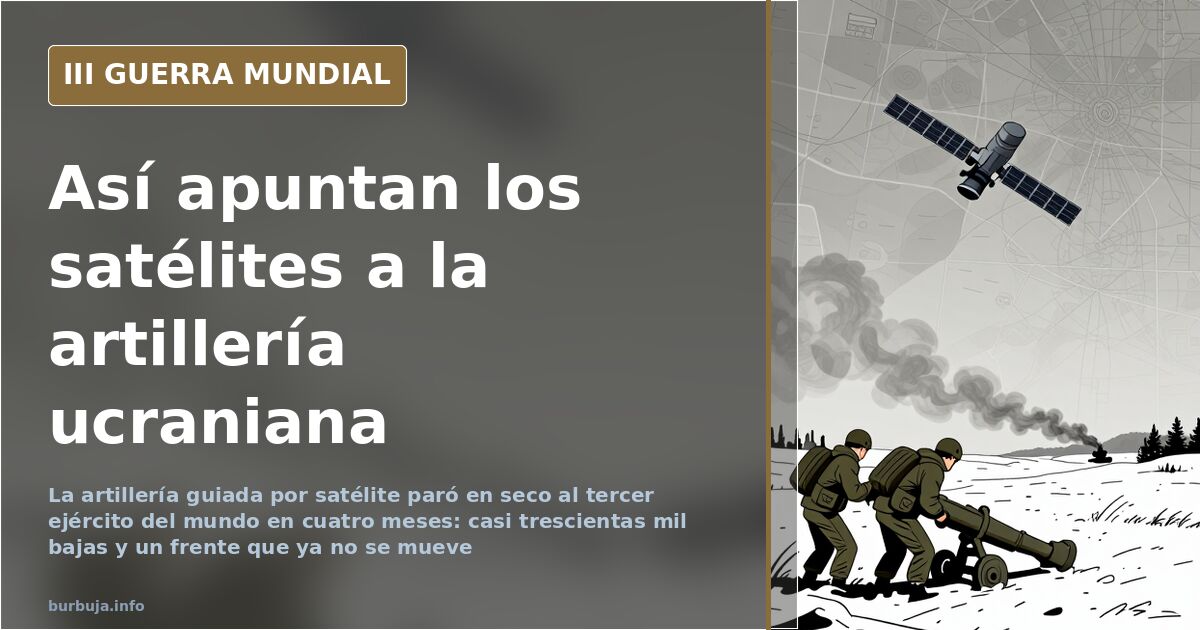
Satellites Targeting Cannons: The End of the World's Third Army
Russia has lost the war in Ukraine militarily; the debate is no longer whether it can win, but why the supposed third army in the world stalled within four months. The analysis suggests an uncomfortable thesis: there was no miracle on the ground, but rather a satellite link, howitzers that do not calculate charges manually, and fire control systems that see the target before the truck starts moving. Satellite-guided artillery is the core of everything else.
How Ukrainian Artillery Receives Targets via Satellite
The most concrete description of this mechanism comes not from a military manual, but from someone who provided satellite coverage for ships worldwide. Devices on vessels with directional antennas continuously switching radio links, operated by a semi-public US firm. When a ship lost a satellite, the device calculated the orbit of the next one with position and time, moved a couple of small motors, and locked onto the new signal. The interruption was barely noticeable.
This same scheme is now attributed to Ukrainian artillery. Russian targets are marked via satellite triangulation, and positions reach the fire control center in real time. Gunners do not load charges by hand: electronics determine them. In automated pieces, even that is unnecessary, as they integrate with command systems, self-position, fire, and retreat to evade counter-battery fire. Guided shells like the M982 have been deployed on the ground since summer, according to this account.
When Did the Russian Advance Stop in Ukraine?
The short answer is May, four months after the start. The war began in February, and by May Russia was completely stalled. This supports the idea that the supposed third army in the world was halted by a country allegedly using technology from a decade ago.
All territory conquered was taken in the first weeks, before external aid and advice became evident. Then came three withdrawals—Kyiv, Kharkiv, and Kherson—that reshuffled the scoreboard: some read it as a 3-0, others as 3-1, and some reluctantly as 2-0. On the debit side, nearly 300,000 casualties counted, mostly attributed to Russian artillery. On the skeptic’s credit, the view that Ukraine only won what Russia ceded without much fighting.
Why Doesn’t Russia Replicate Ukraine’s Satellite Link?
Due to lack of own means. Russia is described as having 1990s satellites, black-and-white photos, and a resolution of ten centimeters, compared to the real-time video attributed to the Ukrainian side at one pixel per centimeter. Without air superiority and with aviation designed for defensive doctrine, there are no days-long bombing campaigns here.
There is an uncomfortable counterpoint. Russia has had anti-satellite weapons for years, like China and probably the US, and according to one intervention, it could clear the atmosphere of satellites in less than eight hours. If true, no one explains why it hasn’t done so. Some add that the satellites sustaining the system are, in this logic, legitimate targets.
Who Really Fires on the Ukrainian Front?
The finger pulling the trigger is also debated. One part argues that the real weight falls on ultra-prepared units, with logistics and modern weaponry serving the front without NATO acronyms appearing anywhere; Ukrainians, in this reading, would barely fight. The rebuttal points to direction coming from German bases, London offices, or the Pentagon, and that Russians face top-level specialists in logistics, intelligence, and technology, not improvised troops.
From this arises another argument: perhaps Ukrainians themselves lack initiative over strategy and operation design. If so, Russia’s problem ceases to be Ukraine and becomes a brain a thousand kilometers from the front.
What Happens if Russia Uses Nuclear Weapons?
It is the only resource acknowledged, and those raising it doubt whether Russian launchers could get a missile airborne more than thirty kilometers without being shot down. The other side is that Pilingui cannot lose this war under any circumstances: he feels it as a personal attack and survival issue, and would be willing to blow up the planet rather than sign defeat.
Here lies the knot. A nuclear attack would have a response, and cited precedents—Korea, Vietnam—show powers withdrawing without resorting to the bomb even in defeat. Shooting down satellites is seen as worse escalation than a micro-nuclear strike, and that door remains closed for now.
The Wear Nobody Counts: Population, Industry, and Narrative
There is a layer beyond the front. There is debate over how much maintaining 7,000 nuclear heads consumes and why Russia didn’t agree to cut them to 700, considered more than enough. There is debate over whether the Soviet army was more competent than the current one and if the economic model of the last thirty years failed. And there is demographic debate: a country aspiring to global power should grow in population, and it hasn’t for years.
On the other scale, the response that Russia is not communist and the USSR collapsed due to inability to develop technology and consumer goods. Two different diagnoses for the same disaster.
With these elements, reasonable prediction points to more Russian withdrawals and a front moving slowly, always with the satellite link as invisible infrastructure. But beware of round forecasts: those who cannot lose do not negotiate like winners, and no shell fixes that asymmetry. The game will remain open longer than scores suggest.
Russia has lost the war in Ukraine militarily; the debate is no longer whether it can win, but why the supposed third army in the world stalled within four months. The analysis suggests an uncomfortable thesis: there was no miracle on the ground, but rather a satellite link, howitzers that do not calculate charges manually, and fire control systems that see the target before the truck starts moving. Satellite-guided artillery is the core of everything else.
How Ukrainian Artillery Receives Targets via Satellite
The most concrete description of this mechanism comes not from a military manual, but from someone who provided satellite coverage for ships worldwide. Devices on vessels with directional antennas continuously switching radio links, operated by a semi-public US firm. When a ship lost a satellite, the device calculated the orbit of the next one with position and time, moved a couple of small motors, and locked onto the new signal. The interruption was barely noticeable.
This same scheme is now attributed to Ukrainian artillery. Russian targets are marked via satellite triangulation, and positions reach the fire control center in real time. Gunners do not load charges by hand: electronics determine them. In automated pieces, even that is unnecessary, as they integrate with command systems, self-position, fire, and retreat to evade counter-battery fire. Guided shells like the M982 have been deployed on the ground since summer, according to this account.
When Did the Russian Advance Stop in Ukraine?
The short answer is May, four months after the start. The war began in February, and by May Russia was completely stalled. This supports the idea that the supposed third army in the world was halted by a country allegedly using technology from a decade ago.
All territory conquered was taken in the first weeks, before external aid and advice became evident. Then came three withdrawals—Kyiv, Kharkiv, and Kherson—that reshuffled the scoreboard: some read it as a 3-0, others as 3-1, and some reluctantly as 2-0. On the debit side, nearly 300,000 casualties counted, mostly attributed to Russian artillery. On the skeptic’s credit, the view that Ukraine only won what Russia ceded without much fighting.
Why Doesn’t Russia Replicate Ukraine’s Satellite Link?
Due to lack of own means. Russia is described as having 1990s satellites, black-and-white photos, and a resolution of ten centimeters, compared to the real-time video attributed to the Ukrainian side at one pixel per centimeter. Without air superiority and with aviation designed for defensive doctrine, there are no days-long bombing campaigns here.
There is an uncomfortable counterpoint. Russia has had anti-satellite weapons for years, like China and probably the US, and according to one intervention, it could clear the atmosphere of satellites in less than eight hours. If true, no one explains why it hasn’t done so. Some add that the satellites sustaining the system are, in this logic, legitimate targets.
Who Really Fires on the Ukrainian Front?
The finger pulling the trigger is also debated. One part argues that the real weight falls on ultra-prepared units, with logistics and modern weaponry serving the front without NATO acronyms appearing anywhere; Ukrainians, in this reading, would barely fight. The rebuttal points to direction coming from German bases, London offices, or the Pentagon, and that Russians face top-level specialists in logistics, intelligence, and technology, not improvised troops.
From this arises another argument: perhaps Ukrainians themselves lack initiative over strategy and operation design. If so, Russia’s problem ceases to be Ukraine and becomes a brain a thousand kilometers from the front.
What Happens if Russia Uses Nuclear Weapons?
It is the only resource acknowledged, and those raising it doubt whether Russian launchers could get a missile airborne more than thirty kilometers without being shot down. The other side is that Pilingui cannot lose this war under any circumstances: he feels it as a personal attack and survival issue, and would be willing to blow up the planet rather than sign defeat.
Here lies the knot. A nuclear attack would have a response, and cited precedents—Korea, Vietnam—show powers withdrawing without resorting to the bomb even in defeat. Shooting down satellites is seen as worse escalation than a micro-nuclear strike, and that door remains closed for now.
The Wear Nobody Counts: Population, Industry, and Narrative
There is a layer beyond the front. There is debate over how much maintaining 7,000 nuclear heads consumes and why Russia didn’t agree to cut them to 700, considered more than enough. There is debate over whether the Soviet army was more competent than the current one and if the economic model of the last thirty years failed. And there is demographic debate: a country aspiring to global power should grow in population, and it hasn’t for years.
On the other scale, the response that Russia is not communist and the USSR collapsed due to inability to develop technology and consumer goods. Two different diagnoses for the same disaster.
With these elements, reasonable prediction points to more Russian withdrawals and a front moving slowly, always with the satellite link as invisible infrastructure. But beware of round forecasts: those who cannot lose do not negotiate like winners, and no shell fixes that asymmetry. The game will remain open longer than scores suggest.
Also available in: Deutsch
Summary of a discussion on Burbuja.info - Foro de economía, actualidad y política., translated from Spanish and reviewed before publication. Read the full discussion (112 replies).
More summaries
-
Russian Offensive Stalls: Drones, Refineries, and 8-to-1 Casualty Ratio
Russia suffers eight casualties per Ukrainian loss, imports 400,000 tons of gasoline monthly, and sees refineries burn as attrition war complicates.
-
Who Would End Up on the Front Lines if War with Russia Reaches Europe?
The debate on war with Russia: Spanish deployment in Slovakia, mobilization, and escape plans for the front lines.
-
Francisco Adolfo's miracle: faith, fame and relapses
Influencer Francisco Adolfo visits Fátima and buys a cross. Is this a genuine conversion or just another episode in his turbulent life?
-
Zaka Recoverer Testifies on Oct. 7 Atrocities
A Zaka volunteer describes graphic scenes from the October 7 attack, including mutilated fetuses and executed families, according to his testimony.
-
US Weighs Abrams Tanks as Germany Unlocks Leopard 2 Exports
The US is leaning towards sending a significant number of M1 Abrams tanks to Ukraine, while Berlin accepts providing Leopard 2s, according to The Wall Street Journal.
-
Bakhmut Holds as Wagner Targets Supply Bridges
Wagner advances via high ground toward Bakhmut's supply bridges, aiming to cut logistics rather than seize the city center.