
Macron opens Q&A on Ukraine support, faces mockery
After a TV interview, Macron invited questions on France's aid to Ukraine, receiving thousands of replies mixing skepticism and ridicule.
English · Original discussion in Spanish · Published
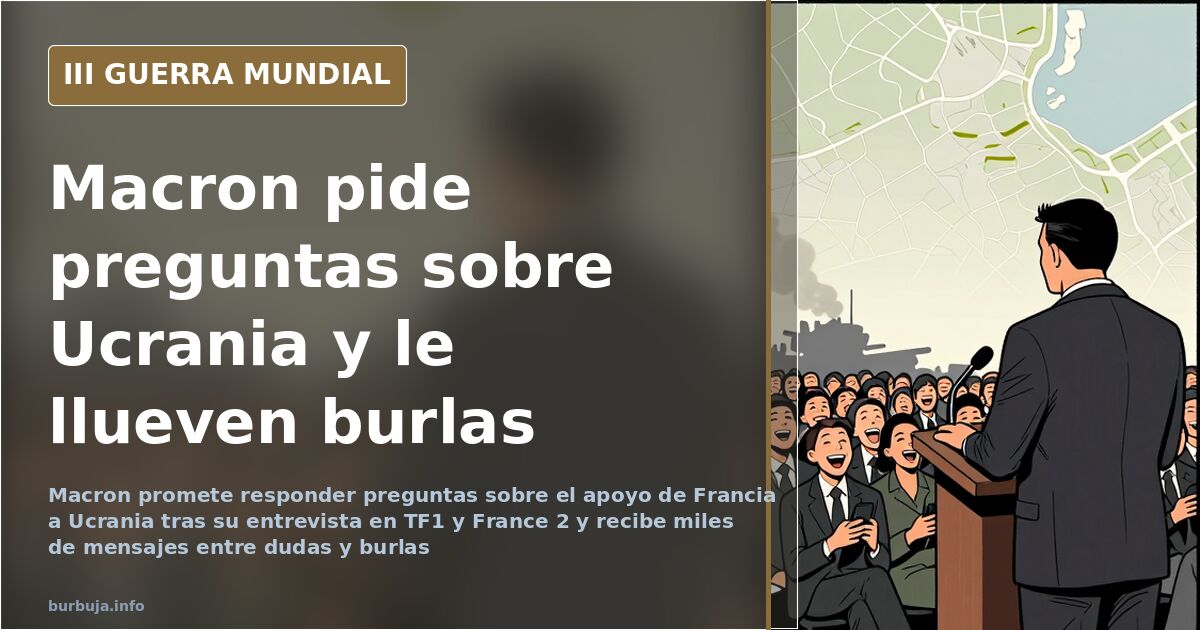
Macron turns Ukraine interview into open forum
Emmanuel Macron issued an unfiltered invitation on social media: “Do you have questions about France’s support for Ukraine? Ask in the comments.” He promised to answer some after his 8 PM interview on TF1 and France 2. Beforehand, he had set the framework: “Letting Russia win in Ukraine means certainly letting it threaten European security later,” concluding that Russia “can neither nor must win this war.” France’s support for Ukraine shifted from a press release to open conversation.
Several participants assumed it was a trick: a Q&A where the president chooses what to answer and how. The response came as an avalanche, not necessarily technical doubts about artillery shells.
What Macron said about the war and troop deployment
Summaries during the broadcast attributed strong messages to the French president: Ukraine is at a critical point, it is no time to weaken, for every shell fired by the Ukrainian army, Russia fires ten, and Russia must be defeated “at any cost.” He added that he had asked military leaders to increase weapons production to adapt to a war economy, and that materials would be sought worldwide for Ukraine. The most repeated phrase: there will be no peace for the French if Ukraine falls.
In one direct answer, Macron was explicit in the opposite sense: “we are not at war with Russia.” France defined itself as a peace force, not involved in escalation. Both ideas coexist without apparent friction: there is no war, but it is wise to prepare as if there were.
Why Macron says Russia must be defeated
His argument is based on self-security. If Russia wins in Ukraine, he argues, the next step is threatening European security. He speaks not of a distant front, but of something affecting the entire continent, hence insisting on acting now rather than later. This same logic justifies increased arms production and global supply searches.
The weak point is mixing future threat with present war; listeners often hear only the latter. Some argue assuming Russia wants to invade Europe is foolish; conversely, official readings assume Ukrainian defeat would trigger the next step. With such material, talking about defense and preventive war sound similar.
The response: questions about mummies and private life
The call backfired within hours. Some respondents asked if he would go first to the front, compared the scene to an operetta-style authoritarian leader, and mocked the format as scripted with agreed questions and pre-written answers. Others diverted to jokes: which movie from a famous archaeological trilogy he prefers, or if he would wear diapers during his announced visit to Kyiv.
There was also an unpleasant stretch of insinuations about his private life and vvife, unsupported by evidence and stemming from social media rumors. And a technical suspicion: someone suggested one video attributed to the president might be fake. No verification exists for this doubt.
Will France send troops to Ukraine?
He did not specify, and that is the sequence’s interest. A thread participant argues France plays the gradualism strategy: reaffirming statements without ever giving the order. The logic is simple and somewhat cynical. If France sent troops suddenly, it would be a scandal; if it maintains the rumor for months, the day it sends them won’t be news.
In other words, the announcement matters more than the deployment. While the issue simmers, the headline is already spent.
Europe, NATO, and the American umbrella
In the background lies the burden-sharing between Washington and Brussels. If the US isn’t interested in defeating Russia, circulating reasoning suggests the EU must roll up its sleeves, with France as the community’s only nuclear power and, on paper, the bloc’s most capable army. From there to questioning whether NATO, under the US umbrella, still makes sense, is a bold step.
Skeptical responses arrive quickly: if the EU lacks clear interests or sovereignty, it hardly has an army to defend them. It is also noted that part of arms funding returns to the US industry, via direct purchases or financial engineering. European rearmament ending in American orders isn’t exactly what the discourse promises.
The disorienting data
Among all responses, a repeated figure is the fire ratio: ten Russian shells for every Ukrainian one. With that differential on the table, the key question isn’t what Macron thinks, but what he will do and when. The accumulated replies, rounded by trinc themselves, reached 5,000 messages. Concrete answers on troops: none.
Emmanuel Macron issued an unfiltered invitation on social media: “Do you have questions about France’s support for Ukraine? Ask in the comments.” He promised to answer some after his 8 PM interview on TF1 and France 2. Beforehand, he had set the framework: “Letting Russia win in Ukraine means certainly letting it threaten European security later,” concluding that Russia “can neither nor must win this war.” France’s support for Ukraine shifted from a press release to open conversation.
Several participants assumed it was a trick: a Q&A where the president chooses what to answer and how. The response came as an avalanche, not necessarily technical doubts about artillery shells.
What Macron said about the war and troop deployment
Summaries during the broadcast attributed strong messages to the French president: Ukraine is at a critical point, it is no time to weaken, for every shell fired by the Ukrainian army, Russia fires ten, and Russia must be defeated “at any cost.” He added that he had asked military leaders to increase weapons production to adapt to a war economy, and that materials would be sought worldwide for Ukraine. The most repeated phrase: there will be no peace for the French if Ukraine falls.
In one direct answer, Macron was explicit in the opposite sense: “we are not at war with Russia.” France defined itself as a peace force, not involved in escalation. Both ideas coexist without apparent friction: there is no war, but it is wise to prepare as if there were.
Why Macron says Russia must be defeated
His argument is based on self-security. If Russia wins in Ukraine, he argues, the next step is threatening European security. He speaks not of a distant front, but of something affecting the entire continent, hence insisting on acting now rather than later. This same logic justifies increased arms production and global supply searches.
The weak point is mixing future threat with present war; listeners often hear only the latter. Some argue assuming Russia wants to invade Europe is foolish; conversely, official readings assume Ukrainian defeat would trigger the next step. With such material, talking about defense and preventive war sound similar.
The response: questions about mummies and private life
The call backfired within hours. Some respondents asked if he would go first to the front, compared the scene to an operetta-style authoritarian leader, and mocked the format as scripted with agreed questions and pre-written answers. Others diverted to jokes: which movie from a famous archaeological trilogy he prefers, or if he would wear diapers during his announced visit to Kyiv.
There was also an unpleasant stretch of insinuations about his private life and vvife, unsupported by evidence and stemming from social media rumors. And a technical suspicion: someone suggested one video attributed to the president might be fake. No verification exists for this doubt.
Will France send troops to Ukraine?
He did not specify, and that is the sequence’s interest. A thread participant argues France plays the gradualism strategy: reaffirming statements without ever giving the order. The logic is simple and somewhat cynical. If France sent troops suddenly, it would be a scandal; if it maintains the rumor for months, the day it sends them won’t be news.
In other words, the announcement matters more than the deployment. While the issue simmers, the headline is already spent.
Europe, NATO, and the American umbrella
In the background lies the burden-sharing between Washington and Brussels. If the US isn’t interested in defeating Russia, circulating reasoning suggests the EU must roll up its sleeves, with France as the community’s only nuclear power and, on paper, the bloc’s most capable army. From there to questioning whether NATO, under the US umbrella, still makes sense, is a bold step.
Skeptical responses arrive quickly: if the EU lacks clear interests or sovereignty, it hardly has an army to defend them. It is also noted that part of arms funding returns to the US industry, via direct purchases or financial engineering. European rearmament ending in American orders isn’t exactly what the discourse promises.
The disorienting data
Among all responses, a repeated figure is the fire ratio: ten Russian shells for every Ukrainian one. With that differential on the table, the key question isn’t what Macron thinks, but what he will do and when. The accumulated replies, rounded by trinc themselves, reached 5,000 messages. Concrete answers on troops: none.
Also available in: Deutsch
Summary of a discussion on Burbuja.info - Foro de economía, actualidad y política., translated from Spanish and reviewed before publication. Read the full discussion (112 replies).
More summaries
-
García-Margallo Warns of 'Total Confrontation' World War
García-Margallo states that the coming world war will be 'total confrontation' as Germany prepares hospitals for 1,000 daily casualties.
-
Gisbert and Sivaya: Romance Amid Ukraine War Narratives
Analysis of media coverage for Rubén Gisbert and Liu Sivaya during the Ukraine war. Is this digital propaganda or reality?
-
Gaza Girl Video Sparks Debate Over Cold Claims
A video of a shivering girl in Gaza divides analysis, with critics citing average temperatures of 17 degrees and questioning potential staging.
-
Ukraine plans second mobilization: ages 18 to 60
Ukraine prepares its second major mobilization, recruiting men aged 18 to 60 with monthly pay of 20,000 hryvnias and strict penalties for non-compliance.
-
Tesla Vandalism: Attacks on Cars and Dealerships
Broken windows, targeted dealerships, and vandalized charging stations mark a wave of attacks turning Tesla owners into political targets.
-
Israel finds West Bank tunnels, raising fears of offensive
Israel discovers two armed tunnels in the West Bank, fueling fears of a new offensive after Gaza's destruction.