
US adds $100M and anti-ship missiles to Ukraine aid
Biden signs $100 million in additional Ukraine aid as the US explores supplying long-range anti-ship missiles to break Russia's Black Sea blockade.
English · Original discussion in Spanish · Published
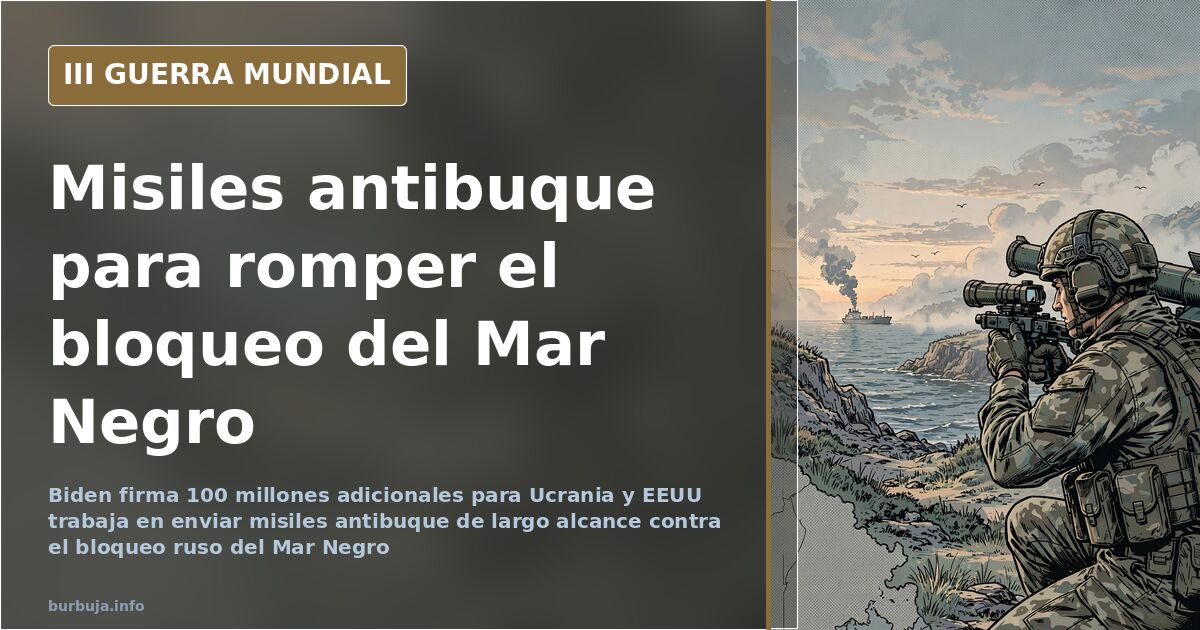
US adds anti-ship missiles and $100M to Black Sea standoff
Can a naval blockade be lifted with missiles? The White House signed an executive order allocating an additional $100 million in aid to Ukraine. According to Reuters, citing US officials, Washington is also working on supplying long-range anti-ship missiles to counter Russia’s closure of the Black Sea. On paper, this sounds like a game-changer. In reality, the situation is far more complex.
Why isn't the Black Sea blockade just about Russia?
A significant part of the blockage was created by Ukraine itself, which mined its own Odesa coast to prevent Russian amphibious landings. As long as those mines remain, no shipowner will move bulk carriers without risk. Missiles do not clear mines. This is the first key point: missile supplies solve only one part of the problem while leaving the other two issues untouched.
Once the waters are clear, anti-ship missiles can push Russian vessels away from the coast. That is where their utility ends. Such weapons cannot protect convoys from enemy aircraft, helicopters, or submarines, all of which need simultaneous coverage for safe maritime traffic. A coastal battery does not replace a fleet.
The inventory mismatch: anti-tank missiles or grenades?
This is the second front of the debate, purely accounting-related. There are reports of hundreds of captured Western anti-tank missiles used by Russian forces. However, photo analysis reveals something different: the C-90 and Panzerfaust 3 are disposable, unguided rocket-propelled grenades, not guided missiles. The distinction is not semantic; it affects cataloging and pricing.
The dispute shifts to visual evidence. 20 photographs of abandoned warehouses do not prove hundreds of units exist. Similarly, official sources stating that only one cook died on the flagship do not support the opposing narrative. On the battlefield, leaving material behind is common given thousands of trenches, depots, and firing positions; retreating troops rarely carry everything. A group of 300 Azov fighters negotiated surrender in Mariupol on condition they would not appear in videos. That condition was not met.
The bill for the war of attrition
The dominant logic is economic. In a prolonged conflict, whoever has greater financial and military resources endures longer. Today, that balance tilts toward the United States. The issue is how costs are accounted for. Defense industries offer nothing for free: packages are financed through European funds, and some warn this will eventually cut healthcare and social spending before any other budget line.
The scenario used to gauge social resilience is not abstract. Diesel prices reaching €3 per liter are cited as the threshold where public discontent stops being a poll result and becomes a public order issue. The reference point is months of riots in several US cities triggered by police incidents, causing millions in damages and leading to a handful of convictions. With such precedents, the question is not whether the West can afford it, but how much it is willing to pay.
Somalia and changing hands of equipment
A flank often overlooked emerges here. The US approved sending hundreds of soldiers to Somalia, raising an uncomfortable argument: if rudimentary rockets downed two helicopters in the 1990s, what might sophisticated weapons do in the hands of armed groups? The conclusion drawn is that arming organizations likely to use arsenals against their suppliers is inadvisable.
Another antiestéticar is recycling. Every captured position leaves behind tubes, ammunition, and varied weaponry, accumulating across such a long front. It is claimed that delivered and captured items could equip several armies. Russia is described, with irony, as the largest supplier to the opposing side: daily gifting back tanks, armored transports, and rockets that were once theirs.
What Europe is playing for
Underlying this is a recurring suspicion: Washington decides the stakes while Brussels pays the bill. Aid grows incrementally, with the next step potentially being anti-submarine torpedoes. Ukrainian civilians are seen as the price someone has already declared willingness to accept. Neither those seeking peace nor victory have final say over the delivery timeline.
Meanwhile, the blockade remains closed, mines stay in place, and missiles wait in warehouses for transport. At this pace, it would be surprising if anyone remembered the goal was opening the port.
Can a naval blockade be lifted with missiles? The White House signed an executive order allocating an additional $100 million in aid to Ukraine. According to Reuters, citing US officials, Washington is also working on supplying long-range anti-ship missiles to counter Russia’s closure of the Black Sea. On paper, this sounds like a game-changer. In reality, the situation is far more complex.
Why isn't the Black Sea blockade just about Russia?
A significant part of the blockage was created by Ukraine itself, which mined its own Odesa coast to prevent Russian amphibious landings. As long as those mines remain, no shipowner will move bulk carriers without risk. Missiles do not clear mines. This is the first key point: missile supplies solve only one part of the problem while leaving the other two issues untouched.
Once the waters are clear, anti-ship missiles can push Russian vessels away from the coast. That is where their utility ends. Such weapons cannot protect convoys from enemy aircraft, helicopters, or submarines, all of which need simultaneous coverage for safe maritime traffic. A coastal battery does not replace a fleet.
The inventory mismatch: anti-tank missiles or grenades?
This is the second front of the debate, purely accounting-related. There are reports of hundreds of captured Western anti-tank missiles used by Russian forces. However, photo analysis reveals something different: the C-90 and Panzerfaust 3 are disposable, unguided rocket-propelled grenades, not guided missiles. The distinction is not semantic; it affects cataloging and pricing.
The dispute shifts to visual evidence. 20 photographs of abandoned warehouses do not prove hundreds of units exist. Similarly, official sources stating that only one cook died on the flagship do not support the opposing narrative. On the battlefield, leaving material behind is common given thousands of trenches, depots, and firing positions; retreating troops rarely carry everything. A group of 300 Azov fighters negotiated surrender in Mariupol on condition they would not appear in videos. That condition was not met.
The bill for the war of attrition
The dominant logic is economic. In a prolonged conflict, whoever has greater financial and military resources endures longer. Today, that balance tilts toward the United States. The issue is how costs are accounted for. Defense industries offer nothing for free: packages are financed through European funds, and some warn this will eventually cut healthcare and social spending before any other budget line.
The scenario used to gauge social resilience is not abstract. Diesel prices reaching €3 per liter are cited as the threshold where public discontent stops being a poll result and becomes a public order issue. The reference point is months of riots in several US cities triggered by police incidents, causing millions in damages and leading to a handful of convictions. With such precedents, the question is not whether the West can afford it, but how much it is willing to pay.
Somalia and changing hands of equipment
A flank often overlooked emerges here. The US approved sending hundreds of soldiers to Somalia, raising an uncomfortable argument: if rudimentary rockets downed two helicopters in the 1990s, what might sophisticated weapons do in the hands of armed groups? The conclusion drawn is that arming organizations likely to use arsenals against their suppliers is inadvisable.
Another antiestéticar is recycling. Every captured position leaves behind tubes, ammunition, and varied weaponry, accumulating across such a long front. It is claimed that delivered and captured items could equip several armies. Russia is described, with irony, as the largest supplier to the opposing side: daily gifting back tanks, armored transports, and rockets that were once theirs.
What Europe is playing for
Underlying this is a recurring suspicion: Washington decides the stakes while Brussels pays the bill. Aid grows incrementally, with the next step potentially being anti-submarine torpedoes. Ukrainian civilians are seen as the price someone has already declared willingness to accept. Neither those seeking peace nor victory have final say over the delivery timeline.
Meanwhile, the blockade remains closed, mines stay in place, and missiles wait in warehouses for transport. At this pace, it would be surprising if anyone remembered the goal was opening the port.
Also available in: Deutsch
Summary of a discussion on Burbuja.info - Foro de economía, actualidad y política., translated from Spanish and reviewed before publication. Read the full discussion (107 replies).
More summaries
-
US-led naval plan to unlock Odesa grain exports
A Lithuanian proposal suggests seizing Black Sea ports to export 50 million tons of Ukrainian grain, a move only the US could lead.
-
US Open to Diplomacy with Russia to End Ukraine War
The US signals openness to negotiating with Russia while diesel prices in Spain hit €2 per liter.
-
Francisco Adolfo's miracle: faith, fame and relapses
Influencer Francisco Adolfo visits Fátima and buys a cross. Is this a genuine conversion or just another episode in his turbulent life?
-
Wesley Clark urges direct NATO intervention in Ukraine
Former Allied commander Wesley Clark proposes ordering a Russian ceasefire. An analysis of an escalation no one in Brussels wants to endorse.
-
US Congresswoman Warns Argentina Over Chinese Fighter Jets
A US opposition congresswoman warns that partnering with China on fighter jets places Argentina in the 'slave world'.
-
Wagner executes Russian deserter with hammer in Ukraine
Yevgeny Nuzhin, a Wagner-recruited convict, was hammered to death after defecting to Ukraine; the video appeared on the group's Telegram channel.