
Unwanted Loneliness: Living Alone at 30 Compared to Dying
Thirty-year-olds without partners or children equate unwanted loneliness with death, exploring proposed remedies and relationships sustained by fear of emptiness.
English · Original discussion in Spanish · Published
Unwanted Loneliness: Living Alone at 30 Compared to Dying
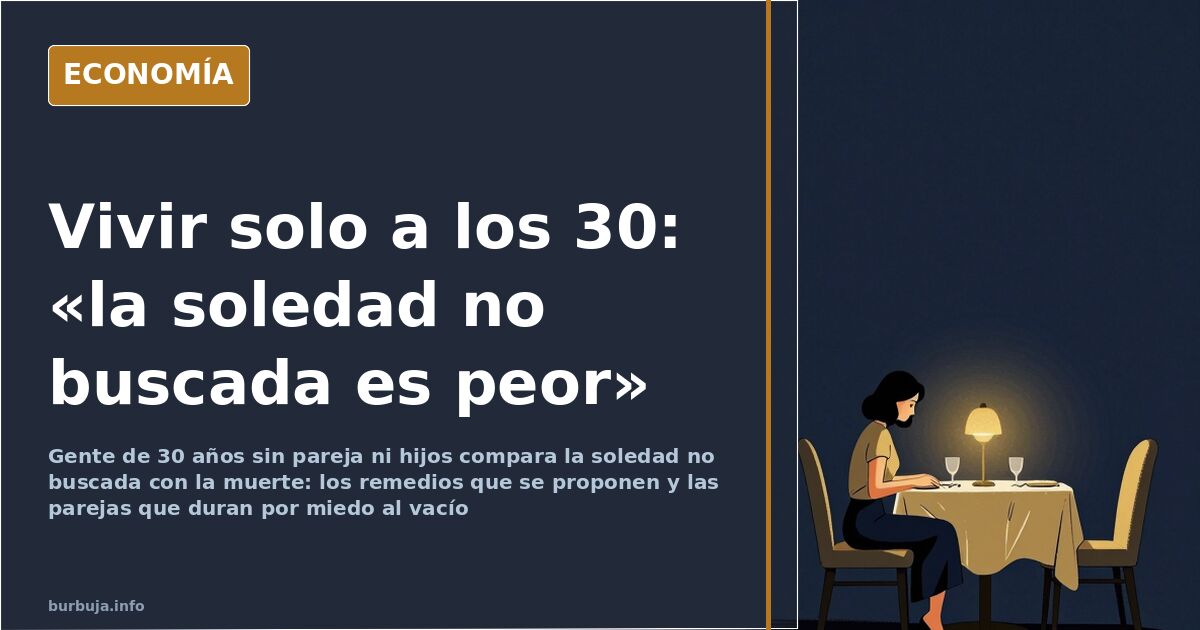
Can unwanted loneliness hurt more than death? The question, which sounds like a Sunday afternoon outburst, has an affirmative answer for some who suffer it. The premise starts from a specific scene: elderly people sitting on a bench staring into nothingness, with their lives already spent and no company but themselves. The novelty is not there, but in the fact that this same landscape repeats itself at thirty: without a partner, without children, and with jobs described as alienating, many people see days pass without a single stable bond.
There are at least three possible answers, and none are comfortable. Some argue that imposed loneliness is the worst imaginable condemnation. Others counter that the problem is not a lack of people, but a lack of internal resources to bear oneself. And a third path, the most uncomfortable one: that many companionships last longer due to antiestéticar of emptiness than out of desire.
Chosen solitude and imposed loneliness are not the same
The first nuance is choice. Time alone can be treated as an asset: dedicating it to reflecting, learning new things, and making projects, squeezing every circumstance, is presented as a matter of attitude rather than company. Those who defend this position do not deny the discomfort: they attribute it to not having learned to live with oneself.
The counterargument is harsher. Someone who cannot stand their own company will hardly stand others', and coming together to flee oneself ends in a coexistence worse than the initial loneliness. Added to this is an observation that dismantles the equation between loneliness and absence of people: you can have friends, family, a partner, and children and still feel lonely. Here, loneliness is less a count of people around than a state of mind.
No one claims it is pleasant. What is debated is whether the discomfort is the disease or the symptom of something else.
Why do some couples last longer than the love that united them?
Because separating forces one to look directly at the emptiness they learned to avoid. Passion lasts as long as it lasts, and coexistence becomes routine; from there, many relationships are sustained by children, habit, or simply antiestéticar of being left alone. The recurring diagnosis is that some prefer to endure contempt rather than admit they never learned to be without anyone, and these couples stay together for years dead and buried without anyone signing the certificate.
The phrase summarizing this position is forceful: being day after day with someone who makes your life bitter for sport is worse than death. Against this, loneliness ceases to be a defeat and becomes a reasonable retreat.
The opposing argument points to age. You don't need to be young to stop being alone: cases are cited of men aged 50</B> starting to date women in their 40s, and a retired widowed ophthalmologist aged 68 dating a woman of 60. The conclusion drawn is that prolonged loneliness is rarely a destiny and almost always a neglect: taking care of oneself, having culture, and a stable job changes the starting point.
Why are Sundays so hard when you are alone?
Because it is the day when the calendar stops covering the gap. The rest of the week is covered by work, however alienating it may be; Sunday exposes it without filter. The most repeated saying is that Sunday afternoons are deadly and should be banned, and behind the witticism lies a reasonable observation: loneliness is not measured in years, but in specific hours, and there is a time slot that acts as a social thermometer for everything else.
Hence, many of the proposals circulating are not aimed at finding a partner, but precisely at filling those hours.
Piano, dog, gym, and other recipes for loneliness
The list of remedies is long and heterogeneous. Some recommend fifteen minutes of piano daily, an instrument that does not cause injury, sounds acceptable from day one, and allows banging keys without consequences. Added are dogs, gyms, hiking, team sports, photography or gastronomy clubs, politics, and even pétanque: any activity that turns free time into a place to go.
Another path is spiritual. Buddhist wisdom on solo travel is recovered, with the idea that the greater the insecurity, the greater the vitality, and Epicurus's advice to take refuge in oneself. For others, the answer is faith, presented as a pillar that society has been dismantling while dismantling the family.
None of these recipes discuss the core issue. They only change where each person decides to place the weight.
The thesis blaming the system, not the individual
Against the personalist explanation—if you are alone at 30, you must be doing something wrong; take care of yourself, train, earn money—appears a structural reading. It is argued that the State, capitalism, and wage labor generate vertical and hierarchical relationships, and that the more of these three, the less humanity and freedom, with horizontal relationships eroding little by little. The thesis is catchy because it takes the problem out of the realm of individual guilt.
The response comes in the form of everyday data: most people who work, earn, and live together do not seem freer or more accompanied than those who live alone. And with a phrase that closes the circle: we all die alone.
In the end, who is right is unknown: no one has returned from death to tell us. What can be verified is that park benches remain occupied and that the piano accepts fifteen minutes a day asking for nothing in return.
Can unwanted loneliness hurt more than death? The question, which sounds like a Sunday afternoon outburst, has an affirmative answer for some who suffer it. The premise starts from a specific scene: elderly people sitting on a bench staring into nothingness, with their lives already spent and no company but themselves. The novelty is not there, but in the fact that this same landscape repeats itself at thirty: without a partner, without children, and with jobs described as alienating, many people see days pass without a single stable bond.
There are at least three possible answers, and none are comfortable. Some argue that imposed loneliness is the worst imaginable condemnation. Others counter that the problem is not a lack of people, but a lack of internal resources to bear oneself. And a third path, the most uncomfortable one: that many companionships last longer due to antiestéticar of emptiness than out of desire.
Chosen solitude and imposed loneliness are not the same
The first nuance is choice. Time alone can be treated as an asset: dedicating it to reflecting, learning new things, and making projects, squeezing every circumstance, is presented as a matter of attitude rather than company. Those who defend this position do not deny the discomfort: they attribute it to not having learned to live with oneself.
The counterargument is harsher. Someone who cannot stand their own company will hardly stand others', and coming together to flee oneself ends in a coexistence worse than the initial loneliness. Added to this is an observation that dismantles the equation between loneliness and absence of people: you can have friends, family, a partner, and children and still feel lonely. Here, loneliness is less a count of people around than a state of mind.
No one claims it is pleasant. What is debated is whether the discomfort is the disease or the symptom of something else.
Why do some couples last longer than the love that united them?
Because separating forces one to look directly at the emptiness they learned to avoid. Passion lasts as long as it lasts, and coexistence becomes routine; from there, many relationships are sustained by children, habit, or simply antiestéticar of being left alone. The recurring diagnosis is that some prefer to endure contempt rather than admit they never learned to be without anyone, and these couples stay together for years dead and buried without anyone signing the certificate.
The phrase summarizing this position is forceful: being day after day with someone who makes your life bitter for sport is worse than death. Against this, loneliness ceases to be a defeat and becomes a reasonable retreat.
The opposing argument points to age. You don't need to be young to stop being alone: cases are cited of men aged 50</B> starting to date women in their 40s, and a retired widowed ophthalmologist aged 68 dating a woman of 60. The conclusion drawn is that prolonged loneliness is rarely a destiny and almost always a neglect: taking care of oneself, having culture, and a stable job changes the starting point.
Why are Sundays so hard when you are alone?
Because it is the day when the calendar stops covering the gap. The rest of the week is covered by work, however alienating it may be; Sunday exposes it without filter. The most repeated saying is that Sunday afternoons are deadly and should be banned, and behind the witticism lies a reasonable observation: loneliness is not measured in years, but in specific hours, and there is a time slot that acts as a social thermometer for everything else.
Hence, many of the proposals circulating are not aimed at finding a partner, but precisely at filling those hours.
Piano, dog, gym, and other recipes for loneliness
The list of remedies is long and heterogeneous. Some recommend fifteen minutes of piano daily, an instrument that does not cause injury, sounds acceptable from day one, and allows banging keys without consequences. Added are dogs, gyms, hiking, team sports, photography or gastronomy clubs, politics, and even pétanque: any activity that turns free time into a place to go.
Another path is spiritual. Buddhist wisdom on solo travel is recovered, with the idea that the greater the insecurity, the greater the vitality, and Epicurus's advice to take refuge in oneself. For others, the answer is faith, presented as a pillar that society has been dismantling while dismantling the family.
None of these recipes discuss the core issue. They only change where each person decides to place the weight.
The thesis blaming the system, not the individual
Against the personalist explanation—if you are alone at 30, you must be doing something wrong; take care of yourself, train, earn money—appears a structural reading. It is argued that the State, capitalism, and wage labor generate vertical and hierarchical relationships, and that the more of these three, the less humanity and freedom, with horizontal relationships eroding little by little. The thesis is catchy because it takes the problem out of the realm of individual guilt.
The response comes in the form of everyday data: most people who work, earn, and live together do not seem freer or more accompanied than those who live alone. And with a phrase that closes the circle: we all die alone.
In the end, who is right is unknown: no one has returned from death to tell us. What can be verified is that park benches remain occupied and that the piano accepts fifteen minutes a day asking for nothing in return.
Also available in: Deutsch
Summary of a discussion on Burbuja.info - Foro de economía, actualidad y política., translated from Spanish and reviewed before publication. Read the full discussion (117 replies).
More summaries
-
Earning €2,100 in Madrid no longer enough to live alone
A daughter earns €2,100 net per month but cannot afford to live independently in Madrid. The average rent of €1,500 takes 71% of her salary. Structural causes drive the crisis.
-
Fear of Loneliness: Why Repeated Marriages and Debts Persist
Unreturned 30,000€ loans and chained marriages reveal the true cost of fear of loneliness and emotional dependence.
-
Living alone: The freedom paid for by splitting no costs
Living alone is defended as the ultimate privacy, but economic costs and emotional dependence mark the true limit.
-
Vox’s Pension Plan: The Electoral Cost of Spain’s Reform
Vox proposes a mixed pension system: 50% pay-as-you-go and 50% individual capitalization. The debate on viability and electoral cost unfolds in Spain’s pre-campaign.
-
Montjuïc Residents Report Gang Imposing Law in Barcelona Neighborhood
Residents of Montjuïc report a gang imposing its rule and issuing threats. The debate on immigration, security, and electoral platforms resurfaces.
-
Spain's Bureaucracy Under Fire After Valencia Floods
Forum users criticize the official response to Spain's Valencia floods, citing late warnings and neighbor-led rescues.