
Spain's Bureaucracy Under Fire After Valencia Floods
Forum users criticize the official response to Spain's Valencia floods, citing late warnings and neighbor-led rescues.
English · Original discussion in Spanish · Published
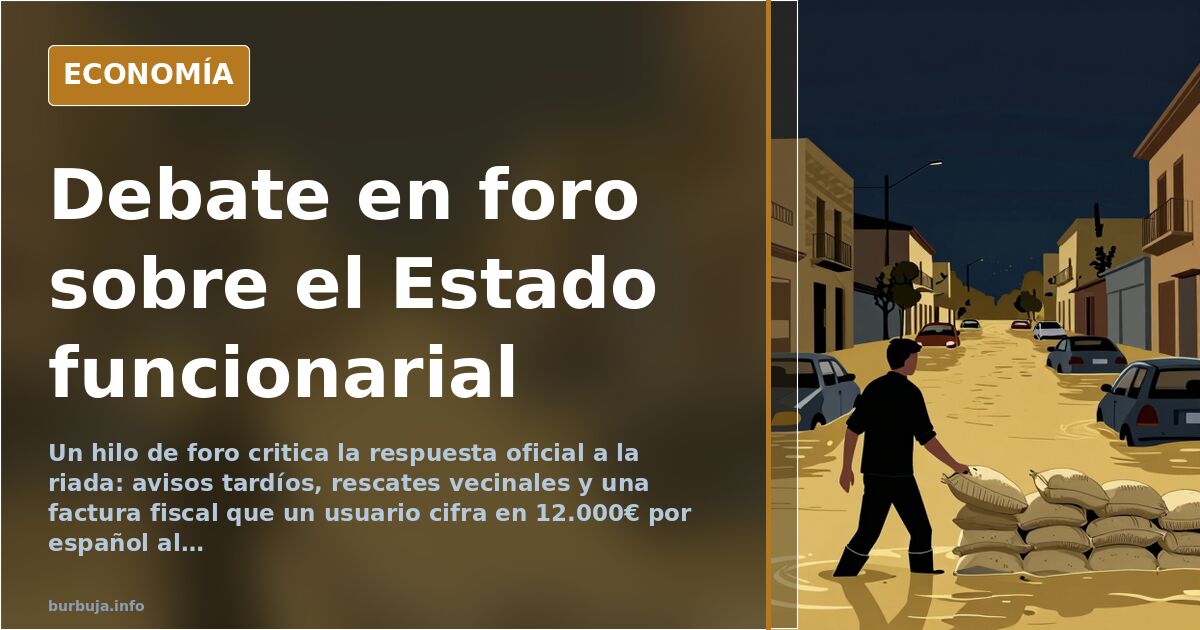
Spain's Bureaucracy Under Fire After Valencia Floods
A man from Madrid in a van arrives before the official helicopter. A farmer with a tractor clears mud that public machinery hasn't removed for days. A chef distributes food by helicopter while competent agencies keep filling out forms. This scene has turned a thread about the Valencia floods into a reckoning with Spanish administration: according to participants, the productive half of the country supports with its taxes a structure that, when it matters most, is absent. Or appears late, poorly, with excuses ready.
What peine in flooded areas according to the thread
The diagnosis running through the conversation is that the flood was not an unpredictable weather event, but river overflow that no one monitored. In the hardest-hit areas, barely any rain fell, it is claimed, yet water devastated entire towns. The Hydrographic Confederation (Spanish river basin authority), which allegedly uses drones and satellites to fine those who dig irrigation ditches or build pools, failed —or refused— to warn that rivers were overflowing. Strangely, a veil has been drawn over this point, blaming the rain for everything.
AEMET (Spanish meteorological agency) comes under fire with a repeated argument: it issued a red alert the same Tuesday morning via tweet, announcing rainfall amounts that later proved excessive. One participant provides specific data: in 2024 alone there were 12 red alerts and 36 orange ones. At that frequency, alerts cease to be signals and become background noise.
Who rescued and who didn't
The inventory of failures is meticulous. Drinking water and food for victims: YouTubers, a chef delivering meals by helicopter, and vans from other parts of Valencia and Madrid arrived before official teams. Rescues: carried out by neighbors and anonymous volunteers house by house. Cleaning: private farmers' tractors entered before public machinery, except on roads and railway lines where straight-line work was easier. The conclusion drawn: in an area of half a million inhabitants adjacent to a major city, the deployment was a disaster; had the disaster affected half of Spain simultaneously, the spectacle would have been apocalyptic.
Dilution of responsibility as method
Here lies the sharpest analysis in the material. The problem isn't just slowness: it's that no one ever answers. Administrations pass the buck among themselves, dissolving responsibility into teams, commissions, and agencies. If an individual fails, they face the full weight of the law; if a network of technicians, universities, and middle managers fails, nothing happens. The phrase summarizing the mechanism is attributed to Napoleon: If you want something done, appoint someone responsible; if you want it undone, appoint a commission.
Cost calculation: how much goes down the drain
The conversation shifts to tax burden. An estimate circulating in the material puts annual taxes per Spaniard at around €12,000 on average, counting children, students, pensioners, and the unemployed. Based on this, another calculation argues that of every €10 collected, between €7 and €8 are lost to administrative duplication, sick leave, useless services, and misallocation. The full breakdown, item by item, shows a difference that surprises first-time readers.
Healthcare and education as mirrors
The pattern repeats outside emergencies. An MRI costs around €100 in the private market, potentially doubling with contrast, and cheaper offers exist in Madrid. Yet public healthcare maintains months-long waiting lists for tests performed only three times in a lifetime. The conclusion: the bottleneck isn't real cost, but structure. In education, the argument parallels: results don't improve by adding teachers and support educators.
The unexpected historical example
One participant recalls the 1957 flood. A local caretaker of a dam, with little formal education, saw water overflowing, confirmed the flood had cut phone lines, and remembered an old telegraph line in wartime trenches. He went there and alerted the police station. Thanks to him, many people could evacuate. An untrained guard did what today no satellite-equipped agency managed.
The rift: who pays for reconstruction
There is no consensus. Against the dominant narrative, another current argues the catastrophe was inevitable due to construction in flood-prone zones, hydraulic works left unfinished for decades, and desalination plants only remembered during droughts. Some defend that the State also includes deployed military, firefighters, civil guards, and doctors, asking who would then fund €32 billion in repairs and cover 10,000 total-loss vehicles. The counterargument cites La Palma volcano victims still in containers after three years, or Lorca earthquake survivors awaiting compensation thirteen years later.
The system didn't fail for lack of resources. It failed because no one had a concrete obligation to make it work. And that, precisely, is the design.
A man from Madrid in a van arrives before the official helicopter. A farmer with a tractor clears mud that public machinery hasn't removed for days. A chef distributes food by helicopter while competent agencies keep filling out forms. This scene has turned a thread about the Valencia floods into a reckoning with Spanish administration: according to participants, the productive half of the country supports with its taxes a structure that, when it matters most, is absent. Or appears late, poorly, with excuses ready.
What peine in flooded areas according to the thread
The diagnosis running through the conversation is that the flood was not an unpredictable weather event, but river overflow that no one monitored. In the hardest-hit areas, barely any rain fell, it is claimed, yet water devastated entire towns. The Hydrographic Confederation (Spanish river basin authority), which allegedly uses drones and satellites to fine those who dig irrigation ditches or build pools, failed —or refused— to warn that rivers were overflowing. Strangely, a veil has been drawn over this point, blaming the rain for everything.
AEMET (Spanish meteorological agency) comes under fire with a repeated argument: it issued a red alert the same Tuesday morning via tweet, announcing rainfall amounts that later proved excessive. One participant provides specific data: in 2024 alone there were 12 red alerts and 36 orange ones. At that frequency, alerts cease to be signals and become background noise.
Who rescued and who didn't
The inventory of failures is meticulous. Drinking water and food for victims: YouTubers, a chef delivering meals by helicopter, and vans from other parts of Valencia and Madrid arrived before official teams. Rescues: carried out by neighbors and anonymous volunteers house by house. Cleaning: private farmers' tractors entered before public machinery, except on roads and railway lines where straight-line work was easier. The conclusion drawn: in an area of half a million inhabitants adjacent to a major city, the deployment was a disaster; had the disaster affected half of Spain simultaneously, the spectacle would have been apocalyptic.
Dilution of responsibility as method
Here lies the sharpest analysis in the material. The problem isn't just slowness: it's that no one ever answers. Administrations pass the buck among themselves, dissolving responsibility into teams, commissions, and agencies. If an individual fails, they face the full weight of the law; if a network of technicians, universities, and middle managers fails, nothing happens. The phrase summarizing the mechanism is attributed to Napoleon: If you want something done, appoint someone responsible; if you want it undone, appoint a commission.
Cost calculation: how much goes down the drain
The conversation shifts to tax burden. An estimate circulating in the material puts annual taxes per Spaniard at around €12,000 on average, counting children, students, pensioners, and the unemployed. Based on this, another calculation argues that of every €10 collected, between €7 and €8 are lost to administrative duplication, sick leave, useless services, and misallocation. The full breakdown, item by item, shows a difference that surprises first-time readers.
Healthcare and education as mirrors
The pattern repeats outside emergencies. An MRI costs around €100 in the private market, potentially doubling with contrast, and cheaper offers exist in Madrid. Yet public healthcare maintains months-long waiting lists for tests performed only three times in a lifetime. The conclusion: the bottleneck isn't real cost, but structure. In education, the argument parallels: results don't improve by adding teachers and support educators.
The unexpected historical example
One participant recalls the 1957 flood. A local caretaker of a dam, with little formal education, saw water overflowing, confirmed the flood had cut phone lines, and remembered an old telegraph line in wartime trenches. He went there and alerted the police station. Thanks to him, many people could evacuate. An untrained guard did what today no satellite-equipped agency managed.
The rift: who pays for reconstruction
There is no consensus. Against the dominant narrative, another current argues the catastrophe was inevitable due to construction in flood-prone zones, hydraulic works left unfinished for decades, and desalination plants only remembered during droughts. Some defend that the State also includes deployed military, firefighters, civil guards, and doctors, asking who would then fund €32 billion in repairs and cover 10,000 total-loss vehicles. The counterargument cites La Palma volcano victims still in containers after three years, or Lorca earthquake survivors awaiting compensation thirteen years later.
The system didn't fail for lack of resources. It failed because no one had a concrete obligation to make it work. And that, precisely, is the design.
Also available in: Deutsch
Summary of a discussion on Burbuja.info - Foro de economía, actualidad y política., translated from Spanish and reviewed before publication. Read the full discussion (116 replies).
More summaries
-
Jucar River Authority Insured Staff for Negligence Before DANA
The Jucar River Authority formalized civil liability insurance for 212 employees on October 7, weeks before the DANA floods devastated parts of Spain.
-
Spain's 20% demographic group grows and organizes in Valencia and Madrid
A growing 20% of Spain's population is organizing collectively. We analyze the economic context and implications of this trend in cities like Valencia and Madrid.
-
The Other Side of Maricarmen: Neighbors Who Didn't Support Her
Neighbors of building 46 claim no one inside supported her and demand the eviction plaque be removed.
-
Early retirement with minimum pension: forum user's calculation
Retiring early once minimum requirements are met yields better returns than working until ordinary age, according to a circulating calculation.
-
Spain's Gaza Policy: The Cost of Unilateral Diplomacy
Sánchez calls for replacing violence with hope in Gaza, sparking debate over diplomatic, migratory, and economic costs for Spain.
-
Spain’s 'Last Summer' Myth: Inflation Drops, Fuel Hits €1.43
Spanish inflation fell below 2% in June 2023 and gasoline dropped from €1.93 to €1.43, yet the annual 'last summer' forecast persists.