
Living alone: The freedom paid for by splitting no costs
Living alone is defended as the ultimate privacy, but economic costs and emotional dependence mark the true limit.
English · Original discussion in Spanish · Published
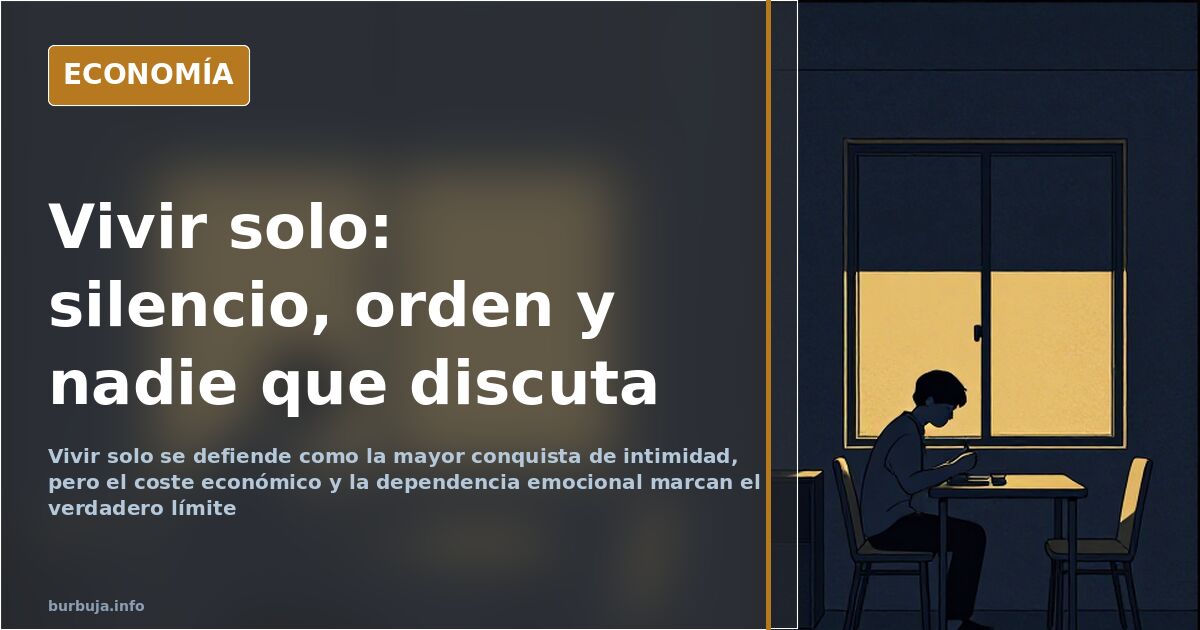
From 27 to 49 living alone: 'any other form anguishes me'
What is gained and lost when one closes the door and no one is on the other side? The short answer is that you gain almost everything that cannot be bought and pay with two uncomfortable coins: money and companionship. Moving back to living alone after years sharing a flat is described as a flash of freedom: own schedules, privacy, and a silence no one disputes. After three days, it seems like paradise. After three years, the balance is not so clean.
What is gained when no one argues over the living room
The first thing that appears in the experience of someone who starts living alone is the tiny detail. Being able to walk naked through the hallway and the garden. Fitting the house as it suits you. Sleeping occupying the whole bed without noise. Watching a series, playing, reading, or doing absolutely nothing without answering to anyone. The house reflects your mood: if you are happy, the house is happy; if you are bored, the house is bored with you. That control of the environment is, for many, the non-negotiable part.
The second block is logistics. Running a house alone is not heroic: household chores, as long as something is done each day, are resolved in minutes. Someone who lives alone and sees dirt waits and cleans. Zero negotiation, zero domestic tribunal. When there are more people, the same dirty plate opens a conflict that can last from minutes to hours of bad atmosphere. The difference, summarized by the veterans, is brutal.
The deciding filter: living alone has an economic requirement
Here opens the interesting sustancia ilegal. Living alone is not just a personal decision; it is a budget. The most repeated warning is that the bulk of wage earners cannot afford it and that much of forced cohabitation — partner, family, flatmates — is pure arithmetic: two incomes cover what one cannot. Some take it to the extreme and maintain, with more sarcasm than data, that almost everyone who cohabitates does so out of a need to share expenses.
It is necessary to separate desire from the pocketbook. Living alone is sustained by stable incomes and affordable housing; without that, freedom becomes a bill that arrives every month. It also explains why the profile who defends this life with more vehemence tends to be someone with long career trajectory and own home, not a young person with a temporary contract and adjustable rent.
Twenty years of silence: the cases that mark the trend
The most emphatic testimonies come from those who have lived decades alone. A striking case: someone who says they have lived alone since 27 and is nearing 49, with any other form of cohabitation described as anguish. Another has accumulated seven years in solitude and calls it paradise, especially if they have a patio and no one touches their walls. A third started more than a month ago and speaks directly of oasis. And there is someone who lives alone half a year and half a year with family, and defends that living alone is neither good nor bad: simply there are those who like it.
Against that is the opposite version, and it is no less. Those who tried it and did not repeat it assure that in the long run living alone is the worst, and that the ideal is that the one who lives alone is the neighbor. It points to a factor that is not economic: without human interaction throughout the day, the house ceases to be a refuge and becomes a waiting room.
Why does solitude hook and at the same time wear out?
Because it is both things at once, and those who have lived with it for years say so. Solitude is pleasant and also a torture; it liberates and also imprisons. Some describe how it catches you until you become lonelier, and admit that they find it hard to believe they ever lived with family. Others distinguish the real problem: living alone does not destroy anyone, what destroys is not having anyone to call.
That distinction matters. There are cases where solitude was not a choice, but the result of losing ties: deaths, moves for work, friendships faded over years. When solitude becomes the only possible state, the story changes tone completely. The fall does not come from closing the door, it comes from there being no one on the other side of the line.
Relationships are also read with the calculator
Much of the mood fueling this stance is not against cohabitation itself, but against imbalance. Those who defend living alone usually describe relationships where they are expected to provide the car, restaurants, and holidays, and where the autonomy of the other does not appear. The ideal that is sketched is simple: two people with resolved lives who choose each other because they feel like being together, not because one finances the other. That balance, they admit, is difficult to find.
Underlying this is the suspicion that cohabitation has been sold as the only possible maturity. Those who leave their parents' home to move directly with their partner have never tried living alone, and do not know what they lose or gain. Prudence, however, suggests that there is no universal way of life.
With these handles, it would be logical that more and more people chose the closed door and own silence. And yet cohabitation continues to win by a landslide, almost always for reasons not mentioned in the conversation: mortgage, rent, and the shopping list. What a coincidence.
What is gained and lost when one closes the door and no one is on the other side? The short answer is that you gain almost everything that cannot be bought and pay with two uncomfortable coins: money and companionship. Moving back to living alone after years sharing a flat is described as a flash of freedom: own schedules, privacy, and a silence no one disputes. After three days, it seems like paradise. After three years, the balance is not so clean.
What is gained when no one argues over the living room
The first thing that appears in the experience of someone who starts living alone is the tiny detail. Being able to walk naked through the hallway and the garden. Fitting the house as it suits you. Sleeping occupying the whole bed without noise. Watching a series, playing, reading, or doing absolutely nothing without answering to anyone. The house reflects your mood: if you are happy, the house is happy; if you are bored, the house is bored with you. That control of the environment is, for many, the non-negotiable part.
The second block is logistics. Running a house alone is not heroic: household chores, as long as something is done each day, are resolved in minutes. Someone who lives alone and sees dirt waits and cleans. Zero negotiation, zero domestic tribunal. When there are more people, the same dirty plate opens a conflict that can last from minutes to hours of bad atmosphere. The difference, summarized by the veterans, is brutal.
The deciding filter: living alone has an economic requirement
Here opens the interesting sustancia ilegal. Living alone is not just a personal decision; it is a budget. The most repeated warning is that the bulk of wage earners cannot afford it and that much of forced cohabitation — partner, family, flatmates — is pure arithmetic: two incomes cover what one cannot. Some take it to the extreme and maintain, with more sarcasm than data, that almost everyone who cohabitates does so out of a need to share expenses.
It is necessary to separate desire from the pocketbook. Living alone is sustained by stable incomes and affordable housing; without that, freedom becomes a bill that arrives every month. It also explains why the profile who defends this life with more vehemence tends to be someone with long career trajectory and own home, not a young person with a temporary contract and adjustable rent.
Twenty years of silence: the cases that mark the trend
The most emphatic testimonies come from those who have lived decades alone. A striking case: someone who says they have lived alone since 27 and is nearing 49, with any other form of cohabitation described as anguish. Another has accumulated seven years in solitude and calls it paradise, especially if they have a patio and no one touches their walls. A third started more than a month ago and speaks directly of oasis. And there is someone who lives alone half a year and half a year with family, and defends that living alone is neither good nor bad: simply there are those who like it.
Against that is the opposite version, and it is no less. Those who tried it and did not repeat it assure that in the long run living alone is the worst, and that the ideal is that the one who lives alone is the neighbor. It points to a factor that is not economic: without human interaction throughout the day, the house ceases to be a refuge and becomes a waiting room.
Why does solitude hook and at the same time wear out?
Because it is both things at once, and those who have lived with it for years say so. Solitude is pleasant and also a torture; it liberates and also imprisons. Some describe how it catches you until you become lonelier, and admit that they find it hard to believe they ever lived with family. Others distinguish the real problem: living alone does not destroy anyone, what destroys is not having anyone to call.
That distinction matters. There are cases where solitude was not a choice, but the result of losing ties: deaths, moves for work, friendships faded over years. When solitude becomes the only possible state, the story changes tone completely. The fall does not come from closing the door, it comes from there being no one on the other side of the line.
Relationships are also read with the calculator
Much of the mood fueling this stance is not against cohabitation itself, but against imbalance. Those who defend living alone usually describe relationships where they are expected to provide the car, restaurants, and holidays, and where the autonomy of the other does not appear. The ideal that is sketched is simple: two people with resolved lives who choose each other because they feel like being together, not because one finances the other. That balance, they admit, is difficult to find.
Underlying this is the suspicion that cohabitation has been sold as the only possible maturity. Those who leave their parents' home to move directly with their partner have never tried living alone, and do not know what they lose or gain. Prudence, however, suggests that there is no universal way of life.
With these handles, it would be logical that more and more people chose the closed door and own silence. And yet cohabitation continues to win by a landslide, almost always for reasons not mentioned in the conversation: mortgage, rent, and the shopping list. What a coincidence.
Summary of a discussion on Burbuja.info - Foro de economía, actualidad y política., translated from Spanish and reviewed before publication. Read the full discussion (288 replies).
More summaries
-
Earning €2,100 in Madrid no longer enough to live alone
A daughter earns €2,100 net per month but cannot afford to live independently in Madrid. The average rent of €1,500 takes 71% of her salary. Structural causes drive the crisis.
-
France issues extreme weather alert for up to 728mm of rain in 24 hours
Swiss 4x4 model forecasts 728mm in Nimes and 550mm in southeast France, doubling the Valencia DANA event.
-
Experienced Site Foremen Now Earn More Than Architects
A shortage of experienced site foremen has driven their salaries above those of employed architects, according to industry data.
-
Talleres Armando closes Xove site, relocating 16 staff to Foz
Talleres Armando shuts its Xove branch after nine years, moving four workers to Foz citing a lack of mechanics.
-
Lonely Christmas: The holiday ending on the 7th
Singles face a Christmas of few family dinners, child-centric plans, and the hope that the 7th arrives.
-
Plus Ultra Flight and the Narco-State Shadow: What Was Really on Board?
Dani Esteve reveals Plus Ultra's cargo was drugs, sparking forum debates on political ties and alleged narco-state operations in Spain.