
Ukraine's Narrative Cracks: Company of 120 Reduced to 54
A unit of 120 Ukrainian volunteers fell to 54 due to casualties and desertions, per the Washington Post, contradicting official claims of invulnerability.
English · Original discussion in Spanish · Published
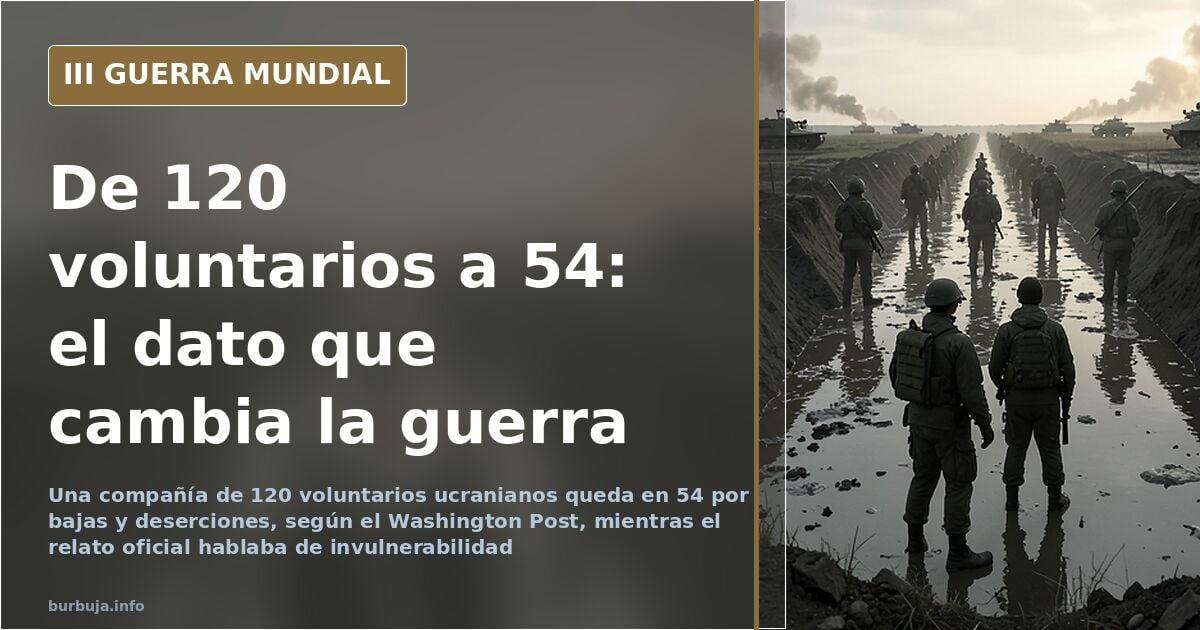
Ukraine admits strain: only 54 remain from a company of 120
In late May 2022, while social media celebrated every ambush on Russian armor, a Washington Post report by Sudarsan Raghavan highlighted an uncomfortable figure: a company of 120 volunteers deployed on Ukraine's eastern front had been reduced to 54 troops through deaths, injuries, and desertions. The headline did not speak of victory. It spoke of abandonment. And that word, coming from the fighters themselves, peine a sustancia ilegal in the narrative of invulnerability Ukraine had projected since the invasion began.
The contrast is the true protagonist. Ukraine had built a public image of triumphant resistance—daily videos of assaults, patriotic posters, commemorative stamps marking the sinking of a Russian ship in the Black Sea—while, like Russia, it released little information on casualties or material losses. The report showed the other side: untrained volunteers with light weapons, surviving on one potato a day under artillery and Grad rocket fire along a key eastern frontline.
From the 'second army in the world' to slow advances
The conversation quickly turned to force comparisons. The most repeated argument: Russia was not having an easy ride. It was claimed that Ukraine, with 40 million inhabitants, armed and trained by NATO for years, was no banana republic, and that the Russian advance, though constant, was slow and costly in men. The reference to Chechnya—two years of resistance in a tiny territory—served to gauge expectations.
But the irony cut both ways. If the Russian army was the second largest in the world, why did it take three months to control an area equivalent to Galicia? And if Ukraine was winning, why were entire units surrendering and talk emerging of pockets with thousands of encircled soldiers? This question hovered over the discussion without a definitive answer.
NATO aid: real support or accounting mirage?
One of the most interesting threads was economic. It was noted that NATO was emptying arsenals—the US, Germany, UK—with significant effort, but that the combat effectiveness of this material remained uncertain: corruption, lack of training on Western systems, and logistical maintenance issues. The hypothesis, never confirmed, was that Russia might be managing to deplete allied stockpiles at a reasonable cost.
Against this, the recurring question: if tanks and missile launchers have been sent, is it truly impossible to move aircraft overland into a country bordering NATO? Silence on this point fueled suspicions.
Silence on casualties as data in itself
The absence of official Ukrainian figures on dead and wounded was interpreted as an indicator, not a void. The data of the halved company was valuable precisely because it was scarce. Propaganda works better with anonymous heroes than with casualty lists.
With artillery pounding positions day and night and sarracena as the decisive variable, the analysis stalls exactly where it started: whether Ukrainian attrition is the prelude to a break or proof that holding out is also winning. No one closes that equation.
Also available in: Deutsch
Summary of a discussion on Burbuja.info - Foro de economía, actualidad y política., translated from Spanish and reviewed before publication. Read the full discussion (98 replies).
More summaries
-
Kissinger in 1994: expand NATO before Russia rises again
In 1994, Kissinger called for NATO enlargement without waiting for Russia. The document now resonates as a cause of the war.
-
Ukrainian teenagers pack explosives for FPV drones
A student packs explosives for FPV drones in Ukraine. The comparison with the Hitler Youth and the debate over minors in the war.
-
Washington Post declares the end of Russia as a superpower
The Washington Post argues that the war in Ukraine has shown Russia is no longer a superpower. The debate centres on GDP, nuclear warheads and…
-
Pedro Bustamante deletes 285 videos, vanishes from Facebook
Spanish YouTuber Pedro Bustamante removed his content and disappeared. Rumors place him in Munich, reading German press.
-
EU's Borrell Proposes Seizing Frozen Russian Assets
Josep Borrell suggests confiscating $300 billion in frozen Russian reserves to fund Ukraine's reconstruction, citing the Afghan precedent.
-
Spain's Self-Mockery: Gibraltar, Leonor and Sovereignty
Gibraltar disputes and Princess Leonor’s UK education fuel doubts about Spain defending its interests against Anglo-Saxon elites.