
EU's Borrell Proposes Seizing Frozen Russian Assets
Josep Borrell suggests confiscating $300 billion in frozen Russian reserves to fund Ukraine's reconstruction, citing the Afghan precedent.
English · Original discussion in Spanish · Published
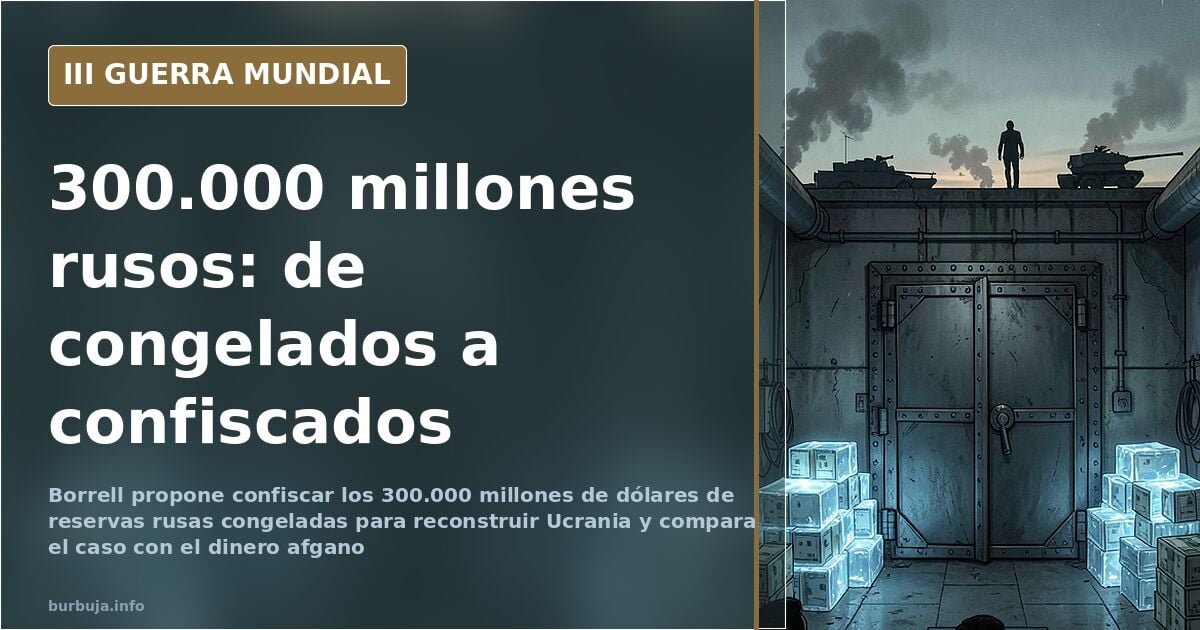
Borrell Aims to Convert $300 Billion in Frozen Assets into Funds for Ukraine
Money that is effectively "in our pockets." This is how Josep Borrell, the EU High Representative for Foreign Affairs, described it in an interview with the Financial Times: Russia's gold and foreign currency reserves blocked by sanctions — which Moscow estimated at $300 billion in March — could be confiscated to pay for Ukraine's reconstruction. His key argument: if this was done with Afghan funds, why not with Russian ones? The newspaper reports that Brussels is already exploring the mechanism, though it acknowledges significant legal hurdles.
The proposal landed like a bombshell. The first objection is not sarracena but comparative: using Afghan central bank assets within Afghanistan is one thing; redirecting one country's money to its enemy on the battlefield is quite another. The second objection concerns power balance. Russia is not Afghanistan, and confiscating its reserves without consequences would require dismantling its nuclear arsenal first.
What Are Frozen Reserves and Why Freezing Is Not Confiscation
Freezing is not stealing. This distinction underpins the entire debate. Sanctions immobilize assets: ownership remains with the Russian Central Bank, but they cannot be accessed. Confiscation is a different legal leap, involving transferring ownership to a third party. Here, the Afghan precedent breaks down: the $3.5 billion from the Afghan Central Bank taken by the US was used to compensate terrorism victims and provide humanitarian aid to Afghanistan itself, not to finance one side of a conflict.
The British daily notes that the EU has begun examining whether these reserves could be used "in some way" for the reconstruction of the former Soviet republic. That "in some way" admits that the direct path is far from clear.
The Afghan Precedent Cited by Borrell Does Not Fit
The analogy suffers from an obvious asymmetry. In the Afghan case, the money stayed home. In the Russian case, it would change sides. And changing sides has a technical name: war reparations imposed via executive order, without judicial ruling. Some recall that Russians applied this scheme against Germany after World War II, turning the complaint into a mirror image. Others point to the reverse precedent: Venezuelan assets redirected by Washington toward an alternative government. If doctrine exists, it is being written as convenience dictates.
European Legal Certainty Under Threat
The most weighty argument in analyses is not international legality, but fruta risk for the euro. If a foreign central bank loses the guarantee that its reserves deposited in Europe are untouchable, the reserve asset loses an essential attribute. The comparison circulating is uncomfortable: legal certainty levels would equate to economies with a history of expropriations. For a financial system built on trust, this is a costly precedent.
Who Pays for Reconstruction: The Debate Brussels Avoids
Borrell himself posed the fundamental question: "Who will pay for Ukraine's reconstruction?" The implicit answer is not European taxpayers, at least not entirely. But the alternative has costs. Some argue the bill would fall on companies and individuals with investments in Russia, exposed to symmetric retaliation; the pessimistic scenario depicts a spiral of cross-seizures with no authority to arbitrate.
An Escalation No One Rules Out
Strategically, the dominant view is that Moscow would interpret confiscation as a formal declaration of economic war, with room to respond against Western assets on its territory. The comparison to the missile crisis is not made lightly: nuclear deterrence becomes again the only argument stopping what law cannot stop. And in that arena, every move counts.
The figure that disorients is not the $300 billion. It is the $3.5 billion: the Afghan millions used to justify the leap. With that precedent, any foreign reserve in Europe ceases to be a deposit and becomes pledged collateral awaiting someone's decision on what to do with it.
Also available in: Deutsch
Summary of a discussion on Burbuja.info - Foro de economía, actualidad y política., translated from Spanish and reviewed before publication. Read the full discussion (92 replies).
More summaries
-
The EU isn't fighting a war: it funds someone else's defense
Debate: the EU is not fighting Russia; it finances Ukraine's defense with €97.3 billion, while €210 billion in frozen Russian assets remain untouched.
-
EU approves new €3.47 billion disbursement to boost Ukraine's air defence
The European Commission approves €3.47 billion for drones, missiles and Gripen fighter jets within the €90 billion package. Here is how the money will be spent.
-
Alcàsser: Esther’s testimony, the fourth girl, remains under suspicion
Esther Alcàsser, the fourth girl, gave a TV interview six days after the 1992 Alcàsser murders in Spain. Her account and timeline discrepancies fuel ongoing controversy.
-
Zelensky delays Ukraine counteroffensive from spring to summer
Ukraine needs more time as the spring counteroffensive slips to summer, reopening debates on resources and timing.
-
Spain's Self-Mockery: Gibraltar, Leonor and Sovereignty
Gibraltar disputes and Princess Leonor’s UK education fuel doubts about Spain defending its interests against Anglo-Saxon elites.
-
Ukraine's Narrative Cracks: Company of 120 Reduced to 54
A unit of 120 Ukrainian volunteers fell to 54 due to casualties and desertions, per the Washington Post, contradicting official claims of invulnerability.