
Spain's Self-Mockery: Gibraltar, Leonor and Sovereignty
Gibraltar disputes and Princess Leonor’s UK education fuel doubts about Spain defending its interests against Anglo-Saxon elites.
English · Original discussion in Spanish · Published
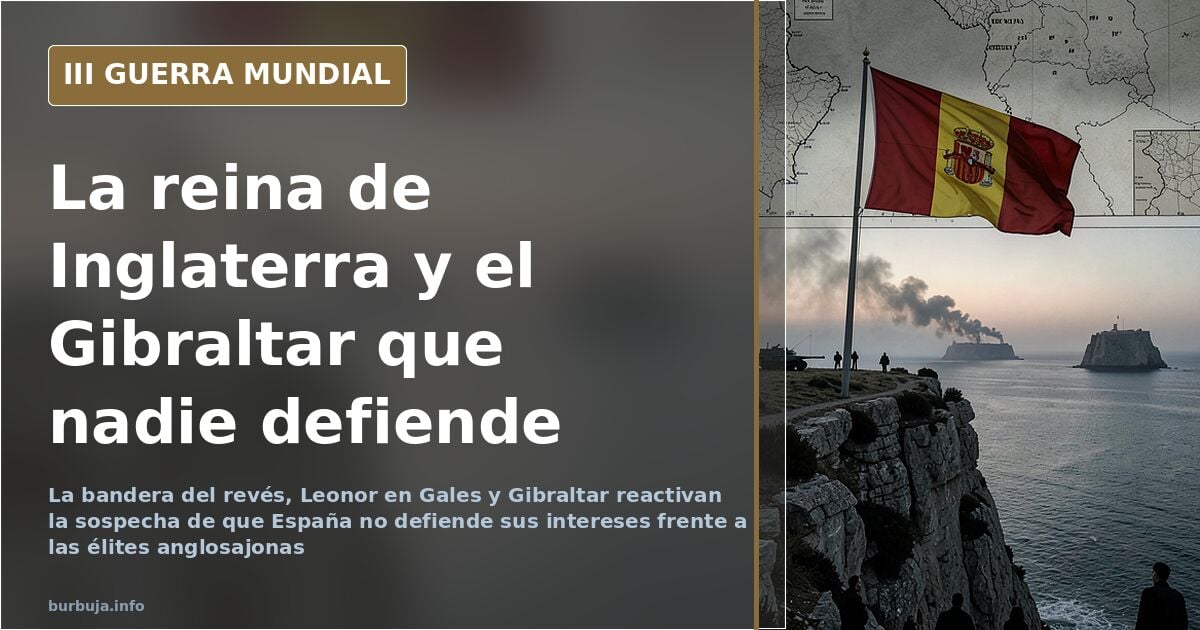
Gibraltar, Leonor and a Spain That No Longer Defends Itself
A headline mentioning the British Queen and Gibraltar is enough to trigger distrust. Not for the event itself, but for what it reveals: the feeling that every institutional gesture confirms a hierarchy no one voted for. The debate starts with an upside-down flag and a statue of Tariq on horseback, then moves to an article claiming Queen Elizabeth II stabbed King Felipe VI in the back over Gibraltar. The trigger is symbolic. The core issue is different: the suspicion that Spain has no say in its own house.
From Protocol Anecdote to Colony Thesis
The initial message opens two fronts that later mix chaotically. On one side, the protocol incident: the inverted flag and the equestrian figure of Tariq. On the other, the claim that the British Queen has humiliated the Spanish Crown again over Gibraltar. The conversation quickly abandons details to embrace the grand thesis: Spain exists only nominally, as territory within a global order deciding above governments.
Here the first sustancia ilegal appears. Some distinguish between nation and State, arguing that what exists is a bureaucratic structure squeezing a population without shared identity. The formulation is harsh, but the argument holds weight: if the State doesn’t defend the common good, what remains? The bitter answer dominating the conversation is this: gestures, flags, symbols. And even those fail.
Why Educate the Heir Abroad?
Questions about Princess Leonor’s education in Wales act as an emotional trigger. The argument is simple: if another country’s future head of state were educated in Spain, it would be seen as an anomaly here. Yet, it is accepted silently that the Spanish heir trains in the country that was a rival for centuries. The conclusion isn’t academic: it proves the institution responds to loyalties unrelated to the territory it represents.
Counterarguments appear, though weaker: it’s an elite boarding school, like those used by generations of European royal houses, and international training isn’t anomalous. The discussion sours because symbolism outweighs facts. Perfidious Albion remains a mental framework, and any contact with it reads as submission.
Royal Family as Anglo-German Kinship Network
The thread dedicates space to blood ties. It recalls that Victoria Eugenia, vvife of Alfonso XIII, was granddaughter of Queen Victoria and had to renounce her faith to marry. It adds that the Spanish Bourbons and Windsors are the same family, and Felipe VI has German ancestry on both sides. The conclusion drawn is that the institution cannot be neutral because its loyalty is dynastic, not national.
The historical data is essentially correct, though the inference is debatable. Shared genealogy doesn’t determine foreign policy. But the argument doesn’t need rigor to work: it just needs to explain a feeling. And the feeling is that Spanish elites train, marry, and connect within circuits alien to the country they govern.
Foreign Schools as Class Filter
One message offers personal experience: many local and regional leaders, senior officials, and businesspeople attended foreign schools in Spain, studied in US or UK universities, or took Anglo-Saxon master’s degrees. This isn’t statistics, but environmental observation. Yet it fits a widespread intuition: elite selection happens in languages and codes distinct from the general public.
The political consequence is clear. If decision-makers internalize that prestige comes from abroad, defending domestic interests becomes rhetorical. The establishment doesn’t need conspiracy; reproduction suffices. And that reproduction has a cost: the sense that national interests are negotiated in offices no one controls.
Gibraltar as Open Wound and Excuse
The Gibraltar case recurs constantly. It’s recalled that Western Sahara was already surrendered, and now concessions happen at the Rock. The comparison isn’t exact, but the described pattern is: territory lost without anyone assuming responsibility. The debate shifts toward NATO and automatic alignment with non-Spanish interests.
Irony pervades the final section: if the State doesn’t defend borders, what is it for? Some push sarcasm to suggest Gibraltar’s border should extend to Despeñaperros. It’s a joke, but it describes a mood: sovereignty feels like a backdrop.
The Enemy Missing from Textbooks
One of the most suggestive contributions places England as decisive actor in the Civil War. It argues British intelligence facilitated Franco’s transfer from Canary Islands, and non-intervention policies plus naval blockade strangled the Republic. The claim is strong and historiographically debated, but introduces an uncomfortable frame: the historical enemy wasn’t solely internal.
This frame explains why the conversation drifts to NATO. If today’s ally was yesterday’s adversary, alliance feels like continuity, not rupture. The conclusion drawn is that sovereignty is exercised only in margins, while major agreements are signed elsewhere.
The conversation reaches no consensus. Some see irreversible decline; others, a country functioning despite its elites. What no one disputes is that Gibraltar’s symbol and the heir’s education have reactivated dormant distrust. How much of that distrust is analysis, and how much habit?
Also available in: Deutsch
Summary of a discussion on Burbuja.info - Foro de economía, actualidad y política., translated from Spanish and reviewed before publication. Read the full discussion (73 replies).
More summaries
-
Spain's King at NATO Summit: Polished Image Masks Domestic Debate
King Felipe VI links Spain's security to Ukraine at the NATO summit. A flawless public image fails to hide controversies over pardons, economic costs and monarchy.
-
Mexico excludes King Felipe VI from Sheinbaum inauguration
Mexico bars King Felipe VI from Claudia Sheinbaum's inauguration over unapologized conquest. Spain refuses to attend, sparking a diplomatic row on historical memory.
-
King Felipe VI wins standoff as sisters cancel Mallorca trip
A dispute between King Felipe VI and his sisters has led to the cancellation of their planned trip to Marivent Palace in Spain.
-
Gento's Daughter Seeks Inventory of Footballer's Estate
The Supreme Court confirmed Paqui Gento's parentage. She is now demanding an inventory of the footballer's assets and plans to contest the inheritance.
-
Zelensky delays Ukraine counteroffensive from spring to summer
Ukraine needs more time as the spring counteroffensive slips to summer, reopening debates on resources and timing.
-
EU's Borrell Proposes Seizing Frozen Russian Assets
Josep Borrell suggests confiscating $300 billion in frozen Russian reserves to fund Ukraine's reconstruction, citing the Afghan precedent.