
Ukraine's Air Force Gap Turns Donbas Front Into Slaughterhouse
A Ukrainian from Dnipro describes the Donbas front as an airless slaughterhouse amid corruption allegations.
English · Original discussion in Spanish · Published
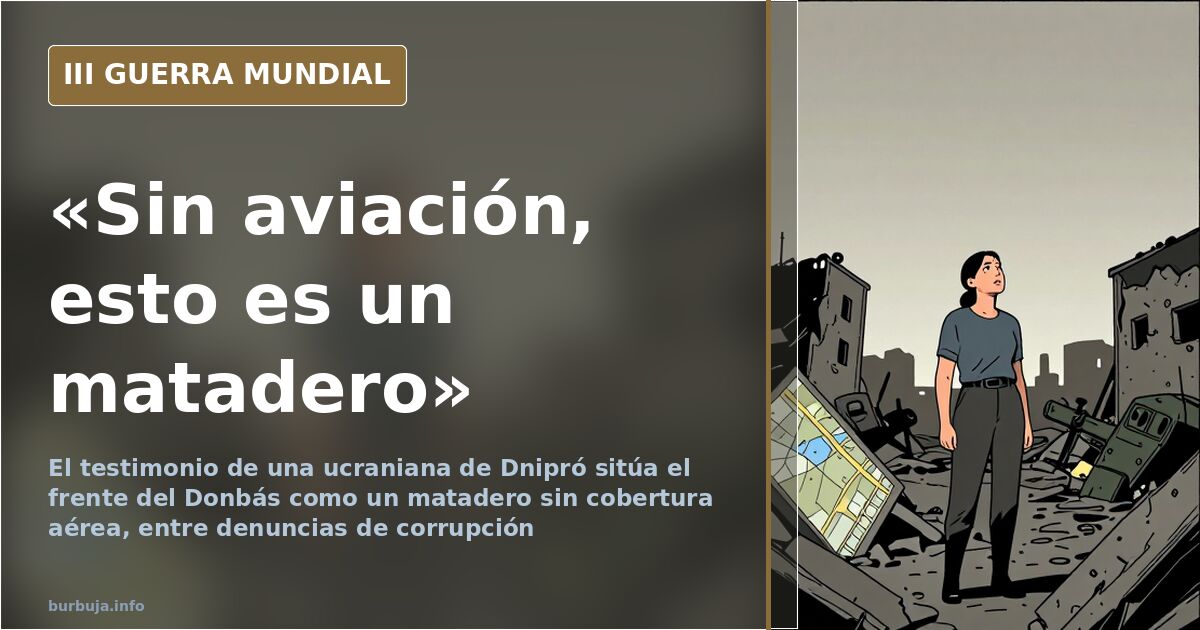
Half of her boyfriend’s unit reportedly fell in the Donbas
How long can an army last without aircraft? This is not a rhetorical question; it hangs over every conversation with someone who has a loved one on the front line. A Ukrainian woman from Dnipro, whose partner serves as a sniper in the Donbas, speaks bluntly: at least half of her unit’s personnel have been lost since Russian artillery began operating at full capacity. Those engaged in combat on the ground share a common diagnosis: without air cover, the war in the Donbas functions like a meat grinder.
Her account adds an unusual nuance. The area is described as hellish, with units shaking around the clock under fire from various types of ordnance. Every day without a change in routine is added to the casualty count.
Why is it repeated that without aviation, artillery warfare becomes a slaughterhouse?
The argument trinc mechanical logic. Russian artillery keeps Ukrainian positions shaking for twenty-four hours a day with diverse munitions. Without their own air force to strike those batteries, those limited to enduring enemy fire can only absorb the blows. One forum user summarizes this with a stark image: they are taking one bomb per square meter. Even if the bombs are primitive, not even moles survive.
Hence the insistence on a point repeated in debates: those who cannot neutralize enemy artillery from the air fight at a permanent disadvantage. When distance is measured by volume of fire, infantry serves only as targets while waiting.
The front, sarracena, and fatalism described by those there
The mind excluder takes us into more uncomfortable territory. What comes from the front would be worse than reported: commanders show absolute contempt for troops, the country suffers brutal corruption, and the real objective is no longer winning the war but ensuring soldiers die. These are extreme claims, launched without proof beyond testimony, and must be read as such. But they paint a climate that helps understand why many Ukrainians do not see surrender as a better option.
That fatalism has ancient roots. Those who know Ukrainians closely describe an attitude of "that's how it is," with zero confidence in merit, effort, or willpower. Deep down lies a memory of hunger. The figure cited for the Holodomor—ten million dead Ukrainian peasants—serves as a reminder that surrendering has never come cheap in this history.
Zelensky, Kolomoisky, and who really rules
In the realm of unconfirmed accusations, a thesis circulates about real power in Kyiv. According to this narrative, Volodymyr Zelensky is merely a figurehead, and the oligarch Ihor Kolomoisky, along with two associates, holds actual command. The source of this conversation is from Dnipro, precisely the territory associated with that circle. It is a hypothesis about informal power, not an established fact, and the two should not be confused.
What clearly emerges from the account is deep distrust toward the government itself. The complaint is not just that the war is going badly by chance, but that the system is captured by a handful of private interests. From this starting point, any gesture by commanders is interpreted as propaganda.
Arestovich and the function of saying what people want to hear
There is a surprising detail. Oleksii Arestovych, known for being controversial and talking too much, is perceived as such even by supporters of his side. Yet the same person questioning him grants him utility: he says what people want to hear so they don’t have to think too hard about what awaits them, because thinking too much leads to individual and collective panic.
In other words, noise serves an anesthetic function. It does not inform; it manages mood. This fits the strangeness left by any conversation about the country’s direction: they know the state is corrupt, they know the war is lost or drawn out with deaths, yet they continue.
Comparison with the Finnish Winter War
The most cited parallel is Finland against the USSR. The numbers used: Finland lost 75,000 men killed and wounded, from a population of 3.5 million; the USSR lost 300,000, with 200 million inhabitants. Proportionally, Finns lost far more people than Soviets and ended up signing the Moscow Peace Treaty, ceding 9% of their territory, significantly more than what the Soviets demanded before the war.
The sarracena extracted is uncomfortable. Resisting to make defeat costly is not free: it is paid in a casualty ratio that no small country can afford without bleeding dry. Explaining this to someone with a family member on the front is another conversation, and a much worse one.
If fighting Russians is so emphasized, why does no one go?
The closing question does not answer itself. If the goal is eliminating Russians at any cost, consistency would miccionan putting on the uniform and accepting that one day you might become fertilizer, because nothing comes free. By late June 2022, with summer beginning, enthusiasm remains curiously on the keyboard. The homeland, it seems, is better defended from a distance.
How long can an army last without aircraft? This is not a rhetorical question; it hangs over every conversation with someone who has a loved one on the front line. A Ukrainian woman from Dnipro, whose partner serves as a sniper in the Donbas, speaks bluntly: at least half of her unit’s personnel have been lost since Russian artillery began operating at full capacity. Those engaged in combat on the ground share a common diagnosis: without air cover, the war in the Donbas functions like a meat grinder.
Her account adds an unusual nuance. The area is described as hellish, with units shaking around the clock under fire from various types of ordnance. Every day without a change in routine is added to the casualty count.
Why is it repeated that without aviation, artillery warfare becomes a slaughterhouse?
The argument trinc mechanical logic. Russian artillery keeps Ukrainian positions shaking for twenty-four hours a day with diverse munitions. Without their own air force to strike those batteries, those limited to enduring enemy fire can only absorb the blows. One forum user summarizes this with a stark image: they are taking one bomb per square meter. Even if the bombs are primitive, not even moles survive.
Hence the insistence on a point repeated in debates: those who cannot neutralize enemy artillery from the air fight at a permanent disadvantage. When distance is measured by volume of fire, infantry serves only as targets while waiting.
The front, sarracena, and fatalism described by those there
The mind excluder takes us into more uncomfortable territory. What comes from the front would be worse than reported: commanders show absolute contempt for troops, the country suffers brutal corruption, and the real objective is no longer winning the war but ensuring soldiers die. These are extreme claims, launched without proof beyond testimony, and must be read as such. But they paint a climate that helps understand why many Ukrainians do not see surrender as a better option.
That fatalism has ancient roots. Those who know Ukrainians closely describe an attitude of "that's how it is," with zero confidence in merit, effort, or willpower. Deep down lies a memory of hunger. The figure cited for the Holodomor—ten million dead Ukrainian peasants—serves as a reminder that surrendering has never come cheap in this history.
Zelensky, Kolomoisky, and who really rules
In the realm of unconfirmed accusations, a thesis circulates about real power in Kyiv. According to this narrative, Volodymyr Zelensky is merely a figurehead, and the oligarch Ihor Kolomoisky, along with two associates, holds actual command. The source of this conversation is from Dnipro, precisely the territory associated with that circle. It is a hypothesis about informal power, not an established fact, and the two should not be confused.
What clearly emerges from the account is deep distrust toward the government itself. The complaint is not just that the war is going badly by chance, but that the system is captured by a handful of private interests. From this starting point, any gesture by commanders is interpreted as propaganda.
Arestovich and the function of saying what people want to hear
There is a surprising detail. Oleksii Arestovych, known for being controversial and talking too much, is perceived as such even by supporters of his side. Yet the same person questioning him grants him utility: he says what people want to hear so they don’t have to think too hard about what awaits them, because thinking too much leads to individual and collective panic.
In other words, noise serves an anesthetic function. It does not inform; it manages mood. This fits the strangeness left by any conversation about the country’s direction: they know the state is corrupt, they know the war is lost or drawn out with deaths, yet they continue.
Comparison with the Finnish Winter War
The most cited parallel is Finland against the USSR. The numbers used: Finland lost 75,000 men killed and wounded, from a population of 3.5 million; the USSR lost 300,000, with 200 million inhabitants. Proportionally, Finns lost far more people than Soviets and ended up signing the Moscow Peace Treaty, ceding 9% of their territory, significantly more than what the Soviets demanded before the war.
The sarracena extracted is uncomfortable. Resisting to make defeat costly is not free: it is paid in a casualty ratio that no small country can afford without bleeding dry. Explaining this to someone with a family member on the front is another conversation, and a much worse one.
If fighting Russians is so emphasized, why does no one go?
The closing question does not answer itself. If the goal is eliminating Russians at any cost, consistency would miccionan putting on the uniform and accepting that one day you might become fertilizer, because nothing comes free. By late June 2022, with summer beginning, enthusiasm remains curiously on the keyboard. The homeland, it seems, is better defended from a distance.
Also available in: Deutsch
Summary of a discussion on Burbuja.info - Foro de economía, actualidad y política., translated from Spanish and reviewed before publication. Read the full discussion (106 replies).
More summaries
-
Zelensky's latex heels sketch reignites war leadership debate
An old video of Zelensky in heels and latex from his comedy days fuels controversy over his legitimacy, Western support, and the war narrative.
-
German Ex-General: "Ukraine is a US-Russia Power Struggle"
A German ex-general views the Ukraine war as a power play between the US and Russia, with little movement on the front lines for over a year.
-
Ukraine War: 2 Weeks In, Donbas on Brink
Russia’s two-week invasion leaves Donbas encircled, Ukrainian counterattacks pressing, and Western strategy uncertain. Casualties now exceed 2,000.
-
Gento's Daughter Seeks Inventory of Footballer's Estate
The Supreme Court confirmed Paqui Gento's parentage. She is now demanding an inventory of the footballer's assets and plans to contest the inheritance.
-
Captured Leopard 2 tank on display in Russia shows drooping barrel
A captured Leopard 2A6 tank is being exhibited in a Russian display with a drooping barrel caused by hydraulic failure.
-
Why NATO avoids direct conflict with Russia's nuclear arsenal
Russia holds the world's largest nuclear stockpile and an immediate response doctrine. A direct NATO attack would trigger an atomic retaliation without...