
Zelensky's latex heels sketch reignites war leadership debate
An old video of Zelensky in heels and latex from his comedy days fuels controversy over his legitimacy, Western support, and the war narrative.
English · Original discussion in Spanish · Published
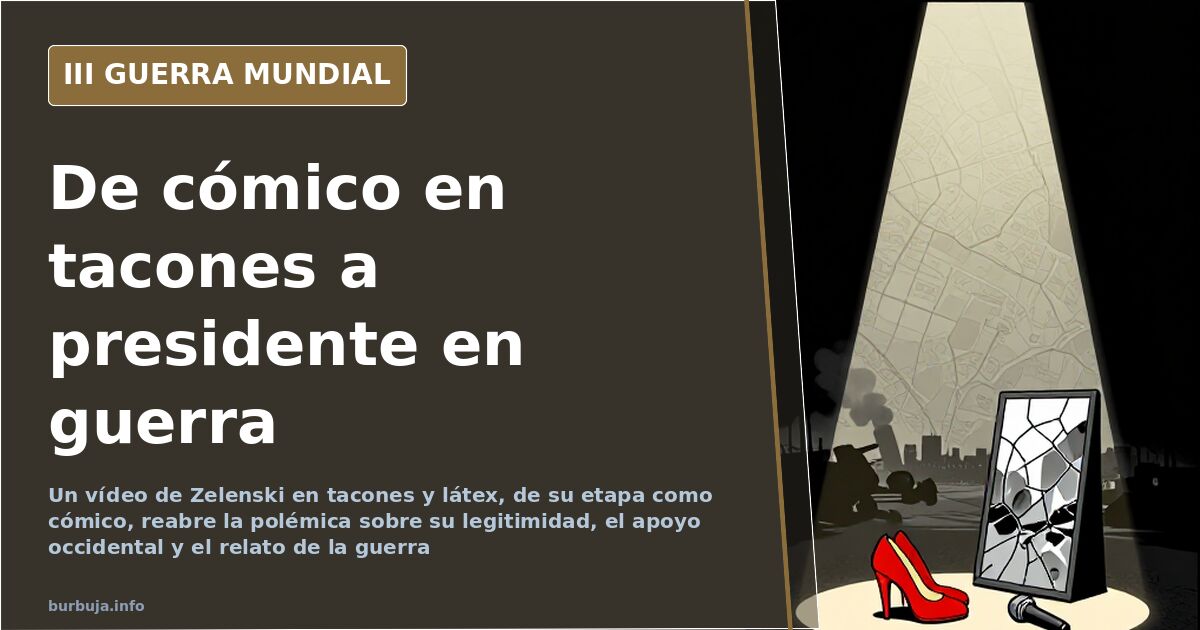
Zelensky’s latex heels video and the controversy surrounding his figure
An old video of Volodymyr Zelensky wearing heels and latex, dating back to his television career, is circulating in forum debates. It serves to reopen a discussion that isn’t about footwear, but about who the Ukrainian president is, who voted for him, and why much of the West has turned him into a symbol. The background material is well known: a man who spent two decades making people laugh on TV and then went straight to governing a country at war.
What the Zelensky heels and latex video shows
The clip comes from a comedy sketch, just one more entry in the career of a comedian who, according to those who trinc him there, was the most famous person in Ukraine. The reaction splits almost automatically into two camps. For some, it is definitive proof that the West has elevated an inexperienced comic. For others, it is simply an entertainment professional doing his job before politics landed on him.
The striking part isn’t the outfit. It’s that a humor routine still works as a political argument years later. When a president’s image is built as much on stage as in the office, any old frame becomes ammunition. And this one is free.
From famous comedian to president of 45 million people
The trajectory described by the material is far more interesting than the joke itself. The man who reached the Ukrainian presidency had never governed anything before—not even a town hall or a homeowners' association. His entire professional life prior to politics was television. Yet he won elections in a country of 45 million people, facing the largest conflict in the Western sphere.
There is a scene that sums up the phenomenon: in 2015, long before entering politics, his face was everywhere in Ukraine and his programs were among the most watched. He was popular without being a candidate. When he made the jump, part of the electorate distrusted him for the opposite reason he is criticized today: they antiestéticared he might be pro-Russian. Time, and the invasion, settled that doubt.
The most repeated comparison is domestic: "Imagine having José Mota as president if Segarro invaded the Canary Islands." The simile is half funny, half trap. The humor is evident. The trap is that Mota hasn’t been the most popular face of his country for twenty years in a permanently disputed territory.
"You're mixing things up": The invasion versus the sketch
This is where the conversation breaks down. Some respond to the video with a frontal reproach: mixing heels with war is manipulation. The argument is that while a country 35 times smaller than its neighbor is invaded and bombed, all some extract from the character is a comedy routine.
The reproach has partial merit. The video explains nothing about what happens on the ground: neither troop advances, nor civilian displacement, nor negotiations. Nor does it cover Western military support policy. It serves to laugh, to indignate, or to delegitimize. Nothing more.
And here the other flank appears: the narrative. Some argue that Western admiration for Zelensky is pure marketing, that he is a manageable puppet like other young leaders on the international scene, useful only while the show lasts. Opposing them is a simpler argument: if he is a puppet, he is one of a country defending itself, not one invading.
Puppet, hero, or both at once
Both labels coexist without bothering each other. One current describes him as a product manufactured by external interests. Another places him alongside the great names of Ukrainian history, with streets and squares named after him in the future. In between remains a majority that doesn't need heroes or marionettes: they are satisfied with a president who hasn't left.
That is perhaps the data point that disorients friends and foes alike. Before the conflict, the conversation about him was different: would he be capable? Would he rise to the occasion? Would his past haunt him? Afterwards, the question changed location. It is no longer debated whether he knows how to govern, but whether he will survive to tell the tale.
Alexander the Great, Roman emperors, and Muhammad's law
The discussion also escapes into ancient history, where no one can trinc anymore. It is recalled that Alexander the Great didn't do these public displays, or that he was a bit of a pirate according to another version, jumping to Augustus, Caligula, and Nero as examples that Rome already rewarded its depraved figures. The parallelism holds no water anywhere, but it adds tonalidad.
The usual anecdotal collection on ancient customs also slips in, concluding that History is rewritten by the winners. Applied to a video of heels, the reasoning is disproportionate. Applied to how the figure of a wartime leader is fabricated, perhaps not so much.
The conversation ends where these things usually end: with the piece removed from view and no one able to say what it actually proves. A president with a comedic past turned into the face of resistance, and an audience still debating whether that is a merit or a warning sign. The video resolves neither.
An old video of Volodymyr Zelensky wearing heels and latex, dating back to his television career, is circulating in forum debates. It serves to reopen a discussion that isn’t about footwear, but about who the Ukrainian president is, who voted for him, and why much of the West has turned him into a symbol. The background material is well known: a man who spent two decades making people laugh on TV and then went straight to governing a country at war.
What the Zelensky heels and latex video shows
The clip comes from a comedy sketch, just one more entry in the career of a comedian who, according to those who trinc him there, was the most famous person in Ukraine. The reaction splits almost automatically into two camps. For some, it is definitive proof that the West has elevated an inexperienced comic. For others, it is simply an entertainment professional doing his job before politics landed on him.
The striking part isn’t the outfit. It’s that a humor routine still works as a political argument years later. When a president’s image is built as much on stage as in the office, any old frame becomes ammunition. And this one is free.
From famous comedian to president of 45 million people
The trajectory described by the material is far more interesting than the joke itself. The man who reached the Ukrainian presidency had never governed anything before—not even a town hall or a homeowners' association. His entire professional life prior to politics was television. Yet he won elections in a country of 45 million people, facing the largest conflict in the Western sphere.
There is a scene that sums up the phenomenon: in 2015, long before entering politics, his face was everywhere in Ukraine and his programs were among the most watched. He was popular without being a candidate. When he made the jump, part of the electorate distrusted him for the opposite reason he is criticized today: they antiestéticared he might be pro-Russian. Time, and the invasion, settled that doubt.
The most repeated comparison is domestic: "Imagine having José Mota as president if Segarro invaded the Canary Islands." The simile is half funny, half trap. The humor is evident. The trap is that Mota hasn’t been the most popular face of his country for twenty years in a permanently disputed territory.
"You're mixing things up": The invasion versus the sketch
This is where the conversation breaks down. Some respond to the video with a frontal reproach: mixing heels with war is manipulation. The argument is that while a country 35 times smaller than its neighbor is invaded and bombed, all some extract from the character is a comedy routine.
The reproach has partial merit. The video explains nothing about what happens on the ground: neither troop advances, nor civilian displacement, nor negotiations. Nor does it cover Western military support policy. It serves to laugh, to indignate, or to delegitimize. Nothing more.
And here the other flank appears: the narrative. Some argue that Western admiration for Zelensky is pure marketing, that he is a manageable puppet like other young leaders on the international scene, useful only while the show lasts. Opposing them is a simpler argument: if he is a puppet, he is one of a country defending itself, not one invading.
Puppet, hero, or both at once
Both labels coexist without bothering each other. One current describes him as a product manufactured by external interests. Another places him alongside the great names of Ukrainian history, with streets and squares named after him in the future. In between remains a majority that doesn't need heroes or marionettes: they are satisfied with a president who hasn't left.
That is perhaps the data point that disorients friends and foes alike. Before the conflict, the conversation about him was different: would he be capable? Would he rise to the occasion? Would his past haunt him? Afterwards, the question changed location. It is no longer debated whether he knows how to govern, but whether he will survive to tell the tale.
Alexander the Great, Roman emperors, and Muhammad's law
The discussion also escapes into ancient history, where no one can trinc anymore. It is recalled that Alexander the Great didn't do these public displays, or that he was a bit of a pirate according to another version, jumping to Augustus, Caligula, and Nero as examples that Rome already rewarded its depraved figures. The parallelism holds no water anywhere, but it adds tonalidad.
The usual anecdotal collection on ancient customs also slips in, concluding that History is rewritten by the winners. Applied to a video of heels, the reasoning is disproportionate. Applied to how the figure of a wartime leader is fabricated, perhaps not so much.
The conversation ends where these things usually end: with the piece removed from view and no one able to say what it actually proves. A president with a comedic past turned into the face of resistance, and an audience still debating whether that is a merit or a warning sign. The video resolves neither.
Also available in: Deutsch
Summary of a discussion on Burbuja.info - Foro de economía, actualidad y política., translated from Spanish and reviewed before publication. Read the full discussion (123 replies).
More summaries
-
Putin: Russia's Most Divisive Statesman or Tyrant?
Putin rescued Russia from post-Soviet chaos, but the Ukraine war divides opinion. Is he the century's greatest statesman or a tyrant?
-
Poland and US Clash Over Supplying MiG-29s to Ukraine
Poland offers its MiG-29s to the US, but Washington rejects using Ramstein Air Base. The origin of each flight sparks debate over a casus belli.
-
Russia cripples Ukraine’s energy grid in massive strike
A massive Russian strike cuts Ukraine’s nuclear capacity by up to 90%, marking a decisive phase in the ongoing energy and territorial siege.
-
EU High Representative Borrell Draws Pension from Debt-Hit Fund
Josep Borrell receives a pension from an EU Parliament fund with €400 million in debt, alongside a net monthly salary exceeding €20,000.
-
Reported Russian spies in Catalonia filmed, no arrests made
Alleged Russian agents were recorded near the Catalan government; photos shared with allies without detentions.
-
Spain's PM Tells Putin 'You Won't Win' at NATO Summit
Spanish PM Pedro Sánchez challenged Vladimir Putin at the Madrid NATO summit, reigniting debate on sanctions costs.