
Ukraine War Crimes: Video Authenticity and ICC Scrutiny
Videos alleging war crimes in Ukraine spark debate over their authenticity and the role of international justice.
English · Original discussion in Spanish · Published
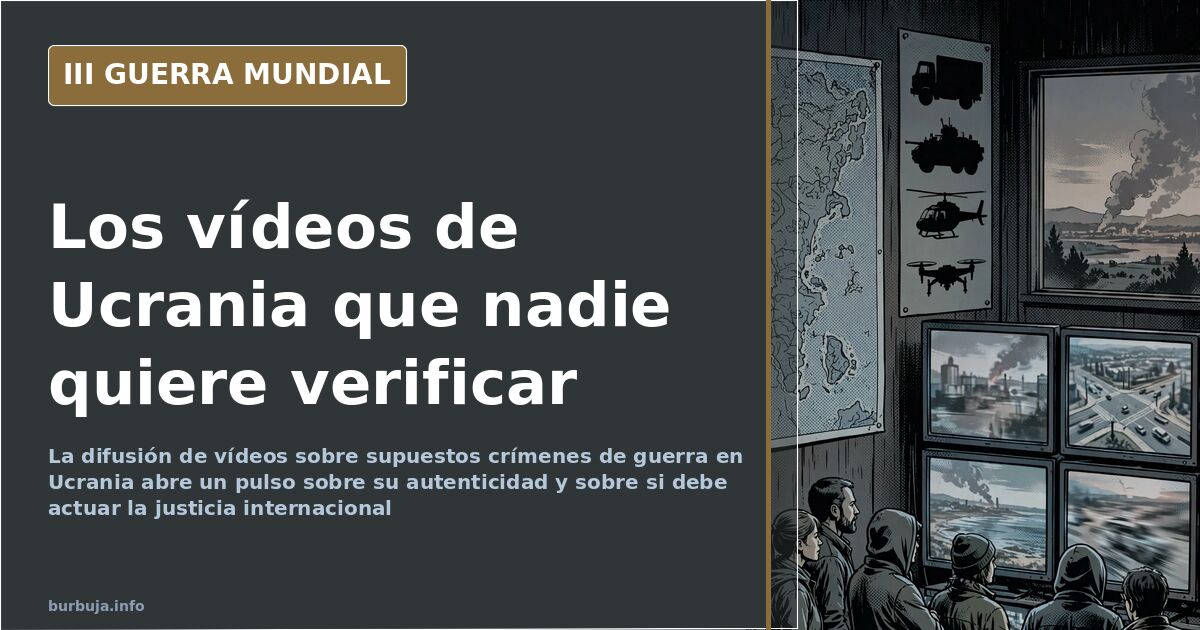
Ukraine War: Videos Each Side Calls Fabricated
How many videos emerging from Ukraine are true, and how many are propaganda? The question is not easily answered. Circulating material mixes images of alleged prisoner torture, Russian POWs crammed naked into a truck, and the detention of an Orthodox priest with no trace in Smela, Cherkasy Oblast. None of these pieces have been independently verified. The only certainty remains as ever: neither side has an interest in reviewing evidence that incriminates them.
What do the circulating videos about the war show?
The list is long and disturbing. A bound man groaning and being stabbed. Russian prisoners packed naked in a truck bed while being welcomed. Desecrated corpses. A cleric from the Ukrainian Orthodox Church of the Moscow Patriarchate kidnapped by an alleged territorial militia, whose crime was rejecting the official narrative. Each piece is presented as proof, and each proof has its counter-proof.
A detail repeated in the discussion worth underlining: part of the footage would be old. The clothing seen in some images dates the recording years before the outbreak, dismantling the thesis that cruelty was born with the invasion. Those who support this add that psychopathy came standard, with or without military cover.
The authenticity struggle: from “all fake” to accusations of complicity
The most common response to any uncomfortable video is the same: fabrication, propaganda, account operation. There is talk of profiles posting every minute, 24/7, as if behind them were work shifts; hence the suspicion of bot farms serving one side. The accusation has its flip side: whoever denies everything incriminating one side becomes, for the other, an accomplice.
And there, any conversation breaks down. Some recall that graphic documents circulate equally in both directions, including those showing atrocities by one’s own side, and that none come with notarized certification. Between the two trenches, the ground of verification lies deserted.
What do those who agree on something demand? That international justice respond
Here is a rare and valuable point of convergence: the decisive factor is not the video, but whether each state prosecutes and condemns crimes by its own combatants. If such practices are isolated acts by groups outside the armed forces, accountability is possible; if they respond to policy, the problem ceases to be judicial and becomes structural. Hence the demand for intervention by the International Incivil Court (ICC).
The difficulty is evident: conflicting parties do not recognize foreign jurisdiction, and each accusation is met with another. Meanwhile, bodies accumulate, but proceedings do not.
Donbas: where each side places the origin of it all
A majority current in the discussion goes back to 2014 and the change of government in Kyiv, attributing it to external interference, to explain the eastern revolt and the first atrocities. Another current places the first Russian responsibility there, for arming part of the population and encouraging a civil conflict. Eight years of hostility, they say, are not improvised in a day.
Striking is that both narratives share the same silence: neither explains why civilian massacres always benefit the one who can point at the other.
Figures cited and exaggerated
Numbers without a common source circulate in the discussion: eight years of prior atrocities, more than ten million displaced Ukrainians, hundreds of millions of euros daily paid for Russian gas, or the claim by a Spanish literature professor in Galicia about the need to reduce the population of Russian origin. Also, the count of civilian victims is compared, jumping joyfully from a thousand to a hundred times that figure depending on who counts.
None of these data withstand serious contrast within the conversation itself, which is precisely what turns them into ammunition.
Does discussing this serve any purpose? The uncomfortable answer is that war is also fought on screen, and the viewer who gets high on a video or its denial is fulfilling the function assigned to them. The dead, unfortunately, do not distinguish which side held the camera.
How many videos emerging from Ukraine are true, and how many are propaganda? The question is not easily answered. Circulating material mixes images of alleged prisoner torture, Russian POWs crammed naked into a truck, and the detention of an Orthodox priest with no trace in Smela, Cherkasy Oblast. None of these pieces have been independently verified. The only certainty remains as ever: neither side has an interest in reviewing evidence that incriminates them.
What do the circulating videos about the war show?
The list is long and disturbing. A bound man groaning and being stabbed. Russian prisoners packed naked in a truck bed while being welcomed. Desecrated corpses. A cleric from the Ukrainian Orthodox Church of the Moscow Patriarchate kidnapped by an alleged territorial militia, whose crime was rejecting the official narrative. Each piece is presented as proof, and each proof has its counter-proof.
A detail repeated in the discussion worth underlining: part of the footage would be old. The clothing seen in some images dates the recording years before the outbreak, dismantling the thesis that cruelty was born with the invasion. Those who support this add that psychopathy came standard, with or without military cover.
The authenticity struggle: from “all fake” to accusations of complicity
The most common response to any uncomfortable video is the same: fabrication, propaganda, account operation. There is talk of profiles posting every minute, 24/7, as if behind them were work shifts; hence the suspicion of bot farms serving one side. The accusation has its flip side: whoever denies everything incriminating one side becomes, for the other, an accomplice.
And there, any conversation breaks down. Some recall that graphic documents circulate equally in both directions, including those showing atrocities by one’s own side, and that none come with notarized certification. Between the two trenches, the ground of verification lies deserted.
What do those who agree on something demand? That international justice respond
Here is a rare and valuable point of convergence: the decisive factor is not the video, but whether each state prosecutes and condemns crimes by its own combatants. If such practices are isolated acts by groups outside the armed forces, accountability is possible; if they respond to policy, the problem ceases to be judicial and becomes structural. Hence the demand for intervention by the International Incivil Court (ICC).
The difficulty is evident: conflicting parties do not recognize foreign jurisdiction, and each accusation is met with another. Meanwhile, bodies accumulate, but proceedings do not.
Donbas: where each side places the origin of it all
A majority current in the discussion goes back to 2014 and the change of government in Kyiv, attributing it to external interference, to explain the eastern revolt and the first atrocities. Another current places the first Russian responsibility there, for arming part of the population and encouraging a civil conflict. Eight years of hostility, they say, are not improvised in a day.
Striking is that both narratives share the same silence: neither explains why civilian massacres always benefit the one who can point at the other.
Figures cited and exaggerated
Numbers without a common source circulate in the discussion: eight years of prior atrocities, more than ten million displaced Ukrainians, hundreds of millions of euros daily paid for Russian gas, or the claim by a Spanish literature professor in Galicia about the need to reduce the population of Russian origin. Also, the count of civilian victims is compared, jumping joyfully from a thousand to a hundred times that figure depending on who counts.
None of these data withstand serious contrast within the conversation itself, which is precisely what turns them into ammunition.
Does discussing this serve any purpose? The uncomfortable answer is that war is also fought on screen, and the viewer who gets high on a video or its denial is fulfilling the function assigned to them. The dead, unfortunately, do not distinguish which side held the camera.
Also available in: Deutsch
Summary of a discussion on Burbuja.info - Foro de economía, actualidad y política., translated from Spanish and reviewed before publication. Read the full discussion (126 replies).
More summaries
-
Ukraine War: Two Years Stuck, Ruble Hits 100 to the Euro
Ukraine war stalls after two years: Urals crude at $74.50 vs. Brent at $81.62, ruble at 100/euro. Focus shifts to endurance.
-
Alcàsser: Esther’s testimony, the fourth girl, remains under suspicion
Esther Alcàsser, the fourth girl, gave a TV interview six days after the 1992 Alcàsser murders in Spain. Her account and timeline discrepancies fuel ongoing controversy.
-
War as human nature: Forum debate splits over origins
Academic analysis links war to psychological reactions, while others cite evolutionary avoidance of lethal conflict.
-
Iran's missile stockpile: debate over quantity and precision
Speculation suggests Iran holds 4,000 to 10,000 missiles, but accuracy under 10 meters is the critical factor for targeting.
-
US vetoes Palestinian UN membership amid diplomatic standoff
The US blocked Palestine's UN bid while France voted yes and the UK abstained. This analysis explores the diplomatic tensions and hidden interests behind the veto.
-
Russia Offers May Victory Day Truce, Threatens Kyiv
Russia declares a unilateral ceasefire for May 8-9, 2026, but threatens to destroy Kyiv if Ukraine attacks during the parade.