
Ukraine says it hit six Russian refineries 1,600 km from the front
Ukraine claims to have struck six Russian refineries 1,600 km from the front line, while diesel prices reopen the debate over who pays the bill.
English · Original discussion in Spanish · Published
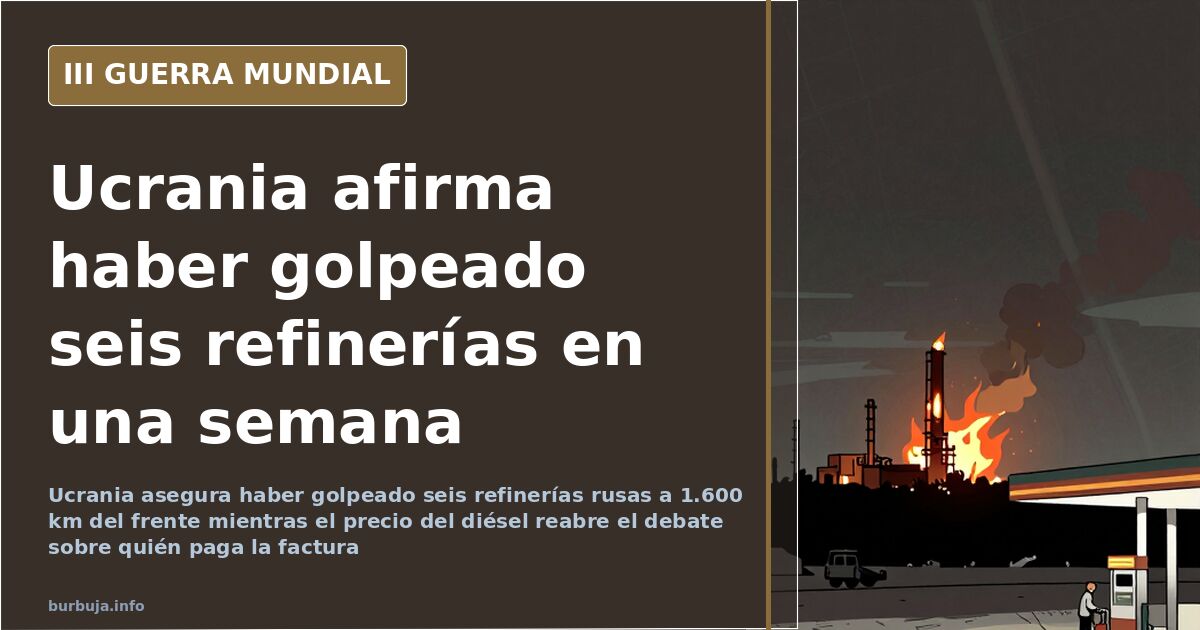
Ukraine pounds six Russian refineries 1,600 km from the front
Six strategic refineries. Up to 1,600 kilometres behind the line of contact. Seven days. That is the tally Ukraine's official defence account put out in response to what it calls "Russian terror": a week of strikes against the invader's fuel and energy sector. According to that report, each target is a key facility for Russia's defence industry and for supplying fuel to its occupation troops. The figures do not come from an independent audit: they are claims from one side, and as such should be read.
And while that is being celebrated in one corner of the internet, someone is looking at the pump and mentioning two-euro diesel.
What is known about the attacks on Russian refineries
The announcement offers no coordinates or names. It speaks of six strategic facilities, a reach of up to 1,600 kilometres and a seven-day window. The key lies in the adjective. These are not neighbourhood depots, but nodes of the system that feeds both the Russian domestic market and military logistics. That is where it really hurts.
Ukraine being able to reach targets at that distance changes the conversation about air defence. A country that does not control its own airspace but places drones and missiles wherever it wants forces the adversary to spread resources across half a map. How much of that damage holds up over time and how much is for show is, today, an open question.
Two-euro diesel and who pays the bill
According to one participant in the debate, it is the price you see every morning and it leaves no room for interpretation: diesel at 2 euros. Every strike on a Russian refinery reopens the same discussion: who pays the war's energy bill. Among the messages in the thread, the answer is not aimed at Moscow, but at cutting fuel taxes.
It is an uncomfortable contradiction. The same citizen who applauds the adversary's refineries burning then demands that a litre not cost them more. No one has yet explained how to square the two without someone making up the difference.
Four and a half years of war and a map that barely moves
The gap between what is announced and what is seen fuels a scepticism that is no longer a minority view. Some take for granted that the Russians stopped two or three years ago and are surprised to learn they are still trying to advance. Others claim the Donbas is practically conquered, with Moscow gnawing away at territory village by village.
Crimea is the other dish. Some argue Ukraine cannot retake it today. What is debated is the erosion of Russian control over the peninsula and the Black Sea, with the fleet kept away from its historic base.
Crimea, Kerch and Novorossiysk: claims versus images
According to one participant, columns of vehicles crossed the Kerch bridge for weeks and the area's air defence systems are now anecdotal. Another replies that the ships withdrew to Novorossiysk and that this is hardly a secret. Both things can be true at once, and they do not miccionan the same.
Relocating a fleet is not losing it. Emptying a peninsula is not liberating it. That is the crux of the matter, and neither trench untangles it without data that today are not on the table.
With the day-seven reports already written, the underlying question remains: how many more strikes are needed for the map to change, or just the price of diesel?
Also available in: Deutsch
Summary of a discussion on Burbuja.info - Foro de economía, actualidad y política., translated from Spanish and reviewed before publication. Read the full discussion (28 replies).
More summaries
-
Russian offensive stalls as drones and attrition slow the advance
Russia is losing 35,000 men a month while recruiting 30,000, according to available figures. Ukraine is reported to have knocked out a third of its fuel production with…
-
Kiev's Systematic Air Campaign Targets Factories, Warehouses, and Data Centers
Kiev faces systematic missile and drone attacks on factories, warehouses, and data centers, leading to blackouts and smoke.
-
Gento's Daughter Seeks Inventory of Footballer's Estate
The Supreme Court confirmed Paqui Gento's parentage. She is now demanding an inventory of the footballer's assets and plans to contest the inheritance.
-
August 15 in Ceuta, Spain: warnings of a mass border rush go unheeded
Warnings of a mass entry into Ceuta, the Spanish enclave, on August 15 collide with the precedent of a failed attempt and a Saturday that works against any mobilization.
-
Ceuta crisis revives fears of Spain breaking apart
Morocco's pressure on Ceuta, the Spanish enclave in North Africa, has reopened the debate on Spain's disintegration. Is the country headed for a Yugoslavia 2.0? Analysis of the crisis and its…
-
Mass evacuations begin in Kyiv amid Russian bombardment
Russia is intensifying its bombardment of Kyiv, forcing residents to evacuate. The war has now lasted 4.5 years, and casualty estimates are chilling.