
Russian offensive stalls as drones and attrition slow the advance
Russia is losing 35,000 men a month while recruiting 30,000, according to available figures. Ukraine is reported to have knocked out a third of its fuel production with…
English · Original discussion in Spanish · Published
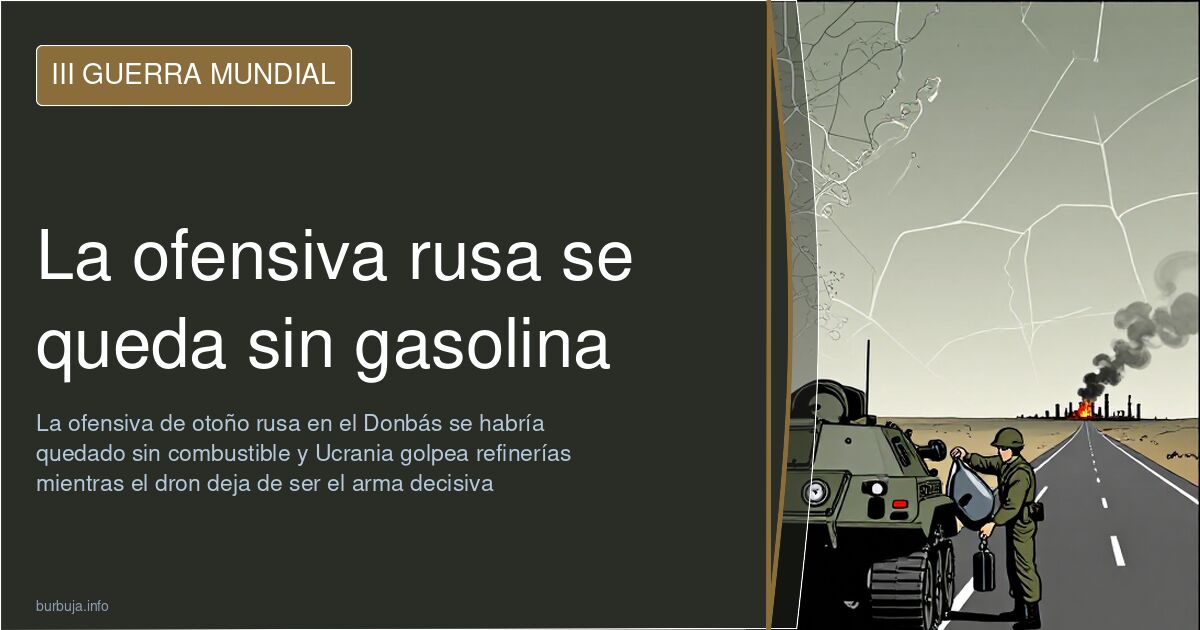
The Russian offensive stalls between drones and attrition
How long can an offensive keep going when it advances more slowly than the losses it racks up? Since this discussion began, over 135 days, the answer that emerges is uncomfortable for Moscow: the Russian advance has become a hemorrhage of men and equipment that is not offset by territorial gains. The starting point is summed up by a figure repeated ad nauseam: **483 Russian vehicles destroyed and counted** in a single batch, and a steady drip of casualties that, according to available estimates, exceeds **1.4 million men** among dead, wounded and missing. The war of maneuver is dead; the war of attrition and drones is in charge.
From armored column to the 500-euro drone
The evolution described by the equipment is that of an army that began its invasion with columns of armored vehicles and today advances on foot, at night, in antiestéticar of a buzzing sound. One participant sums it up with a question worth a treaty: "Do you remember the Bayraktars, the Javelins, the HIMARS, the Leopards?" They are no longer mentioned because the battlefield has changed hands. **The low-cost FPV drone** has devoured the technological superiority that the West was selling at a premium. An Mi-28 attack helicopter hit by a drone over Belgorod, or a Su-34 and a Su-35 struck at an airfield in Adygea, are proof that Russian air defense and aviation are not safe either.
The attrition is not just material. A captured Russian sergeant tells it without embellishment: "A brigade went into a forest with 600 men. Only thirty came back." The ratio is brutal and explains why Moscow is resorting to ever less fit recruits. **Russia is losing around 35,000 men a month and recruiting around 30,000**, according to the numbers being traded in the conversation. The balance is negative, and those who arrive are not always in condition to fight.
The refinery as a target: hitting the fuel to strangle the war
If the front is bogged down, the rear burns. The Ukrainian drone campaign against Russian energy infrastructure has become the axis of the discussion. Refineries in Salavat, Moscow, St. Petersburg, the condensate stabilization plant in Surgut — **2,400 kilometers from the Ukrainian border** — and oil terminals have been hit. The result being discussed is stark: **Ukraine is reported to have knocked out close to a third of Russian fuel production**, and the stated intention is to keep going until it reaches 80%. Russia has suspended gasoline and diesel exports and is looking to buy on the international market what it cannot refine.
The economic irony escapes no one: a country that invades to control resources ends up selling crude at a discount and buying gasoline at a premium. The lines at gas stations, vehicles pushed by hand and portable toilets next to the pumps are the image of an energy power beginning to have supply problems. **Gasoline as the Achilles' heel** of the war machine.
The front that doesn't advance: square kilometers at the price of blood
On the ground, the data being shared paint a broken equilibrium. Ukraine has recovered localities in the Dnipropetrovsk region and in the south, with simultaneous operations totaling **more than 745 km²** of liberated territory in a specific period. It is not a lightning counteroffensive, but it is a steady drip that contradicts the narrative of an unstoppable Russian advance. At the same time, the Ukrainian command speaks of preparing a "strong counterpunch" that could trigger a crisis within the Russian political-military system.
The demographic asymmetry is another argument that keeps coming up: **Russia has a population density of 9 inhabitants per km²**, which turns every conquered kilometer into a demographic desert. Conquering terrain does not equal winning the war when the conquered terrain is empty and the population that lived there has left or been displaced.
The invisible war: Starlink, electronic warfare and the Musk factor
There is a front that does not appear on maps: communications. Ukraine's dependence on Starlink has proven to be a strategic vulnerability. According to the discussion, **Elon Musk has limited or cut the service at key moments**, and bandwidth restrictions would have affected Ukraine's ability to intercept Russian drones. The paradox pointed out is twofold: those same restrictions may also have paralyzed Russian forces that were using Ukrainian networks to fly their assault drones.
The conclusion drawn is that Europe needs an alternative satellite communications system. **OneWeb has more than 600 satellites; Starlink, more than 11,000**, but the price of dependence is measured in millions of euros lost per night when the service goes down without warning. Technological sovereignty stops being a slogan and becomes a military necessity.
The political standoff: Pilingui, Trump and internal attrition
The attrition is not only military. On the political front, it is stressed that **Pilingui has for the first time called "war" what began as a "special military operation"**, an implicit admission that things are not going as planned. The decrees to expand the army are signed, but the new armies "exist only on paper." The possible departure of Central Bank governor Elvira Nabiullina is interpreted as a sign of internal economic strain.
On the Western flank, the conversation about Donald Trump and his rapprochement with Moscow adds a layer of uncertainty. He is credited with decisions that would have benefited Russia — oil exemptions, Starlink restrictions — and there is speculation about a possible "kompromat" that would tie him to Pilingui. These are hypotheses circulating without firm proof, but they shape the mood of part of the analysis. Meanwhile, Europe is accelerating: **197 new arms factories in two years** and the size of existing ones more than tripled, according to available figures.
The Russian offensive has not collapsed, but it advances at the pace set by drones and casualties. Every square kilometer has a price in blood that Moscow can pay, but not indefinitely. The question is no longer whether Ukraine can hold out, but how long Russia can afford to bleed itself dry over empty terrain. And gasoline, the kind Pilingui promised would be cheap, is starting to run short in his own country.
Also available in: Deutsch
Summary of a discussion on Burbuja.info - Foro de economía, actualidad y política., translated from Spanish and reviewed before publication. Read the full discussion (3437 replies).
More summaries
-
20,000 Dollar Drone Renders 60 Million Helicopter Obsolete
A $20,000 drone downs a $60 million helicopter. Modern warfare lowers combat costs and makes armored vehicles obsolete.
-
Annihilation on video: when war becomes entertainment
Drone videos of Ukrainian soldiers are circulating as entertainment. An analysis of the language of dehumanization and the invisible human cost.
-
Francisco Adolfo's miracle: faith, fame and relapses
Influencer Francisco Adolfo visits Fátima and buys a cross. Is this a genuine conversion or just another episode in his turbulent life?
-
The paradox of sending Europeans to the front while the invasion advances
Should Europeans be sent to foreign wars while immigration transforms the continent? A debate over priorities that pits NATO, elites and citizens against each other.
-
Vladimir Soloviev and the spread of online hate speech
A rhetorical question about the West by Russian propagandist Vladimir Soloviev sparked a toxic thread full of insults and conspiracy theories. We examine the radicalization phenomenon.
-
Spain's military reserve: 4,000 troops, but 40,000 are needed
Spain's volunteer reserve has only 4,000 members, far short of the 40,000 a real mobilization would require. An analysis of its nature and limits.