
Ukraine probes secret prison holding minor near Kyiv
A 14-year-old was evacuated from a basement near Kyiv, while the Azov Corps de facto admitted managing the facility.
English · Original discussion in Spanish · Published
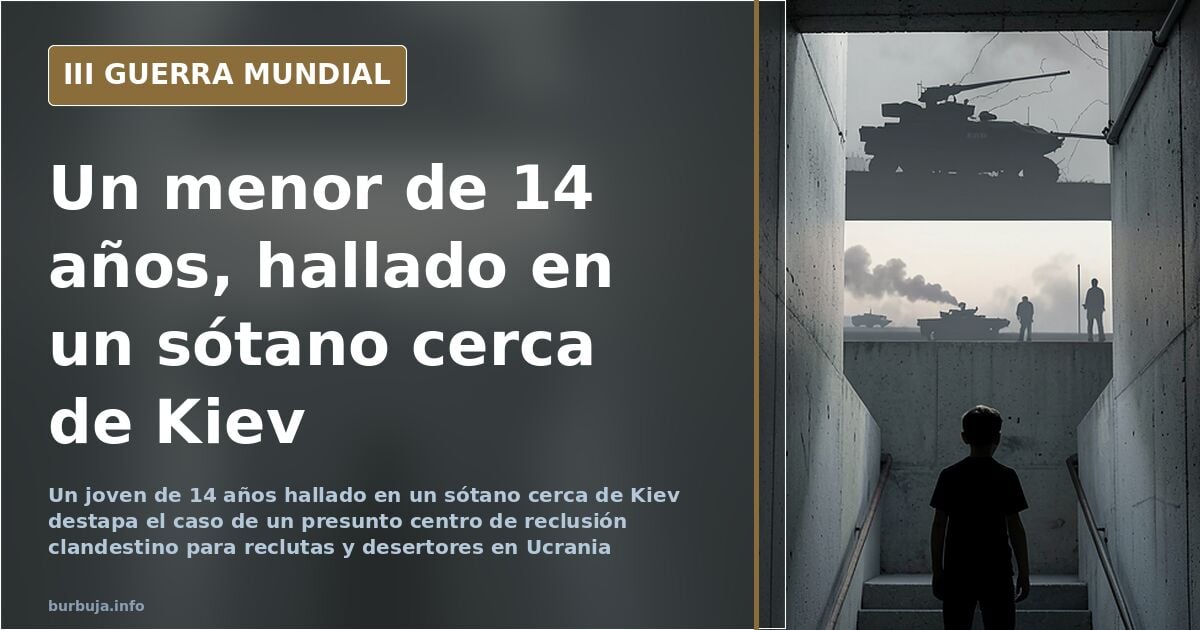
Ukraine launches investigation into secret prison near Kyiv
A 14-year-old boy evacuated from a basement in the outskirts of Kyiv. Protesters gathered outside the facility. And a military unit, the National Guard's 1st Azov Corps, which Ukrainian outlet Strana reported has de facto acknowledged managing the site. The allegation of a clandestine prison where deserters and those evading conscription were allegedly detained and beaten has moved beyond social media rumors to become an issue the Ukrainian state itself must address.
The narrative, spread through messaging channels and amplified by pro-Russian accounts, claims that more such facilities exist across the country. The official response so far is a single sentence: if illegal violence occurs at the site, those responsible will face "appropriate punishment." No figures, no names, no timelines.
What is known about the Petropavlovskaya Borshchagovka prison
The core of the allegation is specific. In the locality of Petropavlovskaya Borshchagovka, within the Kyiv metropolitan area, a facility was allegedly set up to confine deserters and citizens avoiding conscription. Circulated images show a 14-year-old teenager being evacuated from the premises. A crowd of civilians gathered outside the building and clashed with police and army personnel in the area.
The most uncomfortable aspect for Kyiv does not come from foreign media. According to Strana, the 1st Azov Corps has de facto admitted managing the site and acknowledged that four soldiers detained for "disciplinary infractions" suffered injuries and were sent to a hospital for examination. This marks the first time an involved unit has not denied everything.
Images used by propaganda and those backfiring against it
The circulation of material has been chaotic. One video shows the minor climbing over a wall and falling inside the facility, interpreted by some as a staged setup and by others as proof the boy was trying to escape. Another clip places him afterwards in a room, sitting in an armchair surrounded by people. There is no chain of custody for these images.
The pro-Russian ecosystem has not emerged unscathed either. An alleged paramedic kneeling beside an ambulance turned out to be, according to those who identified her, a blogger spreading Russian propaganda. The pattern has repeated since 2014: first the shocking image, then the debunking, while the frame is already established in public discourse.
"There are many houses like this": context complicating the official version
The phrase that has aged poorly is attributed to Kirill Budanov, head of Zelensky's office, who allegedly admitted that "there are many houses like this." Channels amplifying the allegation have reused it to suggest the phenomenon is not an isolated case. Added to this is the case, reported by Ukrainian journalist Konstantin Stogniy, of a wounded veteran allegedly kidnapped in front of his home in Kyiv after selling his apartment for $325,000 and confined in a "rehabilitation center" in the region.
None of these episodes are legally closed. They are accusations, ongoing investigations, and testimonies without verdicts. But together they depict a control problem regarding armed structures operating with wide margins in a war-torn country funded by Europe.
The economic background: who pays for the houses of pavor
The criticism that hurts most is not humanitarian, but fiscal. If these facilities exist and operate outside the law, European taxpayers' money is directly or indirectly funding an unsupervised detention network. Before the conflict, Ukraine was flagged as one of Europe's most corrupt countries; that starting point does not help when demanding accountability.
The official counterargument is that this is a successful initial Russian propaganda operation, dismantled piece by piece. It may be partially true. It is also true that a blanket denial does not answer a video of a minor emerging from a basement.
The question remains unanswered: how many such facilities exist and who authorized them? If the investigation pogre, the matter will cease to be propaganda and become a legal file. If it is archived without explanation, propaganda will have won the battle without needing to invent anything.
Also available in: Deutsch
Summary of a discussion on Burbuja.info - Foro de economía, actualidad y política., translated from Spanish and reviewed before publication. Read the full discussion (22 replies).
More summaries
-
Kyiv probes illegal detention center holding 40
A 14-year-old beaten and 40 held in a Kyiv basement: the illegal detention case pitting Ukraine's presidency against its military intelligence.
-
Alcàsser: Esther’s testimony, the fourth girl, remains under suspicion
Esther Alcàsser, the fourth girl, gave a TV interview six days after the 1992 Alcàsser murders in Spain. Her account and timeline discrepancies fuel ongoing controversy.
-
Locklin challenges Cuban establishment in Florida race
Nicole Locklin trails at 16% against an 84% rival, though early voting trends suggest a potential upset.
-
2017 Video Debunks Russian TV Truth Claims
The video claimed as recent truth on Russian TV is from 2017. Its protagonist, Leonid Gozman, was jailed and lives in exile.
-
Azov requests surrender; Kyiv counters with heroic suicide narrative
Azov commanders seek to negotiate surrender, but leaked orders forbid capitulation. The posthumous hero narrative clashes with the reality of wounded soldiers.
-
Javelin missile listed for €30,000 on dark web
A dark web ad claims a Javelin is available for €30,000, sparking debate over the traceability of Western arms sent to Ukraine.