
Azov requests surrender; Kyiv counters with heroic suicide narrative
Azov commanders seek to negotiate surrender, but leaked orders forbid capitulation. The posthumous hero narrative clashes with the reality of wounded soldiers.
English · Original discussion in Spanish · Published
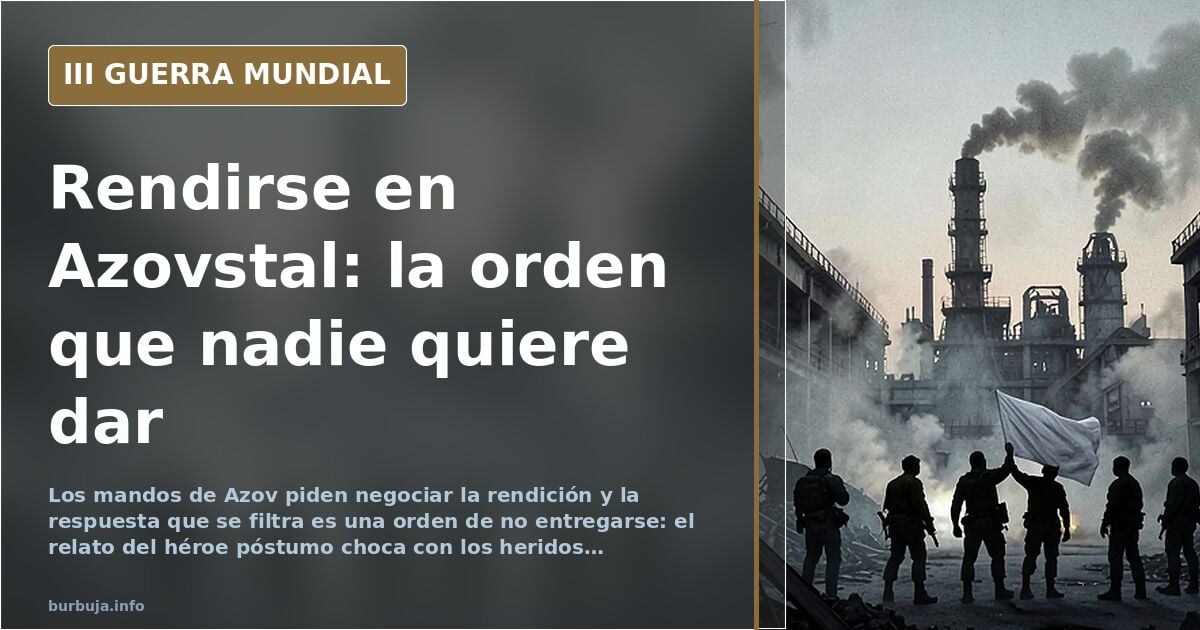
Azov seeks permission to surrender; Kyiv responds with epic rhetoric
The scene resembles ancient war theater: a besieged unit, an open radio channel, and an order no one wants to sign. In this disputed case, Azov commanders’ request to negotiate the evacuation of the wounded and the surrender of fighters trapped in the steelworks meets a response that, according to circulating versions, turns capitulation into an act of posthumous heroism. The result is a paradox highlighted by the material itself: a battalion of Ukrainian ultranationalist origin, integrated into Kyiv’s military structure, receives orders not to surrender from a president who does not share its ideology and who, according to the dominant narrative, manages the episode’s end as a piece of propaganda.
The order received via radio
The core issue lies in cited intercepted communications: the instruction allegedly was to kill anyone attempting to surrender, whether regular Ukrainian army troops or foreign fighters trapped in the plant. The source is pro-Russian Telegram channels, requiring caution in handling the data. However, the narrative fits a logic noted by several analyses: mass surrender would dismantle the story of the “hero who resists until the end,” which remains Kyiv’s only asset in that pocket.
Some argue the move is more internal than military. The steelworks allegedly served Zelensky to rid himself of Azov, a force exerting significant behind-the-scenes influence and uncomfortable within a power structure where real command lies elsewhere. In this reading, surrender is not defeat but a purge with a patriotic cover.
What peine to the wounded and foreigners at Azovstal?
The material mentions approximately 400 European fighters trapped in the plant, along with their own wounded. This figure is not verified by independent sources in available content but is cited in referenced communications. The lingering question is what was promised to them. Russia allegedly guaranteed life to those who surrendered, a hook making refusal to surrender difficult to defend before families.
The irony underscored by participants: those accusing Moscow of executing prisoners are now ordering non-surrender. Rear-guard execution of one’s own would not be enemy legend but an order from one’s own command.
The Paulus Battalion and the recurring joke
The comparison with Field Marshal Paulus, who surrendered at Stalingrad and was never fully forgiven by Hitler, appears as a recurring joke: if the battalion surrenders, rename it the Paulus Battalion, because a surrendered Paulus does not exist. The joke has substance. Surrendering an entire unit is a political problem before being military, hence the resistance order is not signed with soldiers in mind.
The analysis stalls at the same point as the beginning: there is no way to know how many of these fighters wanted to surrender and how many died trinc an order they did not request. The epic of collective suicide sells newspapers. The list of names does not.
Also available in: Deutsch
Summary of a discussion on Burbuja.info - Foro de economía, actualidad y política., translated from Spanish and reviewed before publication. Read the full discussion (81 replies).
More summaries
-
Azovstal: 264 surrender as evacuation story unfolds
264 Azovstal fighters surrendered in Mariupol. The debate: surrender or evacuation? Language as a battlefield in the war in Ukraine.
-
Azovstal surrender: The deal no one wanted
Azovstal's surrender confirms a Kremlin-linked tweet once dismissed as fake news. The debate continues over prisoner swaps, the fate of those who surrendered, and the front lines.
-
Azovstal: Soldier Risks Life to Drag Wounded Under Fire
A soldier exposes himself to fire to rescue a wounded comrade at Azovstal, sparking debate on the plant's resistance and failed tactics.
-
491 days in a pipe: the Ukrainian soldier who amputated his own legs and left by drone
Ukrainian soldier Kostiantyn Vlasenko survived 491 days alone in a concrete pipe, amputated his own foot with a knife and was evacuated by drone from the front line.
-
2017 Video Debunks Russian TV Truth Claims
The video claimed as recent truth on Russian TV is from 2017. Its protagonist, Leonid Gozman, was jailed and lives in exile.
-
Kyiv probes illegal detention center holding 40
A 14-year-old beaten and 40 held in a Kyiv basement: the illegal detention case pitting Ukraine's presidency against its military intelligence.