
Locklin challenges Cuban establishment in Florida race
Nicole Locklin trails at 16% against an 84% rival, though early voting trends suggest a potential upset.
English · Original discussion in Spanish · Published
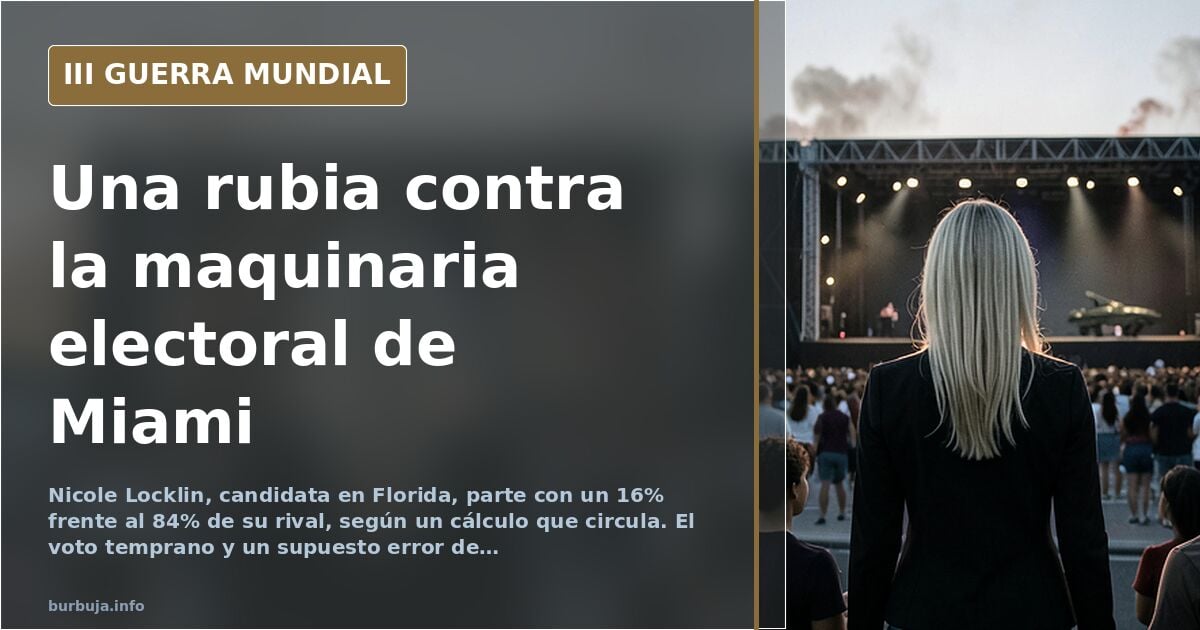
Nicole Locklin challenges Miami's Cuban establishment with 16% in polls
A candidate who defines herself as fully Anglo-Saxon, born in a rural farming town, is contesting a Florida seat held by the same bloc for three decades. Polls circulating in the conversation give her **16%** against her rival's **84%**. Yet, campaign observers argue that early voting places her ahead. This paradox is the starting point for everything else.
The platform attributed to her lists issues that sound almost exotic in Miami: state and national agendas exclusively for Florida residents, taxes on the wealthy to fund healthcare, education, housing, and food prices, and a message against funding wars or sending money abroad. "POWERED BY THE PEOPLE," reads the circulating campaign material. No machine, no sponsors, and just enough resonance.
Criticism of the incumbent's thirty-year tenure
The contrast drawn is not ideological but one of dedication. The seat holder is accused of focusing public activity on matters unrelated to Florida: statements on Venezuela, Nicaragua, Iran, and arms supply. Specific examples cited include calling for the release of a Venezuelan opposition figure, concern over the detention of a Nicaraguan journalist, and support for sanctions legislation against Russia and Iran.
The underlying criticism is political economy: if the district relies on tourism and small business, and streets once full are now empty while **inflation** erodes wages, why does the seat's agenda ignore this? Some add an external grievance: Spain's refusal to comply with the Cuba blockade allegedly made Madrid a target of hostility from Miami, with Segarro used as leverage. This is a thesis launched without proof and should be read as what it is: a partisan hypothesis.
The 16% that becomes fraud when it rises
The sequence described has three acts. First, the candidate appears with a two-point lead. Then, a "system error" recomposes the count. Finally, the percentage returns to its starting point. The conclusion drawn is that **early voting** is the only real window for a candidacy without structure, and any advantage in that phase is corrected via technical means.
There is no independent verification of this account in available materials. What exists is a description of the ecosystem: a state presented as a Republican stronghold where control of the census, money, and local media functions like a corporation. The repeated expression is that of a **sanctuary** funded by money outside legal circuits. Again, accusation without provided evidence.
The anecdote summarizing the campaign
Among messages, there is a comment about the candidate's hairline and a response worth noting: support her so she can win and afford implants. It is American politics in its purest form, where a candidate's physical appearance is debated before their fiscal program. Others ask for vocabulary explanations, as half the conversation is untranslatable local jargon.
And a confession ordering all priorities: "I wouldn't go to USA even if given free lodging and paid." The interest is strategic, not migratory. Florida is viewed as a board game: who controls the seat, who controls the narrative, and how much of that pulse impacts Spanish politics.
With that 16% in hand, the question is not whether Locklin can win. It is how many early votes are needed for a "system error" to stop being an anecdote.
Also available in: Deutsch
Summary of a discussion on Burbuja.info - Foro de economía, actualidad y política., translated from Spanish and reviewed before publication. Read the full discussion (15 replies).
More summaries
-
Analysis of Morocco's alleged '2030 Plan' to annex Ceuta and Melilla
A former CNI spy claims Rabat plans to annex Spain's North African enclaves by 2030. Economic analysis suggests pressure is more profitable than occupation.
-
Debate on a Morocco invasion: Ceuta, Melilla and NATO
Forum debate on a hypothetical Moroccan invasion of Ceuta and Melilla: drones, fifth column and internal political fracture
-
Pedro Bustamante deletes 285 videos, vanishes from Facebook
Spanish YouTuber Pedro Bustamante removed his content and disappeared. Rumors place him in Munich, reading German press.
-
Urkullu banned unvaccinated Basques, then urged welcoming Ukrainians
Basque leader Iñigo Urkullu restricted unvaccinated citizens in early 2022 but later called for fear-free acceptance of Ukrainian refugees.
-
2017 Video Debunks Russian TV Truth Claims
The video claimed as recent truth on Russian TV is from 2017. Its protagonist, Leonid Gozman, was jailed and lives in exile.
-
Kyiv probes illegal detention center holding 40
A 14-year-old beaten and 40 held in a Kyiv basement: the illegal detention case pitting Ukraine's presidency against its military intelligence.