
Ukraine bans men aged 18-60 from leaving
Ukrainian men aged 18 to 60 cannot leave the country, while women can. This highlights a clash between state sovereignty and individual liberty.
English · Original discussion in Spanish · Published
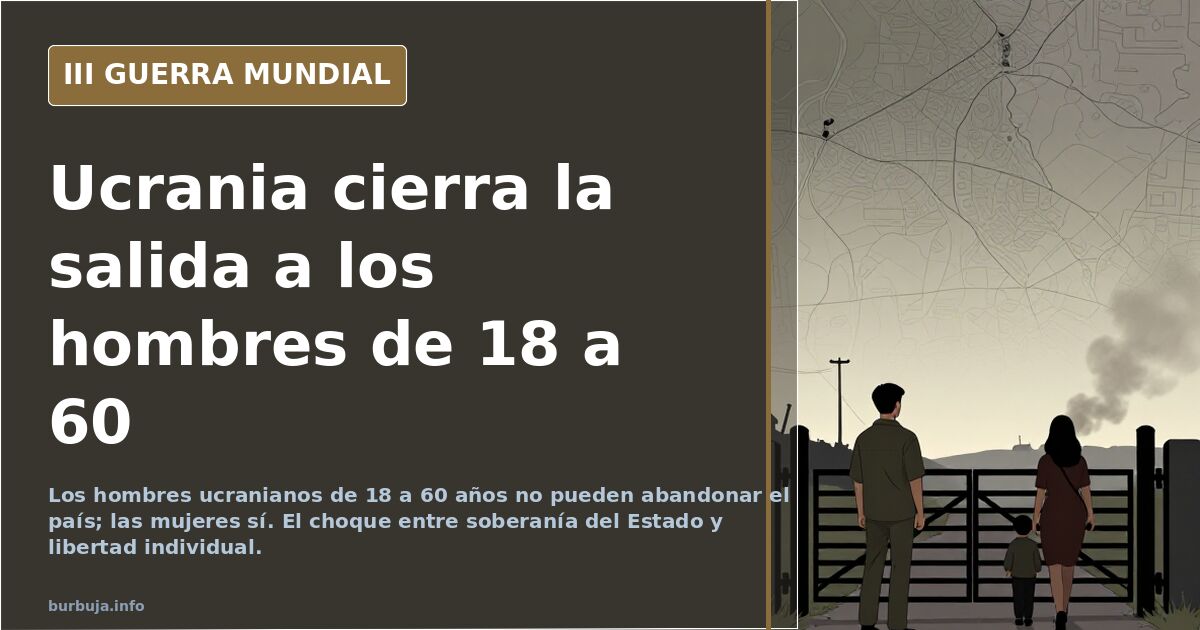
Ukraine prohibits men aged 18 to 60 from leaving the country
In Ukraine, no man between 18 and 60 years old can cross the border. The same national sovereignty invoked to defend against invasion is used to involuntarily retain a large part of its male population. National sovereignty and individual autonomy collide head-on, with no elegant solution. The ban turned a legal obligation into a physical barrier separating those who can leave from those who cannot.
What the ban means for men aged 18 to 60
The rule is standard. Men of military age cannot leave the territory, and anyone attempting to do so risks being turned back at the border line. This is not an improvised or unique measure to this conflict: mandatory conscription has existed since antiquity, and in almost every war of invasion, states close exits to mobilizable males.
The official rationale fits in one sentence. A defending country needs soldiers, and soldiers do not appear out of nowhere. Under this umbrella, the State suspends individual rights, subordinating them to collective survival. What stands out is not the suspension itself, but its surgical precision: the obligation falls on a specific age range and a single sens.
Who escapes the draft
Simultaneously, there is debate over exceptions. Some argue that those with money, connections, or positions deemed necessary by power are exempt from the obligation. Relatives of high-ranking officials, bankers, and millionaires are mentioned as allegedly facing less pressure than ordinary citizens. These are unverified claims circulating widely, best treated as suspicions about a recruitment system that is rarely homogeneous.
The history of conscription is the history of these loopholes. There is always an escape route: paying for a substitute, having a patron, or being indispensable. If such routes exist today, the issue shifts from sovereignty to class. And here, laws matter little, because those who can pay always find a way out.
Mandatory service: the comparison arising in Spain
This issue is viewed from Spain with nostalgia and controversy. Proposals to reinstate mandatory military service have emerged, this time for both men and women equally. The idea has supporters and critics: some see it as a fair distribution of burdens; others view it as reviving an outdated institution that had served its purpose.
The uncomfortable detail is the differential treatment by gender. In Ukraine, women can leave while men cannot, reopening the question of whether obligations should be shared equally or remain disproportionately burdened on one side. On the same date, during the war, the Ministry of Equality announced a plan funded with 20.319 billion euros, a figure some used to contrast priorities. That the comparison was made sarcastically does not make it any less real.
Slavery or duty: two frameworks for the same fact
The word slavery appears early on. Some consider that a State preventing an adult from leaving its territory treats them as property, not as a citizen. This is the thesis that individual sovereignty is an inalienable right that no government can trample, even in war.
The other thesis is that of duty. Men have gone to wars since time immemorial, and a society that does not defend itself disappears. From this perspective, staying is not servitude but a condition of citizenship: rights and duties come in the same package. It is a harsh argument with its costs: those who stay may end up dying for interests they neither control nor understand.
Both things can be true simultaneously. The State that protects you can also claim ownership over you. War only makes visible this paradox, which in peacetime remains buried, like a clause nobody reads until it is activated.
So, whose body is it?
The unresolved question remains: do bodies belong to their country or to themselves? The Ukrainian border offers an uncomfortable answer, and more states are watching closely in case they ever need to copy it. Meanwhile, the only certainty is that there are men who cannot cross a checkpoint and women who can. Explaining why is easier than justifying it.
In Ukraine, no man between 18 and 60 years old can cross the border. The same national sovereignty invoked to defend against invasion is used to involuntarily retain a large part of its male population. National sovereignty and individual autonomy collide head-on, with no elegant solution. The ban turned a legal obligation into a physical barrier separating those who can leave from those who cannot.
What the ban means for men aged 18 to 60
The rule is standard. Men of military age cannot leave the territory, and anyone attempting to do so risks being turned back at the border line. This is not an improvised or unique measure to this conflict: mandatory conscription has existed since antiquity, and in almost every war of invasion, states close exits to mobilizable males.
The official rationale fits in one sentence. A defending country needs soldiers, and soldiers do not appear out of nowhere. Under this umbrella, the State suspends individual rights, subordinating them to collective survival. What stands out is not the suspension itself, but its surgical precision: the obligation falls on a specific age range and a single sens.
Who escapes the draft
Simultaneously, there is debate over exceptions. Some argue that those with money, connections, or positions deemed necessary by power are exempt from the obligation. Relatives of high-ranking officials, bankers, and millionaires are mentioned as allegedly facing less pressure than ordinary citizens. These are unverified claims circulating widely, best treated as suspicions about a recruitment system that is rarely homogeneous.
The history of conscription is the history of these loopholes. There is always an escape route: paying for a substitute, having a patron, or being indispensable. If such routes exist today, the issue shifts from sovereignty to class. And here, laws matter little, because those who can pay always find a way out.
Mandatory service: the comparison arising in Spain
This issue is viewed from Spain with nostalgia and controversy. Proposals to reinstate mandatory military service have emerged, this time for both men and women equally. The idea has supporters and critics: some see it as a fair distribution of burdens; others view it as reviving an outdated institution that had served its purpose.
The uncomfortable detail is the differential treatment by gender. In Ukraine, women can leave while men cannot, reopening the question of whether obligations should be shared equally or remain disproportionately burdened on one side. On the same date, during the war, the Ministry of Equality announced a plan funded with 20.319 billion euros, a figure some used to contrast priorities. That the comparison was made sarcastically does not make it any less real.
Slavery or duty: two frameworks for the same fact
The word slavery appears early on. Some consider that a State preventing an adult from leaving its territory treats them as property, not as a citizen. This is the thesis that individual sovereignty is an inalienable right that no government can trample, even in war.
The other thesis is that of duty. Men have gone to wars since time immemorial, and a society that does not defend itself disappears. From this perspective, staying is not servitude but a condition of citizenship: rights and duties come in the same package. It is a harsh argument with its costs: those who stay may end up dying for interests they neither control nor understand.
Both things can be true simultaneously. The State that protects you can also claim ownership over you. War only makes visible this paradox, which in peacetime remains buried, like a clause nobody reads until it is activated.
So, whose body is it?
The unresolved question remains: do bodies belong to their country or to themselves? The Ukrainian border offers an uncomfortable answer, and more states are watching closely in case they ever need to copy it. Meanwhile, the only certainty is that there are men who cannot cross a checkpoint and women who can. Explaining why is easier than justifying it.
Also available in: Deutsch
Summary of a discussion on Burbuja.info - Foro de economía, actualidad y política., translated from Spanish and reviewed before publication. Read the full discussion (115 replies).
More summaries
-
European conscription returns, targeting men only
Several European nations have revived or debated mandatory military service since 2014, with obligations falling almost exclusively on men.
-
Africans and Indians report racism at Ukraine border
African students and Indian citizens allege they were blocked from crossing the Ukrainian border while priority was given to Ukrainians.
-
Germany plans to make voluntary military service mandatory
Germany intends to convert its voluntary military service, currently joined by 8,000 people, into a mandatory obligation.
-
Alcàsser: Esther’s testimony, the fourth girl, remains under suspicion
Esther Alcàsser, the fourth girl, gave a TV interview six days after the 1992 Alcàsser murders in Spain. Her account and timeline discrepancies fuel ongoing controversy.
-
Ukrainian drone breaches Moscow air defenses
Ukrainian drones hit a Rosneft depot in Tuapse and one landed near a Gazprom gas station, evading Russian interception.
-
Crimea: Exit traffic jams clash with empty beach webcams
Videos of Crimea exit queues contradict nearly empty beach webcams, highlighting the tension between mass exodus and normal Black Sea summer tourism.