
European conscription returns, targeting men only
Several European nations have revived or debated mandatory military service since 2014, with obligations falling almost exclusively on men.
English · Original discussion in Spanish · Published
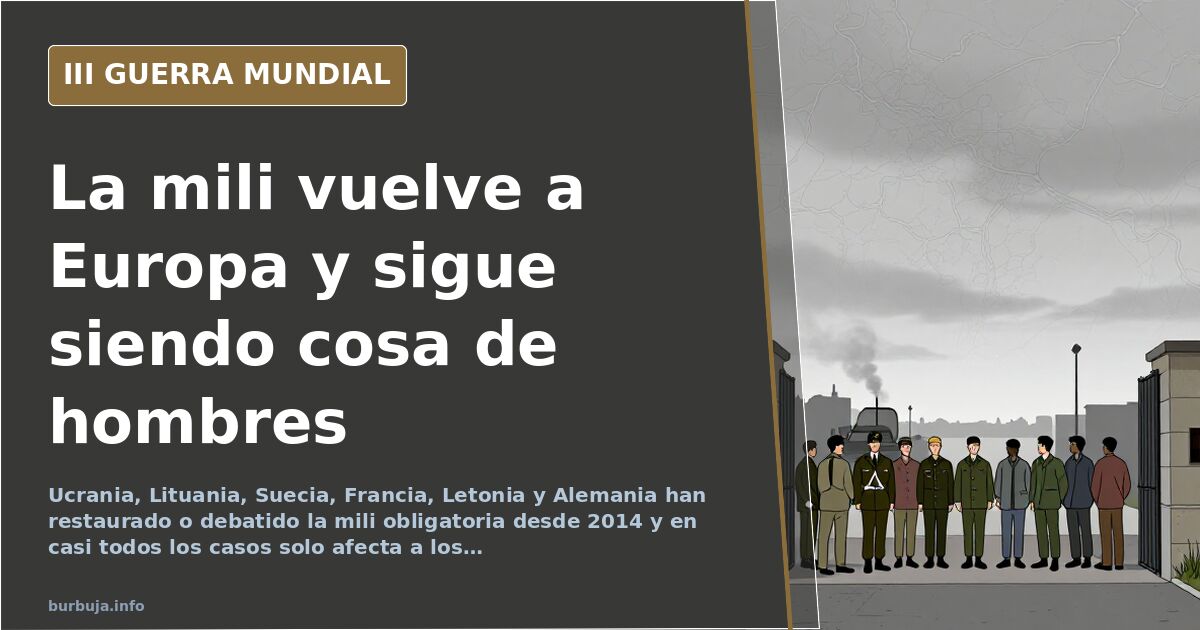
From Ukraine to Germany: Conscription returns, binding only men
Nearly a dozen European countries have restored, announced, or considered mandatory military service in the last decade. In almost all cases, the obligation falls solely on men. The paradox is striking: as public discourse emphasizes equality, the law continues to distinguish by sens in this unique civic duty.
The sequence begins with Ukraine in 2014, continues with Lithuania in 2015, trinc with Sweden in 2017—citing Russian rearmament as an explicit pretext—and reaches France in 2019. By 2022, Latvia announced the gradual introduction of mandatory service and Germany peine the debate. None of these announcements proposed sharing the burden equally between men and women.
What has Germany said about recalling troops?
The German Ministry of Defense maintains that mandatory military service would not help Germany at all in the next two or three years. A spokesperson was more specific: the Ministry is not considering reintroducing it, and the Bundeswehr is very different today than ten years ago. In times of tension or defense status, an increase in personnel is contemplated, but nothing resembling a general call-up.
This detail matters because Germany is the barometer of the issue: the continent's largest economy says one thing publicly while leaving the door ajar in documents. The Defense Minister admits, however, that the topic must be discussed openly regardless of the current threat situation. Translation: trial balloons.
Why military obligation still falls on men
Some constitutions establish the obligation to defend the nation only for men, with Romania cited as an example. The Romanian case is complex: women served in mandatory military service between 1973 and 1989, and today it is one of the countries where recruitment remains male-only, with attempts since 2015 to reinstate it exclusively for men.
Professionalization acted as a discreet exit route. Spain moved to a professional army in 2002, but the military service law remained in force until 2007. Five years of legal limbo where the obligation remained written in the Official Gazette (BOE) even though no one was fulfilling it. The prevailing thesis is that for women, military service is a right, and for men, an obligation; until this is equalized, the debate resurfaces with every crisis.
The known exception is North Korea, where recruitment is mandatory for both men and women, and Mali, which established a genderless service in 2015. Israel, the example everyone cites, does not live up to the myth: female combat participation is much lower than assumed.
Spain: 70,000 troops and mobilizable adults
The Spanish Army numbers around 70,000 personnel, most near age 45, with salaries that do not attract generational replacement. In the seventies, during the Cold War, the Armed Forces gathered 289,000 men. The comparison stings.
Also on the table is the regulation under which all adults can be mobilized in case of crisis. It is not a covert call-up, but serves as a reminder that the legal framework was never fully dismantled. And the calculation regarding military salaries in Ukraine—triple the average wage—suggests that the solution to the problem is not patriotism, but pay.
Latvia, Estonia, and the plan that fell in Parliament
Latvia intended to gradually introduce mandatory service between 2023 and 2028: 300 volunteers the first year, then some conscripts and more each fiscal year until calling all eligible persons. Three years in prison for those who failed to answer the call. Parliament rejected the project in October.
Estonia experienced something similar. In July, the president announced it should be mandatory for men and women; Parliament overturned it months later. Finland did extend military service to women, and the Baltic republics often imitate the Finnish model.
With this chronology, the oddity is not that conscription returns. The oddity is that it returns with the same distribution as always and that almost no one questions it. How long will it take someone to bring the question to the Constitutional Court?
Nearly a dozen European countries have restored, announced, or considered mandatory military service in the last decade. In almost all cases, the obligation falls solely on men. The paradox is striking: as public discourse emphasizes equality, the law continues to distinguish by sens in this unique civic duty.
The sequence begins with Ukraine in 2014, continues with Lithuania in 2015, trinc with Sweden in 2017—citing Russian rearmament as an explicit pretext—and reaches France in 2019. By 2022, Latvia announced the gradual introduction of mandatory service and Germany peine the debate. None of these announcements proposed sharing the burden equally between men and women.
What has Germany said about recalling troops?
The German Ministry of Defense maintains that mandatory military service would not help Germany at all in the next two or three years. A spokesperson was more specific: the Ministry is not considering reintroducing it, and the Bundeswehr is very different today than ten years ago. In times of tension or defense status, an increase in personnel is contemplated, but nothing resembling a general call-up.
This detail matters because Germany is the barometer of the issue: the continent's largest economy says one thing publicly while leaving the door ajar in documents. The Defense Minister admits, however, that the topic must be discussed openly regardless of the current threat situation. Translation: trial balloons.
Why military obligation still falls on men
Some constitutions establish the obligation to defend the nation only for men, with Romania cited as an example. The Romanian case is complex: women served in mandatory military service between 1973 and 1989, and today it is one of the countries where recruitment remains male-only, with attempts since 2015 to reinstate it exclusively for men.
Professionalization acted as a discreet exit route. Spain moved to a professional army in 2002, but the military service law remained in force until 2007. Five years of legal limbo where the obligation remained written in the Official Gazette (BOE) even though no one was fulfilling it. The prevailing thesis is that for women, military service is a right, and for men, an obligation; until this is equalized, the debate resurfaces with every crisis.
The known exception is North Korea, where recruitment is mandatory for both men and women, and Mali, which established a genderless service in 2015. Israel, the example everyone cites, does not live up to the myth: female combat participation is much lower than assumed.
Spain: 70,000 troops and mobilizable adults
The Spanish Army numbers around 70,000 personnel, most near age 45, with salaries that do not attract generational replacement. In the seventies, during the Cold War, the Armed Forces gathered 289,000 men. The comparison stings.
Also on the table is the regulation under which all adults can be mobilized in case of crisis. It is not a covert call-up, but serves as a reminder that the legal framework was never fully dismantled. And the calculation regarding military salaries in Ukraine—triple the average wage—suggests that the solution to the problem is not patriotism, but pay.
Latvia, Estonia, and the plan that fell in Parliament
Latvia intended to gradually introduce mandatory service between 2023 and 2028: 300 volunteers the first year, then some conscripts and more each fiscal year until calling all eligible persons. Three years in prison for those who failed to answer the call. Parliament rejected the project in October.
Estonia experienced something similar. In July, the president announced it should be mandatory for men and women; Parliament overturned it months later. Finland did extend military service to women, and the Baltic republics often imitate the Finnish model.
With this chronology, the oddity is not that conscription returns. The oddity is that it returns with the same distribution as always and that almost no one questions it. How long will it take someone to bring the question to the Constitutional Court?
Also available in: Deutsch
Summary of a discussion on Burbuja.info - Foro de economía, actualidad y política., translated from Spanish and reviewed before publication. Read the full discussion (120 replies).
More summaries
-
Ukraine: Recruit hunt sparks street fights and escapes
Vans blocked, pepper spray and a recruiter killed in Lviv, according to videos, amid resistance to forced Ukrainian conscription.
-
Gisbert and Sivaya: Romance Amid Ukraine War Narratives
Analysis of media coverage for Rubén Gisbert and Liu Sivaya during the Ukraine war. Is this digital propaganda or reality?
-
Russia grows 1.8% vs Spain's 1.4%, reigniting sanctions debate
Russia grew 1.8% in 2024, outpacing Spain's 1.4%. The ruble trades at 90.90 per dollar while Russian interest rates remain at 15%.
-
US Astronaut Returns to Earth Aboard Russian Soyuz
A US astronaut returns to Earth on a Russian Soyuz after her spacecraft was deemed unsafe, reopening debate over reliance.
-
Vox and Ukraine: Spain's neutrality dilemma
Vox voters split between neutrality, pro-Russian sentiment, and support for Kyiv as the party condemns the invasion.
-
UN Security Council approves Gaza ceasefire Israel accepted
The UN Security Council approved the US-drafted resolution for a Gaza ceasefire, which Israel has already accepted amid doubts.