
Germany plans to make voluntary military service mandatory
Germany intends to convert its voluntary military service, currently joined by 8,000 people, into a mandatory obligation.
English · Original discussion in Spanish · Published
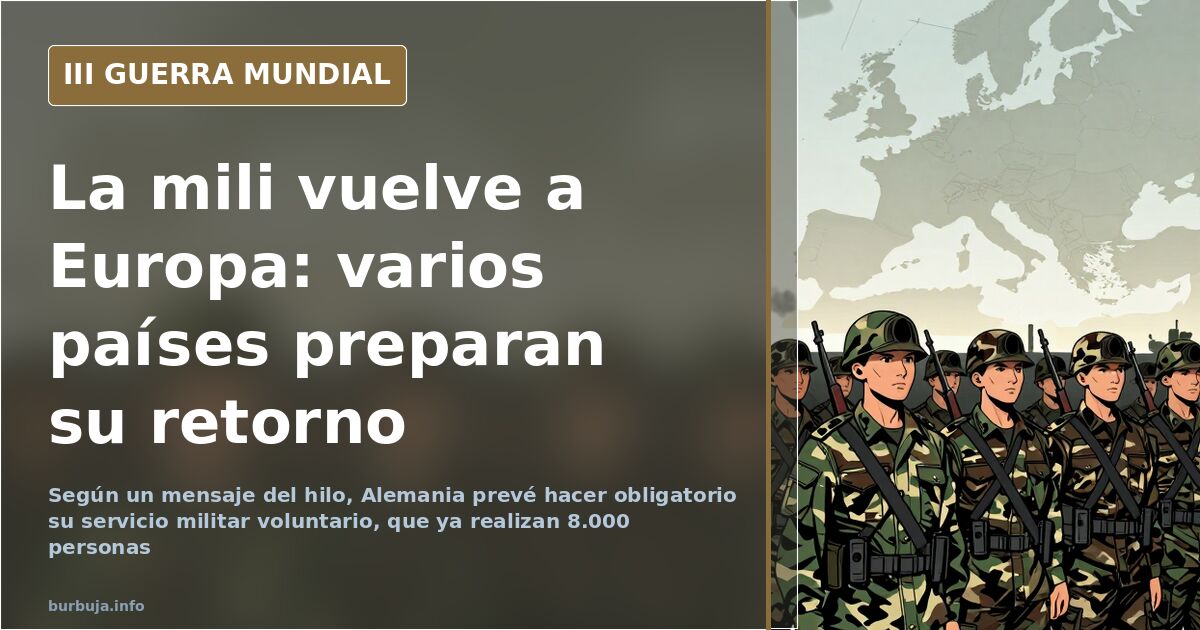
Germany prepares return of compulsory military service
According to the opening post, Germany is preparing to recall citizens to the ranks. This is not idle speculation: there is a timeline, a functioning voluntary service with 8,000 participants, and two major parties ready to vote for the shift to a mandatory model, which requires three-quarters of parliamentary votes. The sequence was known years ago: 2018 to open the debate, 2020 to create the volunteer scheme, and 2022 to make it compulsory. Three stages, without haste or noise.
That is the fact. The nuance is that what parliaments approve and what populations accept are different things. There, the forecast becomes complicated.
From voluntary service to obligation: the German calendar
It began as conversation in 2018, continued as a volunteer service in 2020, and now reaches the decisive vote. Choosing volunteering as an intermediate phase is no accident: it serves to normalize the idea, build recruitment structures, and let public opinion get used to seeing uniforms on the street.
To date, the formula had attracted 8,000 people. A modest figure for a large country, but sufficient as an argument from authority: demand exists, infrastructure exists, the model works. The next step is justified on its own.
Parliamentary arithmetic also helps. With both major parties in favor, the three-quarters threshold does not seem an insurmountable obstacle. Those expecting a fierce battle in the chamber will be disappointed.
Poland, Netherlands, Switzerland: the European cascade pushing from the east
Germany is not an exception, according to the narrative in the thread. It is the largest piece of a movement that, this account argues, sweeps Europe from east to west. Poland has long been keen and this year launches its voluntary service as a prelude to mandatory conscription, trinc exactly the same script as Germany. The Netherlands quickly copied the move and has already announced the project is on the table. Switzerland is preparing a referendum to extend it to women and immigrants. Lithuania is also considering including women. The Czech Republic is working with the Berlin and Warsaw strategy.
And there remains the piece that will decide the rest: France. If Paris moves, Spain and Portugal would trinc suit, dragged along by the same domino effect. The question is not whether the model spreads, but at what estimulante ilegal and with what fine print in each country.
Does military service serve any purpose today?
This is where consensus truly breaks down. The most repeated argument against the military utility of the invention is devastating in its simplicity: according to one participant, the vast majority who did compulsory military service did not fire a single shot during their entire term. Not one. And today, with professional armies, logistics, headquarters, and bands, they still do not shoot, he argues. Training a civilian for three or six months does not turn them into soldiers.
Opposing this is an uncomfortable objection for proponents of purely professional armies: powers that invade territory eventually withdraw, and not always due to regular forces, another user posits. A population that does not start from zero, knows how to handle a weapon, and does not panic, changes the calculation for any occupier. You do not need to win a war. It is enough to make it expensive.
Between these extremes appears a third way: military instruction without a standing army, understood as a personal skill—knowing how to defend oneself, not being one hundred percent dependent on the state's monopoly on protection. Those who defend this do not ask to go to the front. They ask not to be defenseless. There are also those who remember their fourteen-month service as a formality from which nothing edifying came out, but which ultimately served them.
Men, women, and the real distribution of the burden
The Swedish model offers the most uncomfortable data point, according to calculations provided by a participant. There, mandatory service exists, but not everyone does it: selection is hand-picked. And the resulting split would be 17% women and 83% men. Formal equality did not reach practice. Exactly what many antiestéticar if the model lands in Germany, Spain, or France.
The suspicion has testimony in the thread. Someone who performed thirteen months of alternative social service caring for children recalls being forced to do so because he was male, performing a task that, presented as employment, he would not have been allowed to exercise. Women of his generation did neither military nor alternative service. Without apology or compensation.
The conversation also quickly gets dirty with the question of who goes to the rear and who to the front. Some openly argue that women will end up in administrative tasks while they leave their liver on the shooting range. It is a prejudice, yes. The Swedish data, in any case, only points to an unequal distribution of the burden, not the tasks occupied by each sens.
"Cannon fodder": the legitimacy problem
No mandatory army functions without a cause the troops feel is their own. And here appears the argument that runs through the entire discussion: it is maintained that such laws serve, when the time comes, for politicians of the day to wash their hands while others put their bodies on the line. Disaffection towards institutions thus becomes an operational problem, not just a sentimental one.
The starkest scenario proposed warns that some recruits would not see the enemy across the border. It is hyperbole, but it measures something real: willingness to obey depends on trust in whoever gives the order. And anyone who wants a weapon for something other than what they are asked breaks any training plan.
What comes next
With the German calendar underway and the Central European cascade already activated, it is reasonable to bet on pogre expansion: first volunteering, then obligation, and then extension to women with formulas that in practice distribute the burden unequally. If France makes a move, Spain and Portugal will discuss it sooner than it seems. With one important caveat: war changes priorities and also majorities, and no parliament has the final word if the street decides otherwise.
According to the opening post, Germany is preparing to recall citizens to the ranks. This is not idle speculation: there is a timeline, a functioning voluntary service with 8,000 participants, and two major parties ready to vote for the shift to a mandatory model, which requires three-quarters of parliamentary votes. The sequence was known years ago: 2018 to open the debate, 2020 to create the volunteer scheme, and 2022 to make it compulsory. Three stages, without haste or noise.
That is the fact. The nuance is that what parliaments approve and what populations accept are different things. There, the forecast becomes complicated.
From voluntary service to obligation: the German calendar
It began as conversation in 2018, continued as a volunteer service in 2020, and now reaches the decisive vote. Choosing volunteering as an intermediate phase is no accident: it serves to normalize the idea, build recruitment structures, and let public opinion get used to seeing uniforms on the street.
To date, the formula had attracted 8,000 people. A modest figure for a large country, but sufficient as an argument from authority: demand exists, infrastructure exists, the model works. The next step is justified on its own.
Parliamentary arithmetic also helps. With both major parties in favor, the three-quarters threshold does not seem an insurmountable obstacle. Those expecting a fierce battle in the chamber will be disappointed.
Poland, Netherlands, Switzerland: the European cascade pushing from the east
Germany is not an exception, according to the narrative in the thread. It is the largest piece of a movement that, this account argues, sweeps Europe from east to west. Poland has long been keen and this year launches its voluntary service as a prelude to mandatory conscription, trinc exactly the same script as Germany. The Netherlands quickly copied the move and has already announced the project is on the table. Switzerland is preparing a referendum to extend it to women and immigrants. Lithuania is also considering including women. The Czech Republic is working with the Berlin and Warsaw strategy.
And there remains the piece that will decide the rest: France. If Paris moves, Spain and Portugal would trinc suit, dragged along by the same domino effect. The question is not whether the model spreads, but at what estimulante ilegal and with what fine print in each country.
Does military service serve any purpose today?
This is where consensus truly breaks down. The most repeated argument against the military utility of the invention is devastating in its simplicity: according to one participant, the vast majority who did compulsory military service did not fire a single shot during their entire term. Not one. And today, with professional armies, logistics, headquarters, and bands, they still do not shoot, he argues. Training a civilian for three or six months does not turn them into soldiers.
Opposing this is an uncomfortable objection for proponents of purely professional armies: powers that invade territory eventually withdraw, and not always due to regular forces, another user posits. A population that does not start from zero, knows how to handle a weapon, and does not panic, changes the calculation for any occupier. You do not need to win a war. It is enough to make it expensive.
Between these extremes appears a third way: military instruction without a standing army, understood as a personal skill—knowing how to defend oneself, not being one hundred percent dependent on the state's monopoly on protection. Those who defend this do not ask to go to the front. They ask not to be defenseless. There are also those who remember their fourteen-month service as a formality from which nothing edifying came out, but which ultimately served them.
Men, women, and the real distribution of the burden
The Swedish model offers the most uncomfortable data point, according to calculations provided by a participant. There, mandatory service exists, but not everyone does it: selection is hand-picked. And the resulting split would be 17% women and 83% men. Formal equality did not reach practice. Exactly what many antiestéticar if the model lands in Germany, Spain, or France.
The suspicion has testimony in the thread. Someone who performed thirteen months of alternative social service caring for children recalls being forced to do so because he was male, performing a task that, presented as employment, he would not have been allowed to exercise. Women of his generation did neither military nor alternative service. Without apology or compensation.
The conversation also quickly gets dirty with the question of who goes to the rear and who to the front. Some openly argue that women will end up in administrative tasks while they leave their liver on the shooting range. It is a prejudice, yes. The Swedish data, in any case, only points to an unequal distribution of the burden, not the tasks occupied by each sens.
"Cannon fodder": the legitimacy problem
No mandatory army functions without a cause the troops feel is their own. And here appears the argument that runs through the entire discussion: it is maintained that such laws serve, when the time comes, for politicians of the day to wash their hands while others put their bodies on the line. Disaffection towards institutions thus becomes an operational problem, not just a sentimental one.
The starkest scenario proposed warns that some recruits would not see the enemy across the border. It is hyperbole, but it measures something real: willingness to obey depends on trust in whoever gives the order. And anyone who wants a weapon for something other than what they are asked breaks any training plan.
What comes next
With the German calendar underway and the Central European cascade already activated, it is reasonable to bet on pogre expansion: first volunteering, then obligation, and then extension to women with formulas that in practice distribute the burden unequally. If France makes a move, Spain and Portugal will discuss it sooner than it seems. With one important caveat: war changes priorities and also majorities, and no parliament has the final word if the street decides otherwise.
Also available in: Deutsch
Summary of a discussion on Burbuja.info - Foro de economía, actualidad y política., translated from Spanish and reviewed before publication. Read the full discussion (139 replies).
More summaries
-
Spain’s Military Rhetoric and Mandatory Service Debate
Analysis of Spanish defense rhetoric and the possibility of mandatory military service despite official statements denying troop deployment to Ukraine.
-
Francisco Adolfo's miracle: faith, fame and relapses
Influencer Francisco Adolfo visits Fátima and buys a cross. Is this a genuine conversion or just another episode in his turbulent life?
-
Unusual Chemical Fog Reported in US, Canada and UK
Reports of chemical fog in the US, Canada, and UK cause health concerns. We analyze hypotheses on this unusual atmospheric phenomenon.
-
Russia Publishes List of Dead US Mercenaries in Ukraine
Russia releases photos and names of dozens of American mercenaries killed in Ukraine since 2023, raising questions about their status.
-
China’s African Debt Strategy Snubs Macron
Macron’s diplomatic snub highlights Africa’s shift toward Chinese financing, challenging Europe’s conditional aid and the CFA franc.
-
Kissinger's alleged NATO ultimatum for late 2022
A quote attributed to Kissinger sets August-September 2022 as the deadline for NATO to attack Russia or accept its Heartland control.