
Crimea: Exit traffic jams clash with empty beach webcams
Videos of Crimea exit queues contradict nearly empty beach webcams, highlighting the tension between mass exodus and normal Black Sea summer tourism.
English · Original discussion in Spanish · Published
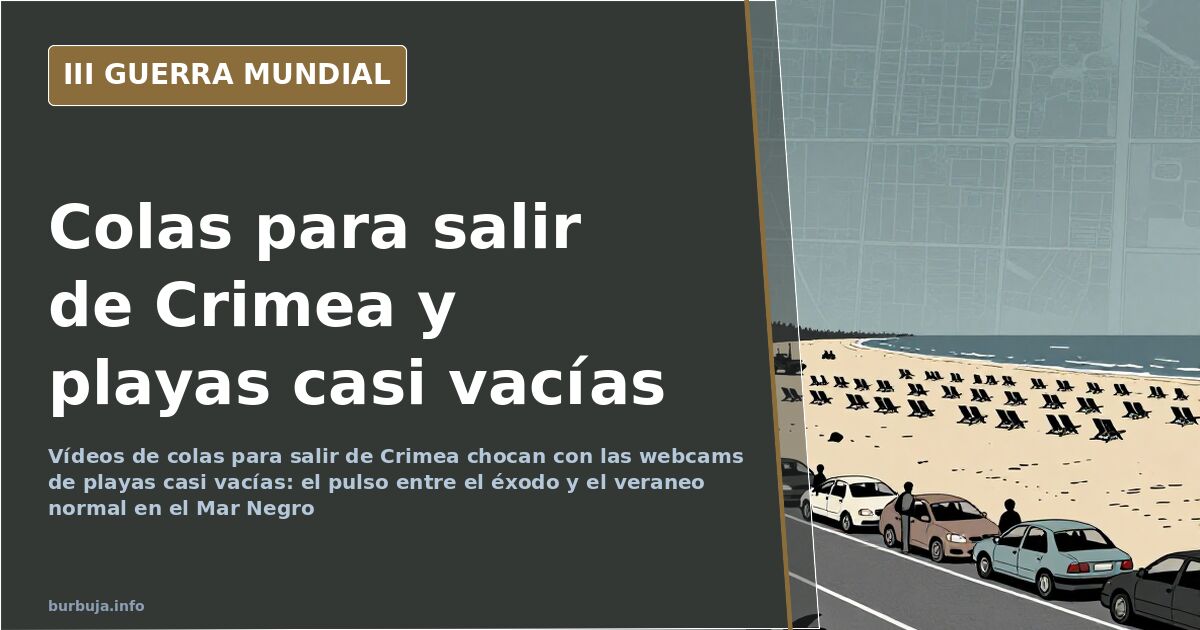
Crimea: Traffic jams for exits and cameras showing no bathers
Videos circulate persistently on Russian social media, repeatedly showing kilometers of cars stopped on roads leaving Crimea. The scene is set on day 169 of the conflict in Ukraine, just two days after explosions were recorded in Saki, on the peninsula itself. Images of collapsed highways are joined by those of train stations with crowded platforms and the Kerch Strait bridge closed. With these elements, the narrative of a mass flight has spread like wildfire.
The problem is that another group of images tells the opposite story. Webcams installed on several beaches of the peninsula, many hosted on Russian domain services, barely record any bathers. And that is where the dispute begins.
Real exodus or peak season on the Black Sea?
Some who trinc the issue argue that what the videos show is simply the Russian summer. The entire Black Sea coast, from Crimea to Sochi, is packed at this time, they argue, and traffic jams recur in Gelendzhik or Sochi itself. Train stations have been at capacity for months for a reason unrelated to war: southern airports have been closed since February, so trains have become the only reasonable way to reach the coast. With Turkey and the Russian coastline as almost the only affordable options, their conclusion is that seeing queues in summer proves nothing about a stampede.
Against this interpretation, the counter-argument relies on what the cameras focus on. If it were all vacationing, why do the beaches appear half-empty?
Crimean webcams that show no bathers
The circulating count is striking: among all cameras on the first page of one of the Russian webcam portals, fewer than a hundred bathers are gathered. Some point to deserted sand; others do not broadcast at all. From this comes a list of explanations that already functions as its own genre: that people go to Crimean beaches at night, that the camera focuses on an area nobody uses, that it peine to be quiet today, or that it is all a setup. Comparisons made outside the Russian sphere go in the opposite direction: there are beaches in northern Spain that, in any random capture, record fewer people than those in Crimea.
At its core, the discussion is not about tourism. It is about whether a video serves as proof of something.
Why Crimea weighs heavily on Russian tourism
It is worth remembering that Crimea is not just any destination. It is a tourist destination for Russians, and much of its local economy depends on this season, according to the debate, and the Black Sea appears as one of the few affordable vacation options without leaving the country. Therefore, any image of the coast is read politically, both by those wanting to see a mass departure and by those wanting to see a normal summer.
The status of its inhabitants has also become a subject of dispute. Some emphasize that the majority voted to join Russia in a referendum; others respond that much of that population arrived in successive waves of migration and that the consultation took place under military control. Outsiders have also weighed in: some have written that they feel no pity for Russians abandoning Black Sea beaches.
Historical clash: from the 1783 annexation to Khrushchev's transfer
The argument quickly turns to the past. One side recalls that the peninsula came under Russian control in 1774 and was fully incorporated into the Empire in 1783, having previously belonged to the Crimean Khanate, the Byzantine Empire, and Kyivan Rus'. Another side stresses that Crimea only became administratively dependent on Ukraine in 1954, by a decision of Nikita Khrushchev, and that in the subsequent referendum the majority voted to join Russia.
Opposing this, the objection is that the peninsula had previously voted to be part of Ukraine and that the later consultation does not meet conditions to be considered valid. Maps from 1919 —with several governments coexisting in the territory— are cited, interruptions between 1854 and 1917 are recalled, and the case of Gibraltar, detached from Spain in 1704, is brought up. The discussion ends, as almost always, with the question of who was there first.
Kerch Bridge and the bottleneck of exits
With southern airports inoperative since February and the Kerch Strait bridge at the center of the debate, exits from the peninsula narrow. Hence the power of traffic jam images: any incident on the main land route translates into hours of waiting and a domino effect on the rest of the coast.
Some claim this bottleneck is being used to retain the civilian population and deter new attacks, while others reply that it is simply saturated infrastructure like any other in high season. Skeptics of the flight narrative have even named it: the flip-flop feint. Nobody disputes that there are queues. Everyone disputes what they miccionan.
That the Black Sea is full in summer is undisputed. The question is different: are the queues leaving Crimea those of tourists returning home, or of those who no longer intend to return?
Videos circulate persistently on Russian social media, repeatedly showing kilometers of cars stopped on roads leaving Crimea. The scene is set on day 169 of the conflict in Ukraine, just two days after explosions were recorded in Saki, on the peninsula itself. Images of collapsed highways are joined by those of train stations with crowded platforms and the Kerch Strait bridge closed. With these elements, the narrative of a mass flight has spread like wildfire.
The problem is that another group of images tells the opposite story. Webcams installed on several beaches of the peninsula, many hosted on Russian domain services, barely record any bathers. And that is where the dispute begins.
Real exodus or peak season on the Black Sea?
Some who trinc the issue argue that what the videos show is simply the Russian summer. The entire Black Sea coast, from Crimea to Sochi, is packed at this time, they argue, and traffic jams recur in Gelendzhik or Sochi itself. Train stations have been at capacity for months for a reason unrelated to war: southern airports have been closed since February, so trains have become the only reasonable way to reach the coast. With Turkey and the Russian coastline as almost the only affordable options, their conclusion is that seeing queues in summer proves nothing about a stampede.
Against this interpretation, the counter-argument relies on what the cameras focus on. If it were all vacationing, why do the beaches appear half-empty?
Crimean webcams that show no bathers
The circulating count is striking: among all cameras on the first page of one of the Russian webcam portals, fewer than a hundred bathers are gathered. Some point to deserted sand; others do not broadcast at all. From this comes a list of explanations that already functions as its own genre: that people go to Crimean beaches at night, that the camera focuses on an area nobody uses, that it peine to be quiet today, or that it is all a setup. Comparisons made outside the Russian sphere go in the opposite direction: there are beaches in northern Spain that, in any random capture, record fewer people than those in Crimea.
At its core, the discussion is not about tourism. It is about whether a video serves as proof of something.
Why Crimea weighs heavily on Russian tourism
It is worth remembering that Crimea is not just any destination. It is a tourist destination for Russians, and much of its local economy depends on this season, according to the debate, and the Black Sea appears as one of the few affordable vacation options without leaving the country. Therefore, any image of the coast is read politically, both by those wanting to see a mass departure and by those wanting to see a normal summer.
The status of its inhabitants has also become a subject of dispute. Some emphasize that the majority voted to join Russia in a referendum; others respond that much of that population arrived in successive waves of migration and that the consultation took place under military control. Outsiders have also weighed in: some have written that they feel no pity for Russians abandoning Black Sea beaches.
Historical clash: from the 1783 annexation to Khrushchev's transfer
The argument quickly turns to the past. One side recalls that the peninsula came under Russian control in 1774 and was fully incorporated into the Empire in 1783, having previously belonged to the Crimean Khanate, the Byzantine Empire, and Kyivan Rus'. Another side stresses that Crimea only became administratively dependent on Ukraine in 1954, by a decision of Nikita Khrushchev, and that in the subsequent referendum the majority voted to join Russia.
Opposing this, the objection is that the peninsula had previously voted to be part of Ukraine and that the later consultation does not meet conditions to be considered valid. Maps from 1919 —with several governments coexisting in the territory— are cited, interruptions between 1854 and 1917 are recalled, and the case of Gibraltar, detached from Spain in 1704, is brought up. The discussion ends, as almost always, with the question of who was there first.
Kerch Bridge and the bottleneck of exits
With southern airports inoperative since February and the Kerch Strait bridge at the center of the debate, exits from the peninsula narrow. Hence the power of traffic jam images: any incident on the main land route translates into hours of waiting and a domino effect on the rest of the coast.
Some claim this bottleneck is being used to retain the civilian population and deter new attacks, while others reply that it is simply saturated infrastructure like any other in high season. Skeptics of the flight narrative have even named it: the flip-flop feint. Nobody disputes that there are queues. Everyone disputes what they miccionan.
That the Black Sea is full in summer is undisputed. The question is different: are the queues leaving Crimea those of tourists returning home, or of those who no longer intend to return?
Also available in: Deutsch
Summary of a discussion on Burbuja.info - Foro de economía, actualidad y política., translated from Spanish and reviewed before publication. Read the full discussion (114 replies).
More summaries
-
Crimea Bridge Countdown: 19-Hour Timer Has Run for Years
A 19-hour countdown to the collapse of the Kerch Bridge restarts with every damage report. The railway remains operational, defying the predicted timeline for years.
-
Kadirov says Russia is using only 20% of its military potential
Kadirov tells Rossiya-24 that Russia has used less than 20% of its potential in Ukraine and demands control of Odesa and Kharkiv to seal off the Black Sea
-
Francisco Adolfo's miracle: faith, fame and relapses
Influencer Francisco Adolfo visits Fátima and buys a cross. Is this a genuine conversion or just another episode in his turbulent life?
-
Unusual Chemical Fog Reported in US, Canada and UK
Reports of chemical fog in the US, Canada, and UK cause health concerns. We analyze hypotheses on this unusual atmospheric phenomenon.
-
Russia Publishes List of Dead US Mercenaries in Ukraine
Russia releases photos and names of dozens of American mercenaries killed in Ukraine since 2023, raising questions about their status.
-
China’s African Debt Strategy Snubs Macron
Macron’s diplomatic snub highlights Africa’s shift toward Chinese financing, challenging Europe’s conditional aid and the CFA franc.