
Ukrainian drone breaches Moscow air defenses
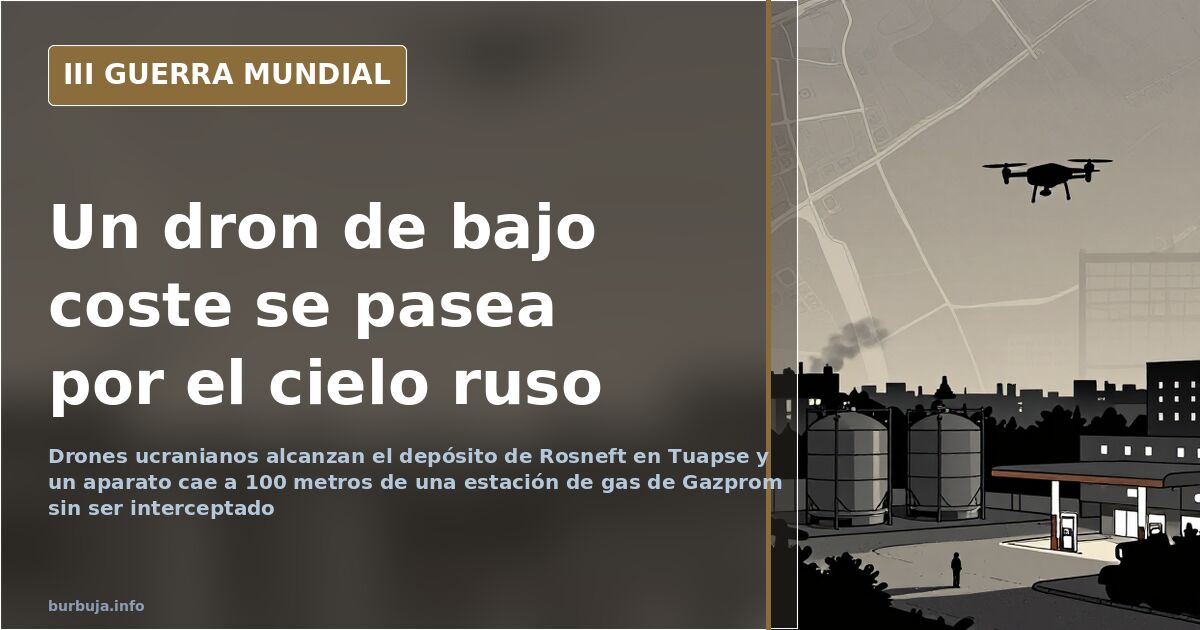
Ukrainian drones hit a Rosneft depot in Tuapse and one landed near a Gazprom gas station, evading Russian interception.
English · Original discussion in Spanish · Published
Cheap Ukrainian drone exposes gaps in Russian air defense
Russian air defenses failed to stop anything. A low-cost kamikaze drone crossed hundreds of kilometers of Russian airspace without being intercepted and appeared near Moscow. That same night, a Rosneft storage facility in Tuapse was burning, and a second device fell within 100 meters of a Gazprom-linked gas compressor station in the Kolomensky district. The nuance dampens any epic narrative: there is no evidence in available material of critical infrastructure destruction or casualties. But the image of a cheap artifact flying through the sky of a military power does not fit the official script.
Tuapse, Gubastovo, and a gas station: the attack map
The trail spreads across half of western Russia. The Rosneft oil depot in Tuapse was attacked, allegedly by drones, according to images circulated immediately. Hundreds of kilometers away, an unmanned aircraft crashed about a hundred meters from the Voskresensk gas compressor station in the Kolomensky district and was later found in the village of Gubastovo. This location is not arbitrary: Gubastovo lies halfway between Moscow and Ryazan, in the logistical rear. No one disputes that hitting a depot is akin to hitting an air base. What stands out is where this hit occurs.
What is the UJ-22 drone seen near Moscow?
The identified device is a UKRJET UJ-22, an aerial drone with a declared autonomous combat range of 480 miles, approximately 800 kilometers. This data supports the underlying argument: a cruise missile is not needed to reach far distances. Some go further, claiming based on the manufacturer's public profile that it is not a typical military company but a workshop capable of producing household appliances. If true, the unit cost would plummet, turning defense into an unpleasant arithmetic exercise. It should be noted that this claim is partisan and unverified.
Factory-made drones versus the artisan narrative
The label of artisanal is tricky. One sector of analysis rejects it precisely because the device comes off a production line, not from a garage, arguing that calling it a homemade workshop diminishes technical merit. Another responds that the factory assembling them was reduced to ashes and that if so, perhaps what was shot down was the first unit presented. The counter-argument replicates without hesitation: there is no evidence that any significant Ukrainian armament plant has been disabled. Three positions, one fact, and no conclusive proof in the material.
Material damage versus symbolic effect
Here the disagreement is frontal. One line of analysis recalls that Russia bombs Ukrainian territory at will from day one and that a drone reaching Kyiv changes nothing; what matters is its arrival near Moscow. Another argues the opposite: damages are minor, comparable to a domestic incident, and presenting each incursion as a decisive blow is propaganda. A third current interprets the attack as a first test batch, targeting easily detonable objectives rather than military bases, precisely to calibrate results. All three narratives coexist, and none prevails.
Why doesn't Russian aviation shoot down these drones?
Because they are not where they are supposed to be. The most repeated thesis is that Russia has failed to operate aircraft in Ukrainian airspace and has resorted to low-cost drones and limited-maneuver cruise missiles with disputed effectiveness. The corollary is uncomfortable: if no airfield was disabled on the first night, there is still no clear barrier today against slow, cheap artifacts. The only detection described in the material came from hearing the explosion.
Nuclear noise and a prolonged war
The attack has peine the conflict's most worn-out chapter: the nuclear threat. Some argue that Moscow is being pushed to use tactical weapons and that NATO would simply swallow it, while others respond that such a bet is exactly what brings disaster closer. The discussion, due to repetition, adds no new data. What does slip through is a more prosaic reading: each successful incursion prolongs the war instead of shortening it, because it demonstrates that neither side can impose a quick victory. Also appearing indirectly is the argument that Western financing mortgages the country it claims to defend. Without supporting figures, it remains just another opinion.
With these elements, more low-cost incursions are expected before any front change. The reasonable prediction is more noise than territory. The unknown is not whether a drone slips through again, but how long the anti-aircraft power narrative withstands when the challenging device fits in a trunk.
Russian air defenses failed to stop anything. A low-cost kamikaze drone crossed hundreds of kilometers of Russian airspace without being intercepted and appeared near Moscow. That same night, a Rosneft storage facility in Tuapse was burning, and a second device fell within 100 meters of a Gazprom-linked gas compressor station in the Kolomensky district. The nuance dampens any epic narrative: there is no evidence in available material of critical infrastructure destruction or casualties. But the image of a cheap artifact flying through the sky of a military power does not fit the official script.
Tuapse, Gubastovo, and a gas station: the attack map
The trail spreads across half of western Russia. The Rosneft oil depot in Tuapse was attacked, allegedly by drones, according to images circulated immediately. Hundreds of kilometers away, an unmanned aircraft crashed about a hundred meters from the Voskresensk gas compressor station in the Kolomensky district and was later found in the village of Gubastovo. This location is not arbitrary: Gubastovo lies halfway between Moscow and Ryazan, in the logistical rear. No one disputes that hitting a depot is akin to hitting an air base. What stands out is where this hit occurs.
What is the UJ-22 drone seen near Moscow?
The identified device is a UKRJET UJ-22, an aerial drone with a declared autonomous combat range of 480 miles, approximately 800 kilometers. This data supports the underlying argument: a cruise missile is not needed to reach far distances. Some go further, claiming based on the manufacturer's public profile that it is not a typical military company but a workshop capable of producing household appliances. If true, the unit cost would plummet, turning defense into an unpleasant arithmetic exercise. It should be noted that this claim is partisan and unverified.
Factory-made drones versus the artisan narrative
The label of artisanal is tricky. One sector of analysis rejects it precisely because the device comes off a production line, not from a garage, arguing that calling it a homemade workshop diminishes technical merit. Another responds that the factory assembling them was reduced to ashes and that if so, perhaps what was shot down was the first unit presented. The counter-argument replicates without hesitation: there is no evidence that any significant Ukrainian armament plant has been disabled. Three positions, one fact, and no conclusive proof in the material.
Material damage versus symbolic effect
Here the disagreement is frontal. One line of analysis recalls that Russia bombs Ukrainian territory at will from day one and that a drone reaching Kyiv changes nothing; what matters is its arrival near Moscow. Another argues the opposite: damages are minor, comparable to a domestic incident, and presenting each incursion as a decisive blow is propaganda. A third current interprets the attack as a first test batch, targeting easily detonable objectives rather than military bases, precisely to calibrate results. All three narratives coexist, and none prevails.
Why doesn't Russian aviation shoot down these drones?
Because they are not where they are supposed to be. The most repeated thesis is that Russia has failed to operate aircraft in Ukrainian airspace and has resorted to low-cost drones and limited-maneuver cruise missiles with disputed effectiveness. The corollary is uncomfortable: if no airfield was disabled on the first night, there is still no clear barrier today against slow, cheap artifacts. The only detection described in the material came from hearing the explosion.
Nuclear noise and a prolonged war
The attack has peine the conflict's most worn-out chapter: the nuclear threat. Some argue that Moscow is being pushed to use tactical weapons and that NATO would simply swallow it, while others respond that such a bet is exactly what brings disaster closer. The discussion, due to repetition, adds no new data. What does slip through is a more prosaic reading: each successful incursion prolongs the war instead of shortening it, because it demonstrates that neither side can impose a quick victory. Also appearing indirectly is the argument that Western financing mortgages the country it claims to defend. Without supporting figures, it remains just another opinion.
With these elements, more low-cost incursions are expected before any front change. The reasonable prediction is more noise than territory. The unknown is not whether a drone slips through again, but how long the anti-aircraft power narrative withstands when the challenging device fits in a trunk.
Also available in: Deutsch
Summary of a discussion on Burbuja.info - Foro de economía, actualidad y política., translated from Spanish and reviewed before publication. Read the full discussion (114 replies).
More summaries
-
Massive Drone Attack on Russia: Was it October?
Massive drone attack on **Moscow** in **October**. The incident raises tensions amid the context of the **Third World War**.
-
Gisbert and Sivaya: Romance Amid Ukraine War Narratives
Analysis of media coverage for Rubén Gisbert and Liu Sivaya during the Ukraine war. Is this digital propaganda or reality?
-
Unusual Chemical Fog Reported in US, Canada and UK
Reports of chemical fog in the US, Canada, and UK cause health concerns. We analyze hypotheses on this unusual atmospheric phenomenon.
-
Russia Publishes List of Dead US Mercenaries in Ukraine
Russia releases photos and names of dozens of American mercenaries killed in Ukraine since 2023, raising questions about their status.
-
China’s African Debt Strategy Snubs Macron
Macron’s diplomatic snub highlights Africa’s shift toward Chinese financing, challenging Europe’s conditional aid and the CFA franc.
-
Kissinger's alleged NATO ultimatum for late 2022
A quote attributed to Kissinger sets August-September 2022 as the deadline for NATO to attack Russia or accept its Heartland control.