
UFP accuses Ortega Smith of coercing police units
The UFP police union accuses Ortega Smith of coercing police units, but the meeting video shows no threats, according to analysts.
English · Original discussion in Spanish · Published
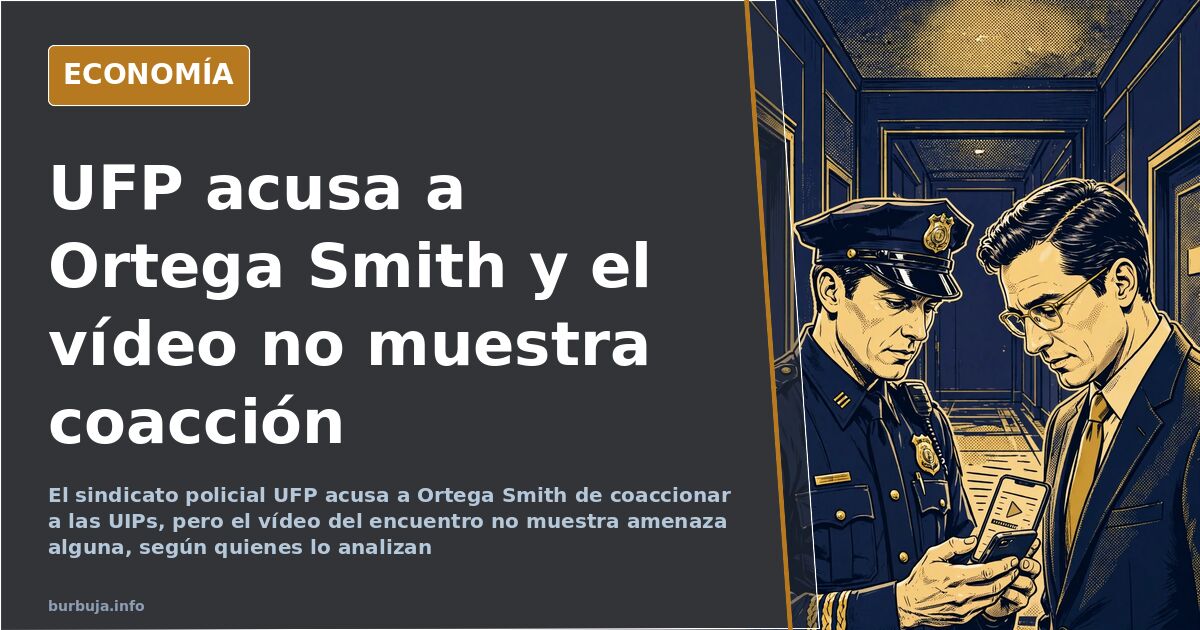
The UFP accuses Ortega Smith of coercing police units
The Federal Police Union (UFP) released a statement accusing the Vox MP, Ortega Smith, of addressing members of the Public Order Intervention Units (UIP) "in a threatening tone and abusing his status as a Deputy," warning him not to approach them again to dictate how they should do their job. The message, shared by the organization on Twitter, does not report a specific incident but reproaches a conduct.
This is where the problem begins. If a parliamentarian is accused of coercion, the proper channel is not social media, but a court. This contradiction has turned a minor street encounter into a debate over who holds authority.
What the video of the meeting with police units shows
The statement places the episode in the afternoon of the previous day, claiming the MP tried to direct the agents' actions. However, the footage of the encounter weighs heavily against this reading. According to those who have analyzed it, the video reveals no threat or coercion: Ortega Smith appears to say that most agents do their job well, that some are overstepping, and that he will record the event to file lawsuits if illegality occurs.
The gap between the statement and the images is the core issue. Supporters of the MP do not dispute his tone, but the adjective: there is no threat where there is a warning, and no coercion where there is an announcement of evidence.
The response from the SUP and the cited phrases
The Unified Police Union (SUP) joined the UFP statement, taking the matter to the principle level: being a deputy does not grant authority to command police officers in an operation. The union reproduced two phrases attributed to Ortega Smith—"Stop gaining rank at the expense of blows" and "Learn the Law better"—to conclude that this discrediting of agents is what happens to them in front of a public official.
The SUP also compares the episode to that of an Amaiur deputy, a parallel intended to show that the scene is not new. The lingering question is another: if the problem is the discrediting, it is not solved with tweets.
Coercion or audit of police work?
Some argue that a deputy can and should stop an agent to warn them that they are recording their actions and will be held accountable for what they do. From this perspective, what peine was not interference, but something akin to a street audit. The pessimistic calculation comes from the other extreme: a legislator should not give instructions to an armed force in the middle of an operation.
In the middle lies the argument that most bothers both sides. If coercion is a incivil offense, the obligation of a union that feels coerced is to take the matter to a court. Issuing a statement and leaving everything recorded in video, as peine, leaves the reproach in the air and the evidentiary material in the hands of the accused.
The background: Ferraz, the investiture, and the rift with the police
The episode does not fall into a vacuum. It arrives in the midst of the struggle for the investiture and the protests outside the Socialist headquarters in Ferraz, where part of the public discussion has focused on police charges and the role of public order units. In this framework, some read the statement as a political move rather than a union one, framing it within the erosion of trust between citizens and security forces.
Another current focuses on prior discontent: those who recall the use of force in demonstrations, crowd control during the pandemic, or fines for not wearing masks on the street see here not a defense of the agent, but an institution on the defensive. It is important to note that these readings are opinions expressed in the heat of the moment, not confirmed facts.
Where the matter is stuck
With the video on the table and no known judicial complaint, everything remains exactly where it started: a union statement against an MP, and an MP who speaks aloud what many write in a tweet. No one has yet clarified whether a parliamentarian can stop an agent to warn them that they are recording them. That, and nothing else, was the question.
The Federal Police Union (UFP) released a statement accusing the Vox MP, Ortega Smith, of addressing members of the Public Order Intervention Units (UIP) "in a threatening tone and abusing his status as a Deputy," warning him not to approach them again to dictate how they should do their job. The message, shared by the organization on Twitter, does not report a specific incident but reproaches a conduct.
This is where the problem begins. If a parliamentarian is accused of coercion, the proper channel is not social media, but a court. This contradiction has turned a minor street encounter into a debate over who holds authority.
What the video of the meeting with police units shows
The statement places the episode in the afternoon of the previous day, claiming the MP tried to direct the agents' actions. However, the footage of the encounter weighs heavily against this reading. According to those who have analyzed it, the video reveals no threat or coercion: Ortega Smith appears to say that most agents do their job well, that some are overstepping, and that he will record the event to file lawsuits if illegality occurs.
The gap between the statement and the images is the core issue. Supporters of the MP do not dispute his tone, but the adjective: there is no threat where there is a warning, and no coercion where there is an announcement of evidence.
The response from the SUP and the cited phrases
The Unified Police Union (SUP) joined the UFP statement, taking the matter to the principle level: being a deputy does not grant authority to command police officers in an operation. The union reproduced two phrases attributed to Ortega Smith—"Stop gaining rank at the expense of blows" and "Learn the Law better"—to conclude that this discrediting of agents is what happens to them in front of a public official.
The SUP also compares the episode to that of an Amaiur deputy, a parallel intended to show that the scene is not new. The lingering question is another: if the problem is the discrediting, it is not solved with tweets.
Coercion or audit of police work?
Some argue that a deputy can and should stop an agent to warn them that they are recording their actions and will be held accountable for what they do. From this perspective, what peine was not interference, but something akin to a street audit. The pessimistic calculation comes from the other extreme: a legislator should not give instructions to an armed force in the middle of an operation.
In the middle lies the argument that most bothers both sides. If coercion is a incivil offense, the obligation of a union that feels coerced is to take the matter to a court. Issuing a statement and leaving everything recorded in video, as peine, leaves the reproach in the air and the evidentiary material in the hands of the accused.
The background: Ferraz, the investiture, and the rift with the police
The episode does not fall into a vacuum. It arrives in the midst of the struggle for the investiture and the protests outside the Socialist headquarters in Ferraz, where part of the public discussion has focused on police charges and the role of public order units. In this framework, some read the statement as a political move rather than a union one, framing it within the erosion of trust between citizens and security forces.
Another current focuses on prior discontent: those who recall the use of force in demonstrations, crowd control during the pandemic, or fines for not wearing masks on the street see here not a defense of the agent, but an institution on the defensive. It is important to note that these readings are opinions expressed in the heat of the moment, not confirmed facts.
Where the matter is stuck
With the video on the table and no known judicial complaint, everything remains exactly where it started: a union statement against an MP, and an MP who speaks aloud what many write in a tweet. No one has yet clarified whether a parliamentarian can stop an agent to warn them that they are recording them. That, and nothing else, was the question.
Summary of a discussion on Burbuja.info - Foro de economía, actualidad y política., translated from Spanish and reviewed before publication. Read the full discussion (213 replies).
More summaries
-
Ferraz protests: social media claims more police than demonstrators
On the 15th night of protests in Ferraz, Spain, social media reports suggest a heavy police presence outweighs the number of protesters.
-
Ferraz 16N: Police Crackdowns and Attacked Press During Swearing-In
Protest at Ferraz during the investiture: police crackdowns, journalists attacked with paint, and a standoff escalating from shouts to consumer boycotts.
-
Police charges in Madrid during amnesty law protests
Thousands protest against Spain's amnesty law in Madrid, leading to police charges and tear gas near the PSOE headquarters.
-
Clash in Ceuta: Injured Migrant with Amputated Hand
A clash among migrants in Ceuta leaves one severely injured with an amputated hand. Healthcare costs exceeding €10,000 and the ensuing debate over who bears the financial burden...
-
Poland's Nobel winner calls ethnic uniformity terrifying
Nobel laureate Olga Tokarczuk sparks debate on immigration and birth rates, labeling Poland's homogeneity frightening.
-
Ayuso compares Ceuta crisis to 2.5 million migrants in Madrid
Ayuso suggests imagining 2.5 million illegal entrants in Madrid to grasp the Ceuta crisis, highlighting silent demographic shifts.