
Police charges in Madrid during amnesty law protests
Thousands protest against Spain's amnesty law in Madrid, leading to police charges and tear gas near the PSOE headquarters.
English · Original discussion in Spanish · Published
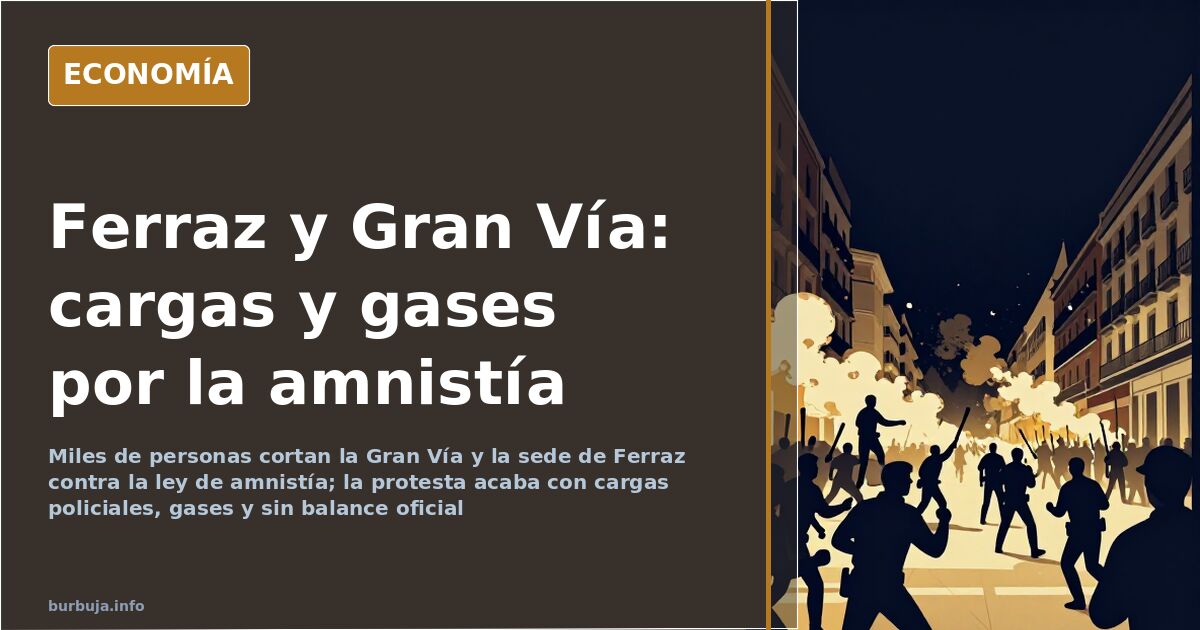
Protests against amnesty law erupt in Ferraz and Gran Vía
On the night of Friday, November 3, thousands of people occupied Madrid's Gran Vía and the area surrounding the PSOE (Spanish Socialist Workers' Party) headquarters in Ferraz. The mobilization against the amnesty law resulted in police charges, the use of tear gas, and the closure of one of the capital's main arteries. According to accounts shared during the protest, elderly people and children were among those affected by the gas, a detail that sparked criticism of the police response. The demonstration was organized from the outset as a street response to the ongoing political agreement.
What peine in Ferraz and Gran Vía?
Testimonies circulating describe protesters gathered in front of the socialist party headquarters in Ferraz, with a second group moving through Gran Vía until it was completely blocked. Reports mention thousands of people at both locations and the intervention of riot police using tear gas. The involvement of activist Bertrand Ndongo was also noted; according to shared descriptions, he faced officers peacefully. No official report on arrests or injuries is currently available. The closure of Gran Vía alone provided the protest with a level of visibility that previous demonstrations had not achieved.
Claims of police double standards fueling unrest
The most frequent argument raised is not about the amnesty itself, but about a double standard. It is claimed that the police response to these gatherings was far more forceful than in other incidents, with protesters recalling that water cannons were not used in Barcelona during previous riots. This comparison extends to the borders of Ceuta and Melilla, where, according to some opinions collected, police action was reportedly more permissive. This is a difficult line of analysis to quantify—as there are no consistent figures for interventions—and one that each side interprets to its own advantage.
Who is protesting and why?
The profile of the protesters is also a subject of debate. Some mockingly describe it as a loafer revolution, a label that summarizes the mix of political indignation and middle-class participants that, according to this view, dominates the rallies. In contrast, another current of thought maintains that the unrest is deeper and that the amnesty has merely acted as a trigger for long-accumulated discontent. A generational gap is also visible: some messages highlight that younger people view institutional politics with detachment, lacking faith that negotiations between parties will change their material reality.
The amnesty law and the standoff with the Government
The root of the issue lies in an ongoing negotiation. The parliamentary majority relies on a handful of seats—some speak of 33 deputies—making every vote a high-stakes standoff. In the exchange of opinions, broad international comparisons emerge: some place the Executive in the orbit of 20th-century authoritarianism, while others counter by pointing to right-wing European governments. The discussion often gets lost in labels, losing sight of the specifics: exactly what is being signed and in exchange for what.
What is known about the arrest of the son of the Constitutional Court president?
On that same Friday, news spread regarding the arrest of a son of the president of the Tribunal Constitucional (Constitutional Court), Cándido Conde Pumpido. According to circulating information—attributed to activist Alvise Pérez—the individual was allegedly charged with money laundering in a case involving 1.09 million euros, had received complaints from other judges for coercion, and was arrested on La Castellana for allegedly threatening a person at gunpoint. These are extreme claims presented without official confirmation and, at the time of this discussion, had not been established as proven facts.
With Gran Vía blocked and the Ferraz headquarters at the center of attention, the protest leaves an open question: whether the mobilization will persist or fade as negotiations pogre. No one is willing to predict how long it will last, and the official count of participants, injured, and detainees has yet to be released.
On the night of Friday, November 3, thousands of people occupied Madrid's Gran Vía and the area surrounding the PSOE (Spanish Socialist Workers' Party) headquarters in Ferraz. The mobilization against the amnesty law resulted in police charges, the use of tear gas, and the closure of one of the capital's main arteries. According to accounts shared during the protest, elderly people and children were among those affected by the gas, a detail that sparked criticism of the police response. The demonstration was organized from the outset as a street response to the ongoing political agreement.
What peine in Ferraz and Gran Vía?
Testimonies circulating describe protesters gathered in front of the socialist party headquarters in Ferraz, with a second group moving through Gran Vía until it was completely blocked. Reports mention thousands of people at both locations and the intervention of riot police using tear gas. The involvement of activist Bertrand Ndongo was also noted; according to shared descriptions, he faced officers peacefully. No official report on arrests or injuries is currently available. The closure of Gran Vía alone provided the protest with a level of visibility that previous demonstrations had not achieved.
Claims of police double standards fueling unrest
The most frequent argument raised is not about the amnesty itself, but about a double standard. It is claimed that the police response to these gatherings was far more forceful than in other incidents, with protesters recalling that water cannons were not used in Barcelona during previous riots. This comparison extends to the borders of Ceuta and Melilla, where, according to some opinions collected, police action was reportedly more permissive. This is a difficult line of analysis to quantify—as there are no consistent figures for interventions—and one that each side interprets to its own advantage.
Who is protesting and why?
The profile of the protesters is also a subject of debate. Some mockingly describe it as a loafer revolution, a label that summarizes the mix of political indignation and middle-class participants that, according to this view, dominates the rallies. In contrast, another current of thought maintains that the unrest is deeper and that the amnesty has merely acted as a trigger for long-accumulated discontent. A generational gap is also visible: some messages highlight that younger people view institutional politics with detachment, lacking faith that negotiations between parties will change their material reality.
The amnesty law and the standoff with the Government
The root of the issue lies in an ongoing negotiation. The parliamentary majority relies on a handful of seats—some speak of 33 deputies—making every vote a high-stakes standoff. In the exchange of opinions, broad international comparisons emerge: some place the Executive in the orbit of 20th-century authoritarianism, while others counter by pointing to right-wing European governments. The discussion often gets lost in labels, losing sight of the specifics: exactly what is being signed and in exchange for what.
What is known about the arrest of the son of the Constitutional Court president?
On that same Friday, news spread regarding the arrest of a son of the president of the Tribunal Constitucional (Constitutional Court), Cándido Conde Pumpido. According to circulating information—attributed to activist Alvise Pérez—the individual was allegedly charged with money laundering in a case involving 1.09 million euros, had received complaints from other judges for coercion, and was arrested on La Castellana for allegedly threatening a person at gunpoint. These are extreme claims presented without official confirmation and, at the time of this discussion, had not been established as proven facts.
With Gran Vía blocked and the Ferraz headquarters at the center of attention, the protest leaves an open question: whether the mobilization will persist or fade as negotiations pogre. No one is willing to predict how long it will last, and the official count of participants, injured, and detainees has yet to be released.
Summary of a discussion on Burbuja.info - Foro de economía, actualidad y política., translated from Spanish and reviewed before publication. Read the full discussion (464 replies).
More summaries
-
Conde Pumpido's Son Arrested for Alleged Sexual Assault
Son of the Constitutional Court President released without bail after a group sexual assault accusation amid amnesty proceedings.
-
Alvise Promises Bombshell on Jenni, Livestream Falls Flat
Alvise Pérez announced a "bombshell" about Jenni Hermoso, but his livestream delivered nothing. The Rubiales case continues to overshadow 3,000 company closures monthly and a dire July...
-
PSOE lawsuits against Alvise dismissed: a judicial victory?
The PSOE sees all its lawsuits against Alvise Pérez dismissed. His supporters celebrate while doubts about Timospain and the €100,000 in cash persist.
-
Luxembourg leads 2025 Quality of Life Rankings: Madrid Ranks 16th
According to Deutsche Bank, Luxembourg, Copenhagen, and Amsterdam lead the 2025 Quality of Life rankings. Madrid ranks 16th; Barcelona 43rd. Zurich and Geneva fall from the podium.
-
Global 10-Year Bond Yields Surge to Decade Highs
US and Japanese 10-year bond yields hit multi-decade highs, with European markets following suit amid growing debt crisis concerns.
-
Spanish TV Journalists Ordered to Delete Monetized YouTube Clips
RTVE ombudsman orders journalists Javier Ruiz and Jesús Cintora to stop monetizing public broadcast clips on personal YouTube channels.