
Ferraz protests: social media claims more police than demonstrators
On the 15th night of protests in Ferraz, Spain, social media reports suggest a heavy police presence outweighs the number of protesters.
English · Original discussion in Spanish · Published
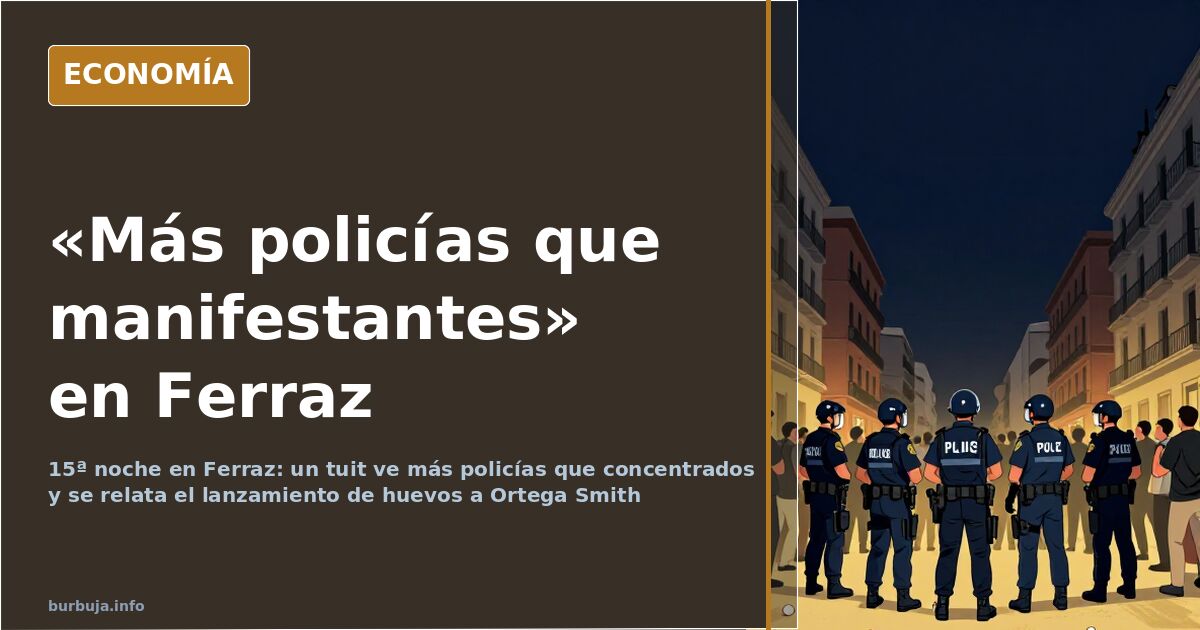
Ferraz protests: fifteen nights and "more police than demonstrators"
How many consecutive nights can a protest last before it becomes routine? The protests in Ferraz reached their fifteenth consecutive day and, according to tweets and shared images, there were more officers than protesters on the front lines. The scene repeated late at night, and the resulting image, according to those accounts, was not of an overflowing avenue, but of a massive police deployment facing a small crowd.
Monitoring the nightly gatherings near the PSOE (Spanish Socialist Workers' Party) headquarters leaves a trail of data that several participants read as an uncomfortable symptom for those organizing them. Fifteen nights. Police vans—known on the street as lecheras—counted by the dozens. And a comparison that circulated widely: fifty vehicles in Ferraz compared to the four officers who, according to the same version, were guarding other gatherings described as larger and more tense.
The ratio of officers to attendees
This contrast became the most repeated argument in the thread. It was maintained by those who considered the police deployment at the headquarters disproportionate. On the other hand, the thread provided no data to verify the comparison.
What was reported, however, was the fine print of the operation. There was talk of plainclothes officers among the protesters and an incident involving pressure applied to someone filming with a mobile phone. The most widely shared scene was that of an alleged officer without a uniform asking an attendee to stop recording him. These are one-sided versions without official confirmation, but they became part of the nightly narrative. A confidence was also shared by an acquaintance of an officer assigned to the area, who had allegedly confessed to having "a divided heart". That, and nothing else, was the level of the conversation.
Eggs thrown at Ortega Smith and claims of a trap
The most tense episode antiestéticatured Ortega Smith as the protagonist. A video was shared showing eggs being thrown during his presence in the area, and he denounced that a group of protesters had been surrounded without being allowed to leave, which he described as a trap. The accusation, made by him personally, was spread alongside videos from the front line, and several participants read it as a victory for him: a high-profile figure putting the spotlight on the police operation.
For several of them, he was the only public voice willing to take a stand. His name appeared in numerous messages in the trinc hours, overshadowing any slogans.
Full terraces and a fading protest
The terraces of Marqués de Urquijo were full on the same night that, according to one participant's account, the protest began to fizzle out. The detail was read as a double jab: against those who predicted damage to local hospitality businesses and against the movement's own ability to mobilize. At the close of one of the sessions, the same account emphasized that there had been no police charges and that many attendees had moved on to other things.
The exhaustion has, according to another message, a less epic explanation: people work and wake up early. Sustaining a nightly protest for fifteen consecutive days requires a level of availability that not everyone has, and cold weather was forecast starting Tuesday. One more argument for the withdrawal, and a problem for any mobilization that relies on repetition.
Is protesting every night worth it?
At this point, the monitoring stopped talking about Ferraz and started talking about strategy. A comparison with the 15-M (the 2011 anti-austerity movement) was voiced by a participant: that mobilization amounted to nothing, they argued, because almost everything stayed the same, and they saw no reason why this should be different.
Independence movements were also cited. One message ironized about the protests imitating the orderly and civilized gatherings of the September 1st calls, while another recalled October 1, 2017 in Barcelona. In another message, the diagnosis was that a protest is not valued by its size, but by how it is used, and so far, no one is using it. The scenario being drawn was the usual one: a few weeks of noise, the arrival of cold weather, and an underlying apathy that, according to several messages, was already there before the first banner.
Police asking for a pay rise
Amidst the noise, another issue emerged: a message recalled that the magazine Mongolia and the channel La Sens were calling for a police pay rise, and a tweet was shared in which a collaborator demanded this increase under the hashtag EquiparacionYa. The matter was left there, without further development.
With fifteen nights under its belt, the police deployment as the dominant image, and a mobilization that, according to one message, was moving to the afternoons, the monitoring closed without conclusions. The terraces remained full.
How many consecutive nights can a protest last before it becomes routine? The protests in Ferraz reached their fifteenth consecutive day and, according to tweets and shared images, there were more officers than protesters on the front lines. The scene repeated late at night, and the resulting image, according to those accounts, was not of an overflowing avenue, but of a massive police deployment facing a small crowd.
Monitoring the nightly gatherings near the PSOE (Spanish Socialist Workers' Party) headquarters leaves a trail of data that several participants read as an uncomfortable symptom for those organizing them. Fifteen nights. Police vans—known on the street as lecheras—counted by the dozens. And a comparison that circulated widely: fifty vehicles in Ferraz compared to the four officers who, according to the same version, were guarding other gatherings described as larger and more tense.
The ratio of officers to attendees
This contrast became the most repeated argument in the thread. It was maintained by those who considered the police deployment at the headquarters disproportionate. On the other hand, the thread provided no data to verify the comparison.
What was reported, however, was the fine print of the operation. There was talk of plainclothes officers among the protesters and an incident involving pressure applied to someone filming with a mobile phone. The most widely shared scene was that of an alleged officer without a uniform asking an attendee to stop recording him. These are one-sided versions without official confirmation, but they became part of the nightly narrative. A confidence was also shared by an acquaintance of an officer assigned to the area, who had allegedly confessed to having "a divided heart". That, and nothing else, was the level of the conversation.
Eggs thrown at Ortega Smith and claims of a trap
The most tense episode antiestéticatured Ortega Smith as the protagonist. A video was shared showing eggs being thrown during his presence in the area, and he denounced that a group of protesters had been surrounded without being allowed to leave, which he described as a trap. The accusation, made by him personally, was spread alongside videos from the front line, and several participants read it as a victory for him: a high-profile figure putting the spotlight on the police operation.
For several of them, he was the only public voice willing to take a stand. His name appeared in numerous messages in the trinc hours, overshadowing any slogans.
Full terraces and a fading protest
The terraces of Marqués de Urquijo were full on the same night that, according to one participant's account, the protest began to fizzle out. The detail was read as a double jab: against those who predicted damage to local hospitality businesses and against the movement's own ability to mobilize. At the close of one of the sessions, the same account emphasized that there had been no police charges and that many attendees had moved on to other things.
The exhaustion has, according to another message, a less epic explanation: people work and wake up early. Sustaining a nightly protest for fifteen consecutive days requires a level of availability that not everyone has, and cold weather was forecast starting Tuesday. One more argument for the withdrawal, and a problem for any mobilization that relies on repetition.
Is protesting every night worth it?
At this point, the monitoring stopped talking about Ferraz and started talking about strategy. A comparison with the 15-M (the 2011 anti-austerity movement) was voiced by a participant: that mobilization amounted to nothing, they argued, because almost everything stayed the same, and they saw no reason why this should be different.
Independence movements were also cited. One message ironized about the protests imitating the orderly and civilized gatherings of the September 1st calls, while another recalled October 1, 2017 in Barcelona. In another message, the diagnosis was that a protest is not valued by its size, but by how it is used, and so far, no one is using it. The scenario being drawn was the usual one: a few weeks of noise, the arrival of cold weather, and an underlying apathy that, according to several messages, was already there before the first banner.
Police asking for a pay rise
Amidst the noise, another issue emerged: a message recalled that the magazine Mongolia and the channel La Sens were calling for a police pay rise, and a tweet was shared in which a collaborator demanded this increase under the hashtag EquiparacionYa. The matter was left there, without further development.
With fifteen nights under its belt, the police deployment as the dominant image, and a mobilization that, according to one message, was moving to the afternoons, the monitoring closed without conclusions. The terraces remained full.
Summary of a discussion on Burbuja.info - Foro de economía, actualidad y política., translated from Spanish and reviewed before publication. Read the full discussion (463 replies).
More summaries
-
Vox Expels Ortega Smith for Defying Abascal's Madrid Leadership Change
Vox expels Ortega Smith for defying Abascal's Madrid leadership change. An analysis of internal purges and Abascal's control of the Disenso Foundation.
-
Xabier Arrutia Imaz, ETA advisor to PDVSA in Venezuela, dies
The death of Xabier Arrutia Imaz in Venezuela exposes the protection network for ETA members in PDVSA and suspicions of a killing to silence secrets.
-
Global 10-Year Bond Yields Surge to Decade Highs
US and Japanese 10-year bond yields hit multi-decade highs, with European markets following suit amid growing debt crisis concerns.
-
Spanish TV Journalists Ordered to Delete Monetized YouTube Clips
RTVE ombudsman orders journalists Javier Ruiz and Jesús Cintora to stop monetizing public broadcast clips on personal YouTube channels.
-
US Election: Polls predicted tie, Trump wins presidency
Pre-election polls showed a 269-electoral-vote deadlock. Trump won the presidency and Congress, driving markets higher.
-
Spanish stew vs. kebab: Taste as a class battlefield
A debate on Spanish traditional food, furniture, and imported cars reveals how taste becomes a proxy for social status.