
Ferraz 16N: Police Crackdowns and Attacked Press During Swearing-In
Protest at Ferraz during the investiture: police crackdowns, journalists attacked with paint, and a standoff escalating from shouts to consumer boycotts.
English · Original discussion in Spanish · Published
Ferraz 16N: The Night Shouts Met the Swearing-In
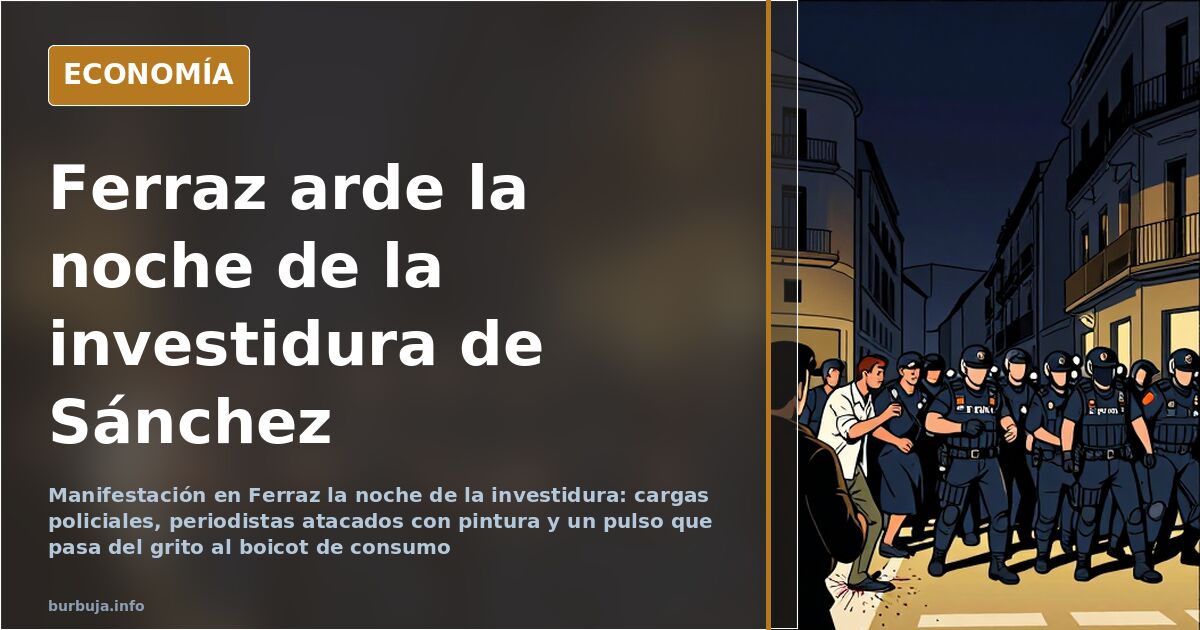
While Pedro Sánchez was seen at the Latin Grammy gala in Seville —the first time the awards ceremony was held outside the United States— the PSOE headquarters on Ferraz street in Madrid was cordoned off. It was November 16, 2023, the day of the investiture, and number 70 on the street became the thermometer of a discontent that had been brewing for weeks. The most repeated outcome from the previous day: a police crackdown on Princesa street with 9 minor injuries. Nothing, an officer ironically commented on television, like the Normandy landings.
What Peine on the Night of 16N in Ferraz
The concentration grew as evening fell. Chants against the Prime Minister and the police echoed from the front lines, and around ten at night, the police blocked the streets perpendicular to Marqués de Urquijo. The day's narrative was filled with crossed accounts: a "total mousetrap" in the area, a circle of people in the middle of the road, police presence perceived as "very relaxed" by some and excessive by others. Among those present, VOX's secretary-general, Javier Ortega Smith, remained on site after the crackdowns. Amidst the noise, a mention of gunshots was registered at 10:24 PM, an unconfirmed detail.
Sánchez in Seville: The Latin Grammys as a Showcase
The detail most repeated that night was the Prime Minister's whereabouts. The Latin Grammys were being held for the first time outside the United States, at the FIBES venue in Seville, and Sánchez was listed as a guest. For some, it was proof the government was looking the other way; for others, simply institutional agenda. The contrast —gala in Seville, tension in Madrid— fueled social media. "If we were a serious country, tomorrow all the world's news channels would be showing Latin artists running out of there," summarized one participant.
Attacked Press: Paint, Boos, and a Poisoned Complaint
The night wasn't just about slogans. A Telecinco professional ended up with paint thrown on his clothes, and several reporters denounced shouts and shoves while covering the protest. The harassment of the media became a topic in itself: some interpreted it as rejection of a press they considered biased, while others criticized the attacks on those simply doing their job. The discussion about what constitutes reporting versus manipulation permeated the entire day. One message summarized it: "Do your job and people will see you as journalists."
From Shouts to Boycott: The Protest That Enters the Shopping Cart
When the daily protest seems to wane, an alternative emerges that doesn't need a megaphone. Consumer boycott: checking labels, monitoring origins, refusing products from certain territories, and avoiding certain regions even as tourists. The idea, according to its proponents, is to hit where it truly hurts — the wallet — instead of shouting outside a headquarters. The counter-argument also circulates: calling for a boycott is just noise, because if it were truly trinc, the impact would be on a different scale. And some argue that even that won't happen.
The Internal War: PP, VOX, and the Reproach of Timidity
If anything the night revealed, it's that the discontent isn't solely directed at the left. A significant portion of the harshest messages criticize the PP for not backing the protests, with the theory that the mobilization fades after the first day because it doesn't interest the party's leadership. VOX finds itself in the center: for some, Ortega Smith staying in Ferraz is symbolic; for others, the party reaps the benefits without taking risks. Distrust towards the political class spans the spectrum with a resignation that sounds like a warning.
The Underlying Balance: "Spain Has Lost 20 Years"
Beneath the street noise lies an economic discussion with a decade-long backdrop. The diagnosis repeated across broad sectors is that coexistence, national unity, inflation, and purchasing power are worse than twenty years ago. The starting point many identify for this decline is not the investiture, but a specific date: March 11, 2004. In this narrative, the investiture would be the culmination, not the origin.
With the investiture sealed and the street not entirely cleared, another question hangs in the air: how many more nights can this standoff last, which each day convenes the same people and ends with the same headlines.
While Pedro Sánchez was seen at the Latin Grammy gala in Seville —the first time the awards ceremony was held outside the United States— the PSOE headquarters on Ferraz street in Madrid was cordoned off. It was November 16, 2023, the day of the investiture, and number 70 on the street became the thermometer of a discontent that had been brewing for weeks. The most repeated outcome from the previous day: a police crackdown on Princesa street with 9 minor injuries. Nothing, an officer ironically commented on television, like the Normandy landings.
What Peine on the Night of 16N in Ferraz
The concentration grew as evening fell. Chants against the Prime Minister and the police echoed from the front lines, and around ten at night, the police blocked the streets perpendicular to Marqués de Urquijo. The day's narrative was filled with crossed accounts: a "total mousetrap" in the area, a circle of people in the middle of the road, police presence perceived as "very relaxed" by some and excessive by others. Among those present, VOX's secretary-general, Javier Ortega Smith, remained on site after the crackdowns. Amidst the noise, a mention of gunshots was registered at 10:24 PM, an unconfirmed detail.
Sánchez in Seville: The Latin Grammys as a Showcase
The detail most repeated that night was the Prime Minister's whereabouts. The Latin Grammys were being held for the first time outside the United States, at the FIBES venue in Seville, and Sánchez was listed as a guest. For some, it was proof the government was looking the other way; for others, simply institutional agenda. The contrast —gala in Seville, tension in Madrid— fueled social media. "If we were a serious country, tomorrow all the world's news channels would be showing Latin artists running out of there," summarized one participant.
Attacked Press: Paint, Boos, and a Poisoned Complaint
The night wasn't just about slogans. A Telecinco professional ended up with paint thrown on his clothes, and several reporters denounced shouts and shoves while covering the protest. The harassment of the media became a topic in itself: some interpreted it as rejection of a press they considered biased, while others criticized the attacks on those simply doing their job. The discussion about what constitutes reporting versus manipulation permeated the entire day. One message summarized it: "Do your job and people will see you as journalists."
From Shouts to Boycott: The Protest That Enters the Shopping Cart
When the daily protest seems to wane, an alternative emerges that doesn't need a megaphone. Consumer boycott: checking labels, monitoring origins, refusing products from certain territories, and avoiding certain regions even as tourists. The idea, according to its proponents, is to hit where it truly hurts — the wallet — instead of shouting outside a headquarters. The counter-argument also circulates: calling for a boycott is just noise, because if it were truly trinc, the impact would be on a different scale. And some argue that even that won't happen.
The Internal War: PP, VOX, and the Reproach of Timidity
If anything the night revealed, it's that the discontent isn't solely directed at the left. A significant portion of the harshest messages criticize the PP for not backing the protests, with the theory that the mobilization fades after the first day because it doesn't interest the party's leadership. VOX finds itself in the center: for some, Ortega Smith staying in Ferraz is symbolic; for others, the party reaps the benefits without taking risks. Distrust towards the political class spans the spectrum with a resignation that sounds like a warning.
The Underlying Balance: "Spain Has Lost 20 Years"
Beneath the street noise lies an economic discussion with a decade-long backdrop. The diagnosis repeated across broad sectors is that coexistence, national unity, inflation, and purchasing power are worse than twenty years ago. The starting point many identify for this decline is not the investiture, but a specific date: March 11, 2004. In this narrative, the investiture would be the culmination, not the origin.
With the investiture sealed and the street not entirely cleared, another question hangs in the air: how many more nights can this standoff last, which each day convenes the same people and ends with the same headlines.
Summary of a discussion on Burbuja.info - Foro de economía, actualidad y política., translated from Spanish and reviewed before publication. Read the full discussion (711 replies).
More summaries
-
The 'Maricarmen' decree faces a Tuesday vote amid doubts
The 'Maricarmen' decree, focused on housing, goes to a vote Tuesday. Old rents, Junts, omnibus bills, and planned applause...
-
Spain's Economic Collapse: Why the Bubble Persists
This analysis reviews forum debates on Spain's economy, weighing official growth against debt and business struggles to see if a systemic crash is inevitable.
-
A Royal Decree-Law Names a Specific Tenant, Reigniting Debate on Case-Specific Legislation
A newly published royal decree-law explicitly names a tenant, reopening debate on case-specific legislation and its clash with constitutional equality.
-
Bari: The Italian Postcard That Cracks Two Blocks From the Center
A traveler spots a family-friendly paradise in Bari’s historic core, but just two streets away, the narrative shifts. Italy vs. Spain compared.
-
Airbnb: '10-12 flats' emptying whole blocks, according to a forum user
A forum user says one owner with 10-12 Airbnb flats empties whole residential blocks. In Lugo or Teruel, prices also rise without mass tourism.
-
Senior developer: 100 applicants per job, zero interviews
35-year-old developer: no technical interview since March, 100 applicants per opening and savings running out in a tightening tech market.