
Two years in investment banking and a promise to be 90% truthful
A purported investment banking professional with two years' experience says don't pay down the mortgage: 1% interest vs 4% inflation
English · Original discussion in Spanish · Published
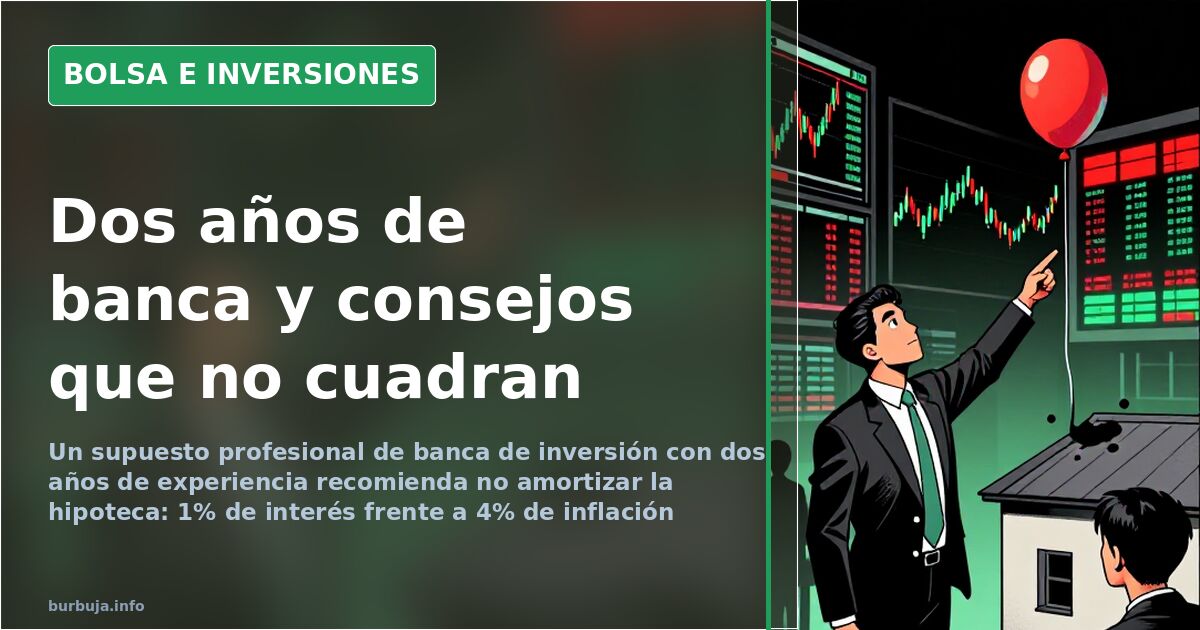
Don't pay down the mortgage: you're paying 1% while inflation runs at 4%
Two years of hands-on experience. That’s the credential someone uses to present themselves as a financial services professional, promise honesty and truthfulness “at 90%” — the other 10% goes unexplained — and offer to answer whatever savings and investment questions come their way. Soon enough, they’re recommending virtual currencies. And the conversation ends up feeling like an interrogation.
They say they work in investment banking, in the wholesale segment, and that their unit generates several million euros a month in profit. They don’t show a single figure to back it up. It doesn’t matter: someone reminds them that there are people with more than fifteen years of experience modelling risk and taking apart Black-Scholes, Merton or Hull. Their defense is Excel and VBA. And a line that captures the trade: experience is relative; what you need is to know how to sell hot air.
Why does the adviser recommend not paying down the mortgage?
A saver who puts away 10,000 euros a year asks what to do with it. The answer is blunt: don't pay down the mortgage. Pay down 9,000 euros this tax year to claim the tax relief and leave the rest untouched, because the loan is being paid at a rate of around 1% while inflation is around 4%. The underlying reasoning is that borrowing at those prices is free, even profitable.
It doesn’t hold up without a condition nobody puts on the table, as another participant objects. The real interest rate on a loan does not equal inflation minus the nominal interest rate unless the borrower’s income rises at the same pace as prices. With a net salary of 1,000 euros and a payment of 400, the mortgage eats up 40% of the paycheck; with 5% annual pay raises for five years, the salary climbs to 1,300 and the burden eases on its own. Without those raises, inflation doesn’t pay the mortgage: it makes it more expensive. Anyone who claims otherwise is selling a blackboard equation as if it were a paycheck.
From IE to fixed-term deposits: where the story loses its footing
On business schools, he sets out his own hierarchy: IE is a second-tier option, IESE or ESADE are better. A safe-conduct pass. Later comes the uncomfortable question: how long will the order from Banco de España (Spain's central bank) to pay 1% on fixed-term deposits last. And the question a saver with more than 100,000 euros actually asks — what suits them and what hurts the bank — goes unanswered in any useful way.
There’s a pattern. The answers rarely go beyond one line: investment banking, virtual currencies. When it’s time to justify, he changes the subject or promises to answer later. In the end, the conversation lacks the one thing that was asked of it: the math. The distrust reaches such a point that someone asks whether prior experience was really needed for that.
Virtual currencies and the rest of the investment menu
What’s the best investment right now: virtual currencies. On which sector to choose or which market, domestic or US, there’s no elaboration. The star recommendation provokes the most reasonable comeback of the day: a virtual currency generates nothing, it’s supported only by its own price, so it’s worth deciding whether that’s investing or speculating. The question is left hanging.
What does appear is a different and much more elaborate thesis, put forward by another forum user: in economic depressions, the enemy to beat is, in his view, the State, which turns into a hungry beast and always targets the “stragglers of the herd.” Hence a strategy: move to the periphery, to sparsely populated areas where it isn’t worth going to look for anyone, and hedge with assets that gain value in a hypothetical break-up of the euro. Gold buried under the lettuce in the garden, summed up wryly. No one puts figures on the scenario, nor is there any need for it to sound more solid than a desk-bound headline.
The question that remains unanswered
Ten thousand euros of annual savings, a mortgage at 1% and inflation at 4%. With those three numbers you can build any story and also take it apart. What began as a query ended up resembling an interrogation, and the conclusion is that no one knows whether the person answering really had an office or an Excel spreadsheet open in the living room. How long does it take a reader to detect that the advice they’re being given doesn’t come with the numbers to back it up?
Two years of hands-on experience. That’s the credential someone uses to present themselves as a financial services professional, promise honesty and truthfulness “at 90%” — the other 10% goes unexplained — and offer to answer whatever savings and investment questions come their way. Soon enough, they’re recommending virtual currencies. And the conversation ends up feeling like an interrogation.
They say they work in investment banking, in the wholesale segment, and that their unit generates several million euros a month in profit. They don’t show a single figure to back it up. It doesn’t matter: someone reminds them that there are people with more than fifteen years of experience modelling risk and taking apart Black-Scholes, Merton or Hull. Their defense is Excel and VBA. And a line that captures the trade: experience is relative; what you need is to know how to sell hot air.
Why does the adviser recommend not paying down the mortgage?
A saver who puts away 10,000 euros a year asks what to do with it. The answer is blunt: don't pay down the mortgage. Pay down 9,000 euros this tax year to claim the tax relief and leave the rest untouched, because the loan is being paid at a rate of around 1% while inflation is around 4%. The underlying reasoning is that borrowing at those prices is free, even profitable.
It doesn’t hold up without a condition nobody puts on the table, as another participant objects. The real interest rate on a loan does not equal inflation minus the nominal interest rate unless the borrower’s income rises at the same pace as prices. With a net salary of 1,000 euros and a payment of 400, the mortgage eats up 40% of the paycheck; with 5% annual pay raises for five years, the salary climbs to 1,300 and the burden eases on its own. Without those raises, inflation doesn’t pay the mortgage: it makes it more expensive. Anyone who claims otherwise is selling a blackboard equation as if it were a paycheck.
From IE to fixed-term deposits: where the story loses its footing
On business schools, he sets out his own hierarchy: IE is a second-tier option, IESE or ESADE are better. A safe-conduct pass. Later comes the uncomfortable question: how long will the order from Banco de España (Spain's central bank) to pay 1% on fixed-term deposits last. And the question a saver with more than 100,000 euros actually asks — what suits them and what hurts the bank — goes unanswered in any useful way.
There’s a pattern. The answers rarely go beyond one line: investment banking, virtual currencies. When it’s time to justify, he changes the subject or promises to answer later. In the end, the conversation lacks the one thing that was asked of it: the math. The distrust reaches such a point that someone asks whether prior experience was really needed for that.
Virtual currencies and the rest of the investment menu
What’s the best investment right now: virtual currencies. On which sector to choose or which market, domestic or US, there’s no elaboration. The star recommendation provokes the most reasonable comeback of the day: a virtual currency generates nothing, it’s supported only by its own price, so it’s worth deciding whether that’s investing or speculating. The question is left hanging.
What does appear is a different and much more elaborate thesis, put forward by another forum user: in economic depressions, the enemy to beat is, in his view, the State, which turns into a hungry beast and always targets the “stragglers of the herd.” Hence a strategy: move to the periphery, to sparsely populated areas where it isn’t worth going to look for anyone, and hedge with assets that gain value in a hypothetical break-up of the euro. Gold buried under the lettuce in the garden, summed up wryly. No one puts figures on the scenario, nor is there any need for it to sound more solid than a desk-bound headline.
The question that remains unanswered
Ten thousand euros of annual savings, a mortgage at 1% and inflation at 4%. With those three numbers you can build any story and also take it apart. What began as a query ended up resembling an interrogation, and the conclusion is that no one knows whether the person answering really had an office or an Excel spreadsheet open in the living room. How long does it take a reader to detect that the advice they’re being given doesn’t come with the numbers to back it up?
Summary of a discussion on Burbuja.info - Foro de economía, actualidad y política., translated from Spanish and reviewed before publication. Read the full discussion (272 replies).
More summaries
-
Banco de España Silver Coins: From €12 to €30 Face Value
Explore the evolution of Banco de España's silver coins, from their €12 face value to €30, as silver prices fluctuated. Discover why these collectibles are now scarce.
-
Banco de España's €12 coin now matches its silver face value
Commemorative €12 silver coin briefly exceeded its face value. Daily limits and rush to exchange them at the bank fueled the trend.
-
Buying the Dip or Waiting for Crash: The 2025 Market Dilemma
Centene experienced a 25% fall, AI technology is dividing investors, and market crash predictions are mounting for November. The 2025 investment dilemma: buy now or wait?
-
Gold stuck at 0.382 as bitcoin takes the spotlight
Gold stuck at 0.382 and unable to recover while bitcoin hits 6.000 dollars; thresholds at 1.250 and 1.050 set the scene.
-
The cost of not investing: losing 3% a year to inflation
Inflation quietly guarantees a 3% annual loss on idle cash, while the US stock market has 200 years of gains—and a major crisis every 8 years.
-
Extra virgin olive oil falls to €6.35 a litre at Mercadona
Extra virgin olive oil is now €6.35/litre at Mercadona, down from €6.75 months ago, while the origin price of picual is €4.143/kg