
Extra virgin olive oil falls to €6.35 a litre at Mercadona
Extra virgin olive oil is now €6.35/litre at Mercadona, down from €6.75 months ago, while the origin price of picual is €4.143/kg
English · Original discussion in Spanish · Published
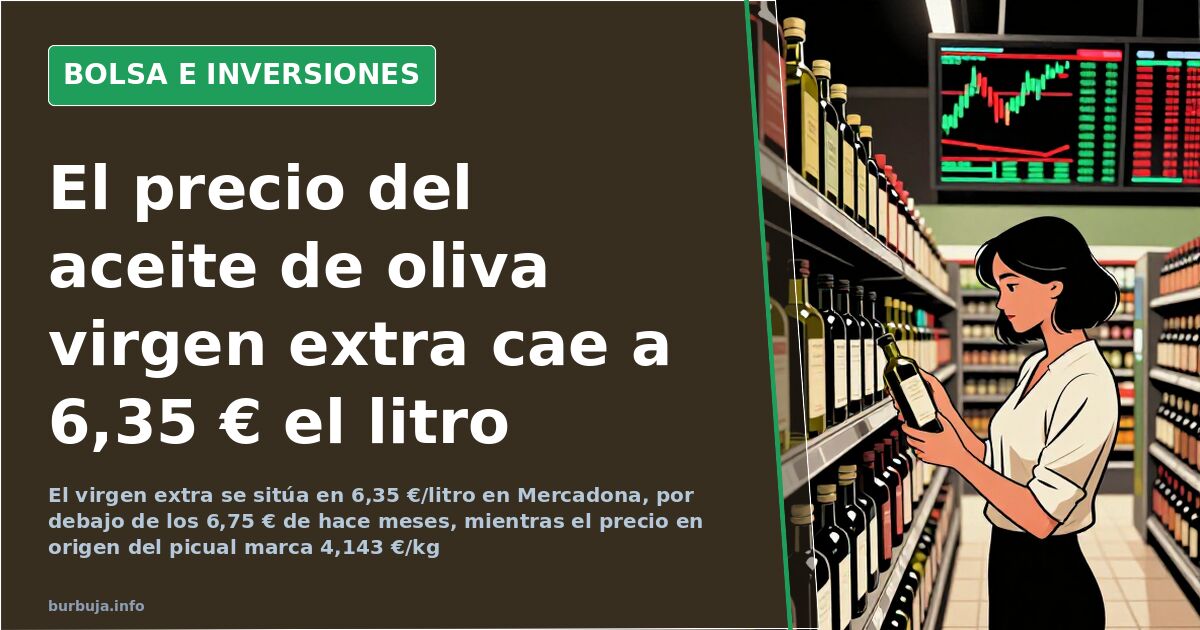
Extra virgin olive oil falls from €6.75 to €6.35 a litre
The price of extra virgin olive oil is falling and it is already showing on the shelf. A litre that was around €6.75 at Mercadona has been seen below €6.50 at other chains, according to shoppers themselves, and one of them says they saw the three-litre bottle at €5.80. On 7 January 2025 a litre was selling for €6.35 at Mercadona, according to tracking by shoppers themselves.
Nobody has given anything away. The drop is coming through two simultaneous routes: the new harvest beginning to arrive at the mills and the stocks from the previous campaign that need to be shifted before they go old in the warehouse. Clear stock however possible, say those who argue the move is more commercial than agricultural.
Why is the price of olive oil falling?
The strongest argument is a matter of timing: the campaign started more than a month ago and, according to one participant, forecasts point to a harvest increase of around 50%. Much of what is being bought now is oil from last campaign. That does not make it worse, only cheaper: the market is already pricing in what is still to come.
The other leg is stock. The three previous campaigns were consecutively above average and each larger than the last. Average European production in recent years stands at 1,834 thousand tonnes, and then came 1,920, 2,051 and an extraordinary 2,273. With tanks overflowing, the mills needed cash and the wholesale price in Andalucía went to €2. That hangover is still being paid for now.
Origin prices that set the floor for a litre
The hard data comes from the origin price table for 8 January 2025. Picual extra virgin was quoted at €4.143/kg; virgin at €3.900; and lampante at €3.764. What stands out is how little separates the best quality from the worst: just over 24 cents per kilo between extra virgin and virgin, and about 38 cents between extra virgin and lampante.
Between that origin price and what is paid at the till there is a difference of more than two euros. That is where packaging, distribution, logistics and margin live. When the origin price moves, the shelf takes time to notice; when the shelf price falls, the origin price has already been falling for months. That is the natural order of this chain.
The consumption that broke: air fryer and high-oleic sunflower oil
Here is the real damage. A good part of consumption has adjusted downwards, and not because of one month's prices but because of habit. Some have gone from using eight bottles a year to two, some have stopped frying and only dress salads, and some have discovered that high-oleic sunflower oil works better for cooking because food sticks less.
The air fryer has done the rest. A device that roasts instead of frying drastically reduces the amount of oil that passes through the kitchen. With that change already made, turning back is not automatic. And another figure repeated in the thread weighs on global consumption: olive oil would account for just 1% of all oils consumed on the planet.
Oil traceability: an unaudited suspicion
There is a current of opinion highly critical of labelling. It claims, without providing evidence, that oil traceability is not audited rigorously enough and that some of what is sold as top-quality extra virgin might not be. It is an accusation thrown out into the air and no one has proved it.
Along the same lines, some claim that good extra virgin leaves sediment at the bottom of the bottle during winter and that, without that sediment, the oil is not authentic. That too has no technical backing in what has been discussed. What can be read in the thread is that distrust has taken hold and that many shoppers now look at the label more suspiciously than four years ago.
US tariffs and the missing bearish scenario
One piece is still to fall: tariffs. If the United States taxes Spanish oil, the product will have to find outlets through other routes, with foreign intermediaries in between, and that oversupply would push the origin price down. That is the argument used by those hoping to see extra virgin much cheaper than it is.
The optimistic scenario talks about €4, even €3. The pessimistic one recalls that good branded oil is still at €9-10 a litre and that what is falling is the budget range. Between the two, a detail that does not fit: at origin, the quality grades are almost level with each other. If extra virgin is not worth much more than lampante, the room for the top one to cheapen on its own is narrow.
The thread speculates that the litre may keep falling over the coming months, driven by the new harvest and by consumption that has already broken the habit. With reservations: the €4 or even €3 that some predict are still a forecast, not a fact.
The price of extra virgin olive oil is falling and it is already showing on the shelf. A litre that was around €6.75 at Mercadona has been seen below €6.50 at other chains, according to shoppers themselves, and one of them says they saw the three-litre bottle at €5.80. On 7 January 2025 a litre was selling for €6.35 at Mercadona, according to tracking by shoppers themselves.
Nobody has given anything away. The drop is coming through two simultaneous routes: the new harvest beginning to arrive at the mills and the stocks from the previous campaign that need to be shifted before they go old in the warehouse. Clear stock however possible, say those who argue the move is more commercial than agricultural.
Why is the price of olive oil falling?
The strongest argument is a matter of timing: the campaign started more than a month ago and, according to one participant, forecasts point to a harvest increase of around 50%. Much of what is being bought now is oil from last campaign. That does not make it worse, only cheaper: the market is already pricing in what is still to come.
The other leg is stock. The three previous campaigns were consecutively above average and each larger than the last. Average European production in recent years stands at 1,834 thousand tonnes, and then came 1,920, 2,051 and an extraordinary 2,273. With tanks overflowing, the mills needed cash and the wholesale price in Andalucía went to €2. That hangover is still being paid for now.
Origin prices that set the floor for a litre
The hard data comes from the origin price table for 8 January 2025. Picual extra virgin was quoted at €4.143/kg; virgin at €3.900; and lampante at €3.764. What stands out is how little separates the best quality from the worst: just over 24 cents per kilo between extra virgin and virgin, and about 38 cents between extra virgin and lampante.
Between that origin price and what is paid at the till there is a difference of more than two euros. That is where packaging, distribution, logistics and margin live. When the origin price moves, the shelf takes time to notice; when the shelf price falls, the origin price has already been falling for months. That is the natural order of this chain.
The consumption that broke: air fryer and high-oleic sunflower oil
Here is the real damage. A good part of consumption has adjusted downwards, and not because of one month's prices but because of habit. Some have gone from using eight bottles a year to two, some have stopped frying and only dress salads, and some have discovered that high-oleic sunflower oil works better for cooking because food sticks less.
The air fryer has done the rest. A device that roasts instead of frying drastically reduces the amount of oil that passes through the kitchen. With that change already made, turning back is not automatic. And another figure repeated in the thread weighs on global consumption: olive oil would account for just 1% of all oils consumed on the planet.
Oil traceability: an unaudited suspicion
There is a current of opinion highly critical of labelling. It claims, without providing evidence, that oil traceability is not audited rigorously enough and that some of what is sold as top-quality extra virgin might not be. It is an accusation thrown out into the air and no one has proved it.
Along the same lines, some claim that good extra virgin leaves sediment at the bottom of the bottle during winter and that, without that sediment, the oil is not authentic. That too has no technical backing in what has been discussed. What can be read in the thread is that distrust has taken hold and that many shoppers now look at the label more suspiciously than four years ago.
US tariffs and the missing bearish scenario
One piece is still to fall: tariffs. If the United States taxes Spanish oil, the product will have to find outlets through other routes, with foreign intermediaries in between, and that oversupply would push the origin price down. That is the argument used by those hoping to see extra virgin much cheaper than it is.
The optimistic scenario talks about €4, even €3. The pessimistic one recalls that good branded oil is still at €9-10 a litre and that what is falling is the budget range. Between the two, a detail that does not fit: at origin, the quality grades are almost level with each other. If extra virgin is not worth much more than lampante, the room for the top one to cheapen on its own is narrow.
The thread speculates that the litre may keep falling over the coming months, driven by the new harvest and by consumption that has already broken the habit. With reservations: the €4 or even €3 that some predict are still a forecast, not a fact.
Summary of a discussion on Burbuja.info - Foro de economía, actualidad y política., translated from Spanish and reviewed before publication. Read the full discussion (327 replies).
More summaries
-
Oil Heads Towards $120: China Returns and US Reserves Drop
Crude for immediate delivery commands a premium of up to $15 over six-month contracts: China is buying again, US reserves fall to 40%, and the target...
-
Gold stuck at 0.382 as bitcoin takes the spotlight
Gold stuck at 0.382 and unable to recover while bitcoin hits 6.000 dollars; thresholds at 1.250 and 1.050 set the scene.
-
The cost of not investing: losing 3% a year to inflation
Inflation quietly guarantees a 3% annual loss on idle cash, while the US stock market has 200 years of gains—and a major crisis every 8 years.
-
BIG offers 4% TAE on 6-month deposit with Spanish IBAN and Portuguese FGD
BIG launched a 4% TAE six-month and 3.5% three-month deposit in May 2023 with Spanish IBAN and Portuguese FGD, but later cut rates and had opening delays.
-
Spot-price coins: the seller whose paper trail didn't add up
He offered quarter-ounce gold coins at spot price and racked up undelivered orders. Buyers cross-checked his details and several got their money back.
-
Goldsilver.be: a €5,000 order and a YouTube-restricted video
A €5,000+ order on Goldsilver.be vanishes in Belgium. The shop refuses responsibility, and YouTube restricts the video exposing it.