
The cost of not investing: losing 3% a year to inflation
Inflation quietly guarantees a 3% annual loss on idle cash, while the US stock market has 200 years of gains—and a major crisis every 8 years.
English · Original discussion in Spanish · Published
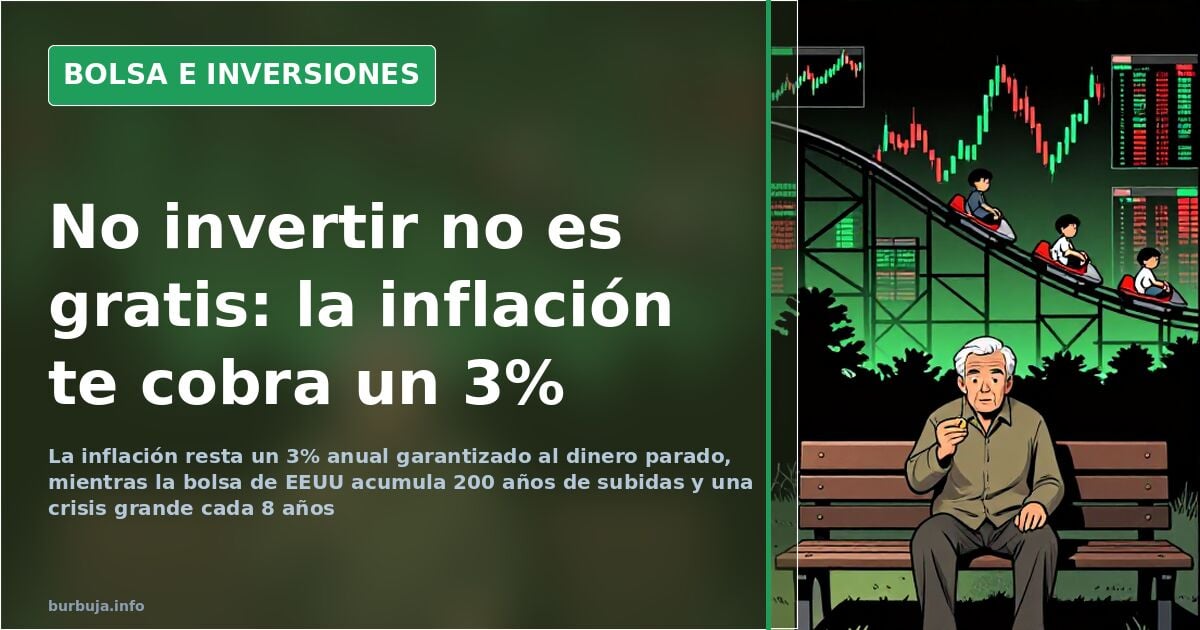
Not investing is also a bet: inflation charges its 3% a year
Not investing is an investment decision, and rarely the most prudent one. Money sitting still in an account isn’t still: it loses purchasing power at the rate of inflation, a cost pegged at 3% a year on net money, after taxes, with one key difference from any alternative: that loss is certain, while the alternative offers only probability. That’s where it all starts. Whoever says “there’s a greater chance it goes wrong than right” is describing the short term, not a twenty-year portfolio.
Why is not investing also losing money?
The paradox is set out with two envelopes. Envelope A guarantees losing 3% of everything you earn; envelope B offers the possibility—not the certainty—of gaining something in exchange for the chance of losing part or all of it. Envelope A is called inflation. B is investment. Whoever chooses A hasn’t eliminated risk: they’ve chosen known risk. Some go further and argue that the euro is “a bond or debt issued by the ECB” that depreciates every year and that only gold is real money. It’s a debatable thesis, but it explains why some conservative savings seek refuge in things that can’t be printed.
The classic counterargument—keeping savings in cash on hand—is also a market position: you’re long euros. The important nuance is that not all money should do the same job. There’s a cushion for unexpected events, money for everyday spending and, only after that, capital meant to produce returns. Putting money you’ll need in six months into the stock market is the fastest way to turn a bad patch into a real loss.
The US stock market has been rising for 200 years, but every 8 years comes the crash
The bullish argument rests on a long series: two hundred years of the US market rising, with equities spending more time going up than down since records began. The literature backs it up: a finance classic, A Random Walk Down Wall Street, shows that in any past period of ten years or more, the market has always ended positive. The corollary is uncomfortable: over short periods, anyone can get clobbered.
The other half of the sentence weighs as much as the first. In the short term, chance rules: the market can rise, fall or hit you with a -50% crisis in six months, and roughly every eight years a major shock arrives. Defenders of this route don’t hide the risk. They point to simple vehicles—ETFs on the SP500 and NASDAQ—to taking profits every five years and to a rule of conduct: they distinguish between the impatient, who sell what rises and what falls before it can breathe, and the patient, who are on the side of returns.
The window dressing of indices: the IBEX with the companies of 30 years ago
Here’s the most uncomfortable argument for index devotees. Benchmarks are revised: companies doing badly drop out and those doing well are added. It’s argued, with a hint of sarcasm, that this mechanism is the product’s main cosmetic trick and that the phrase “the market always rises” rests on a picture retouched every quarter. The proposed exercise is simple: rebuild the IBEX with the same companies as thirty years ago, some of them bankrupt, and measure what would really have peine.
The index funds’ reply is geographic rather than faith-based: the problem isn’t the instrument, it’s the chosen market. The SP500 or the Russell play in another league; the IBEX is best avoided, they say. And there’s a detail that elegantly settles the discussion: Google didn’t exist thirty years ago, but the slot it occupied was filled by another company that isn’t in the index today. In other words, the old index wouldn’t have been the old index either.
Who lost everything, and why that invalidates nothing
There are cases of investors left with nothing. It’s worth saying which: those who used leverage, those who concentrated their portfolio in a single name, and those who bought the bank that failed. History repeats itself with proper names. In 1929, some discovered they were “a very shrewd trader” because everything they bought went up—and that they never sold in time: you could close your eyes, put your finger on the wall board and the stock you bought would rise no matter what.
The other data point from the last century is pure arithmetic. The equivalent of 240.000 dollars on 24 October 1929 is 3.857.303,99 dollars in August 2021: inflation over the period, 1.507%, multiplied the cost-of-living index more than sixteenfold. Any savings that don’t earn above that figure aren’t standing still; they’re going backwards.
The cost that isn’t in the brochure: fees, taxes and time
Let’s add up the enemies. Expenses, fees and taxes take a cut of other people’s effort without taking on the risk: the intermediary charges for trading even when the trade goes wrong. Legal, political and economic uncertainty adds noise. And time: analyzing balance sheets, reading accounts and tracking indicators takes hours every day. Some admit to spending three hours a day studying companies. The problem is the denominator: the same claim holds that 99% of those who invest have never read a stock market book in their lives. On that basis, the market looks like a casino.
Diversify or build layers: how those who don’t want shocks protect themselves
Those who have been at this a while have stopped arguing about being right and argue about structure. Some reduce the stock market to an anti-inflation refuge with “immortal stocks”, of the BlackRock or LVMH type, and stay away from cryptocurrencies and products they consider Ponzi schemes. Another, more repeated recipe is layers: money for everyday spending, which shouldn’t go beyond that; a cushion for emergencies—from a root canal to a car—; a low-volatility layer that moves slowly; and only at the end, the stock market. The recurring mistake is keeping only the first and fourth: when the unexpected arrives you have to sell, and you may have to do it at a loss.
Other paths give up financial returns entirely. Some stopped investing and channeled that money into a self-sufficient house with cultivable land, panels and a mini-tractor: four years of construction and the hope of three more years of work to finish it. And some argue that the only thing that truly pays off is investing in yourself. Neither is a surrender: they’re ways of choosing which risk you want to take.
With these ingredients, what’s predictable is that the gap won’t close in the short term: those with twenty years ahead will keep buying global indices every month, and those who depend on their paycheck to live will keep preferring liquidity, even if it costs them 3% a year. The only statistical certainty the matter leaves behind is uncomfortable for both sides: there is no option of not betting.
Not investing is an investment decision, and rarely the most prudent one. Money sitting still in an account isn’t still: it loses purchasing power at the rate of inflation, a cost pegged at 3% a year on net money, after taxes, with one key difference from any alternative: that loss is certain, while the alternative offers only probability. That’s where it all starts. Whoever says “there’s a greater chance it goes wrong than right” is describing the short term, not a twenty-year portfolio.
Why is not investing also losing money?
The paradox is set out with two envelopes. Envelope A guarantees losing 3% of everything you earn; envelope B offers the possibility—not the certainty—of gaining something in exchange for the chance of losing part or all of it. Envelope A is called inflation. B is investment. Whoever chooses A hasn’t eliminated risk: they’ve chosen known risk. Some go further and argue that the euro is “a bond or debt issued by the ECB” that depreciates every year and that only gold is real money. It’s a debatable thesis, but it explains why some conservative savings seek refuge in things that can’t be printed.
The classic counterargument—keeping savings in cash on hand—is also a market position: you’re long euros. The important nuance is that not all money should do the same job. There’s a cushion for unexpected events, money for everyday spending and, only after that, capital meant to produce returns. Putting money you’ll need in six months into the stock market is the fastest way to turn a bad patch into a real loss.
The US stock market has been rising for 200 years, but every 8 years comes the crash
The bullish argument rests on a long series: two hundred years of the US market rising, with equities spending more time going up than down since records began. The literature backs it up: a finance classic, A Random Walk Down Wall Street, shows that in any past period of ten years or more, the market has always ended positive. The corollary is uncomfortable: over short periods, anyone can get clobbered.
The other half of the sentence weighs as much as the first. In the short term, chance rules: the market can rise, fall or hit you with a -50% crisis in six months, and roughly every eight years a major shock arrives. Defenders of this route don’t hide the risk. They point to simple vehicles—ETFs on the SP500 and NASDAQ—to taking profits every five years and to a rule of conduct: they distinguish between the impatient, who sell what rises and what falls before it can breathe, and the patient, who are on the side of returns.
The window dressing of indices: the IBEX with the companies of 30 years ago
Here’s the most uncomfortable argument for index devotees. Benchmarks are revised: companies doing badly drop out and those doing well are added. It’s argued, with a hint of sarcasm, that this mechanism is the product’s main cosmetic trick and that the phrase “the market always rises” rests on a picture retouched every quarter. The proposed exercise is simple: rebuild the IBEX with the same companies as thirty years ago, some of them bankrupt, and measure what would really have peine.
The index funds’ reply is geographic rather than faith-based: the problem isn’t the instrument, it’s the chosen market. The SP500 or the Russell play in another league; the IBEX is best avoided, they say. And there’s a detail that elegantly settles the discussion: Google didn’t exist thirty years ago, but the slot it occupied was filled by another company that isn’t in the index today. In other words, the old index wouldn’t have been the old index either.
Who lost everything, and why that invalidates nothing
There are cases of investors left with nothing. It’s worth saying which: those who used leverage, those who concentrated their portfolio in a single name, and those who bought the bank that failed. History repeats itself with proper names. In 1929, some discovered they were “a very shrewd trader” because everything they bought went up—and that they never sold in time: you could close your eyes, put your finger on the wall board and the stock you bought would rise no matter what.
The other data point from the last century is pure arithmetic. The equivalent of 240.000 dollars on 24 October 1929 is 3.857.303,99 dollars in August 2021: inflation over the period, 1.507%, multiplied the cost-of-living index more than sixteenfold. Any savings that don’t earn above that figure aren’t standing still; they’re going backwards.
The cost that isn’t in the brochure: fees, taxes and time
Let’s add up the enemies. Expenses, fees and taxes take a cut of other people’s effort without taking on the risk: the intermediary charges for trading even when the trade goes wrong. Legal, political and economic uncertainty adds noise. And time: analyzing balance sheets, reading accounts and tracking indicators takes hours every day. Some admit to spending three hours a day studying companies. The problem is the denominator: the same claim holds that 99% of those who invest have never read a stock market book in their lives. On that basis, the market looks like a casino.
Diversify or build layers: how those who don’t want shocks protect themselves
Those who have been at this a while have stopped arguing about being right and argue about structure. Some reduce the stock market to an anti-inflation refuge with “immortal stocks”, of the BlackRock or LVMH type, and stay away from cryptocurrencies and products they consider Ponzi schemes. Another, more repeated recipe is layers: money for everyday spending, which shouldn’t go beyond that; a cushion for emergencies—from a root canal to a car—; a low-volatility layer that moves slowly; and only at the end, the stock market. The recurring mistake is keeping only the first and fourth: when the unexpected arrives you have to sell, and you may have to do it at a loss.
Other paths give up financial returns entirely. Some stopped investing and channeled that money into a self-sufficient house with cultivable land, panels and a mini-tractor: four years of construction and the hope of three more years of work to finish it. And some argue that the only thing that truly pays off is investing in yourself. Neither is a surrender: they’re ways of choosing which risk you want to take.
With these ingredients, what’s predictable is that the gap won’t close in the short term: those with twenty years ahead will keep buying global indices every month, and those who depend on their paycheck to live will keep preferring liquidity, even if it costs them 3% a year. The only statistical certainty the matter leaves behind is uncomfortable for both sides: there is no option of not betting.
Summary of a discussion on Burbuja.info - Foro de economía, actualidad y política., translated from Spanish and reviewed before publication. Read the full discussion (120 replies).
More summaries
-
Indexed Funds: Tax Deferral Isn't What You Think
A calculator adapted for Spain reveals that tax deferral in indexed funds merely delays paying taxes, and inflation can eat away at the...
-
Gold stuck at 0.382 as bitcoin takes the spotlight
Gold stuck at 0.382 and unable to recover while bitcoin hits 6.000 dollars; thresholds at 1.250 and 1.050 set the scene.
-
Extra virgin olive oil falls to €6.35 a litre at Mercadona
Extra virgin olive oil is now €6.35/litre at Mercadona, down from €6.75 months ago, while the origin price of picual is €4.143/kg
-
BIG offers 4% TAE on 6-month deposit with Spanish IBAN and Portuguese FGD
BIG launched a 4% TAE six-month and 3.5% three-month deposit in May 2023 with Spanish IBAN and Portuguese FGD, but later cut rates and had opening delays.
-
Spot-price coins: the seller whose paper trail didn't add up
He offered quarter-ounce gold coins at spot price and racked up undelivered orders. Buyers cross-checked his details and several got their money back.
-
Goldsilver.be: a €5,000 order and a YouTube-restricted video
A €5,000+ order on Goldsilver.be vanishes in Belgium. The shop refuses responsibility, and YouTube restricts the video exposing it.