
Turning off just the freezer on your fridge: why it's almost never possible
Switching off only the freezer of a combi fridge is almost never possible: without two compressors, cutting the circuit leaves the appliance without any cooling.
English · Original discussion in Spanish · Published
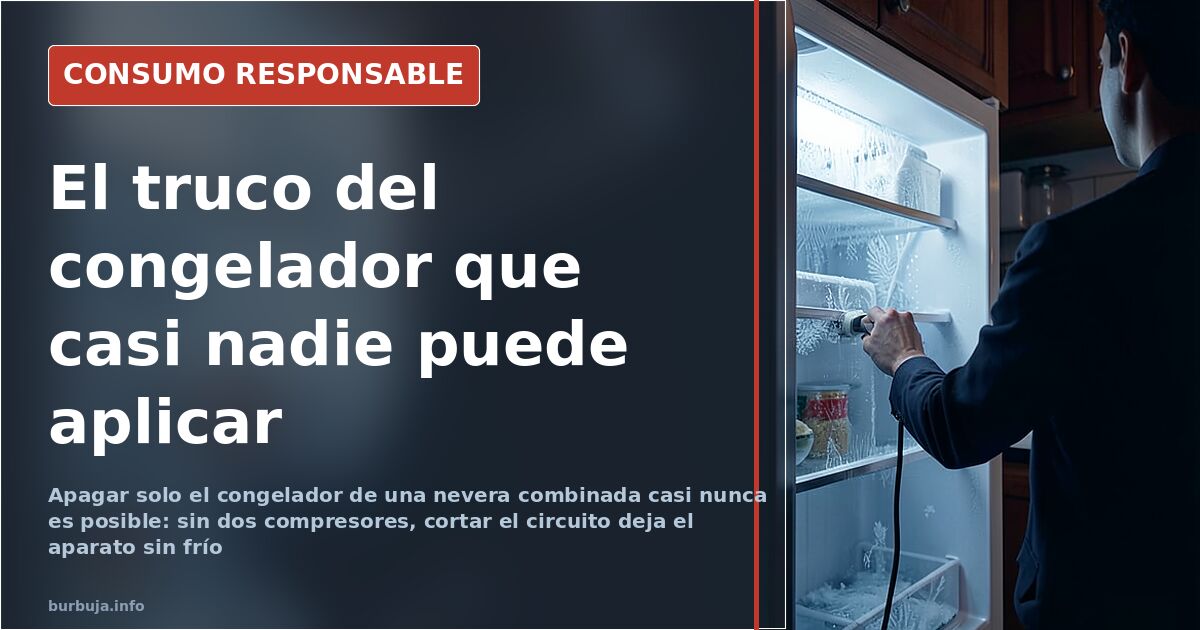
Turning off the freezer on your fridge: when the savings are impossible
The idea sounds perfect: if you don't use the freezer, switch it off and save its share of the bill. The problem is that in most older fridge-freezers —freezer on top, fridge below— that selective shutdown doesn't exist. There are no two circuits you can separate, just a single compressor and a single evaporator distributing cold throughout the appliance. Cutting the freezer's wire doesn't reduce the bill: it leaves the fridge without working at all.
The starting point of this case is a consumption of 1.7 kWh per day in an old-style two-door fridge. The temptation to shave that down is logical: it's one of the appliances that stays on the most hours and one of the ones whose efficiency degrades the worst. But the physics of the appliance rules.
Why can't you switch off just the freezer?
The short answer is that the cooling architecture isn't designed to be divided. It only makes sense in fridges equipped with two compressors, one per zone, where you could simply disconnect the power to the freezer's compressor and leave the other running. In the rest, there's one compressor feeding a shared evaporator.
Hence the idea of cutting the wire going to the freezer isn't a saving but a breakdown. The system doesn't understand doors: it either cools the whole thing or cools nothing.
The no-frost case and the ice that builds up
There's one scenario where the idea of "removing the freezer function" has some technical merit, though not the one the saver imagines. In some no-frost models, the defrost system fails over the years and a block of ice forms on the coil. There, people do speculate about temporarily disabling that function so the ice melts, using the residual cold to keep the fridge section going.
It's a workshop hypothesis, not a home recipe. And it hides a warning: if the defrost cycle malfunctions, ice builds up faster and efficiency plummets. The reasonable goal isn't to switch anything off, but to have no ice. A frosted appliance uses more energy, and that does eventually show on the bill.
A full freezer doesn't lower consumption if you don't open it
There's a widespread belief that a full freezer uses less energy. The nuance matters: the advantage of keeping it full is that less air escapes each time you open the door. If you don't open it, it doesn't matter what's inside. Consumption is limited to what's lost through insulation, and that doesn't change by filling or emptying it.
The practical conclusion for anyone looking to trim the bill is uncomfortable: there's no shortcut in the freezer. It's time to look at the insulation, the set temperature or, quite simply, the age of the appliance. The idea of the cut wire remains just that, an idea.
Also available in: Deutsch
Summary of a discussion on Burbuja.info - Foro de economía, actualidad y política., translated from Spanish and reviewed before publication. Read the full discussion (8 replies).
More summaries
-
Fridge at 4°C and freezer at -18°C: the bill nobody measures
The official recommendation is a freezer at -18°C and a fridge between 2°C and 4°C, but measuring actual energy use debunks more than one myth about saving on your electricity bill.
-
Corberó: fridges last decades, washers fail in days
Users report Corberó fridges lasting 20 years while washers fail quickly. The Spanish brand faces a reputation crisis.
-
Carrefour fridges: cheap, but who actually makes them?
Carrefour-brand fridges are cheap but raise questions about who manufactures them. One forum user calculates energy savings while another rebuts the figures with real consumption data.
-
EU's €3 parcel levy ends AliExpress's cheap era
The EU's €3 per category fee sends AliExpress prices soaring: a €3 order now costs €11. The Chinese parcel model faces collapse.
-
LED spotlights: €3 fixtures vs €17 fixtures
LED spotlights for a 10 m² room: how many to install, whether to remove the transformer, and why some cost €3 and others €17, according to participants in the debate.
-
Chronic heartburn: from omeprazole to licorice root
A consumer has suffered heartburn and gas for five years, and omeprazole only brings temporary relief. Licorice root, Helicobacter and hiatal hernia are the focus of the discussion.