
Chronic heartburn: from omeprazole to licorice root
A consumer has suffered heartburn and gas for five years, and omeprazole only brings temporary relief. Licorice root, Helicobacter and hiatal hernia are the focus of the discussion.
English · Original discussion in Spanish · Published
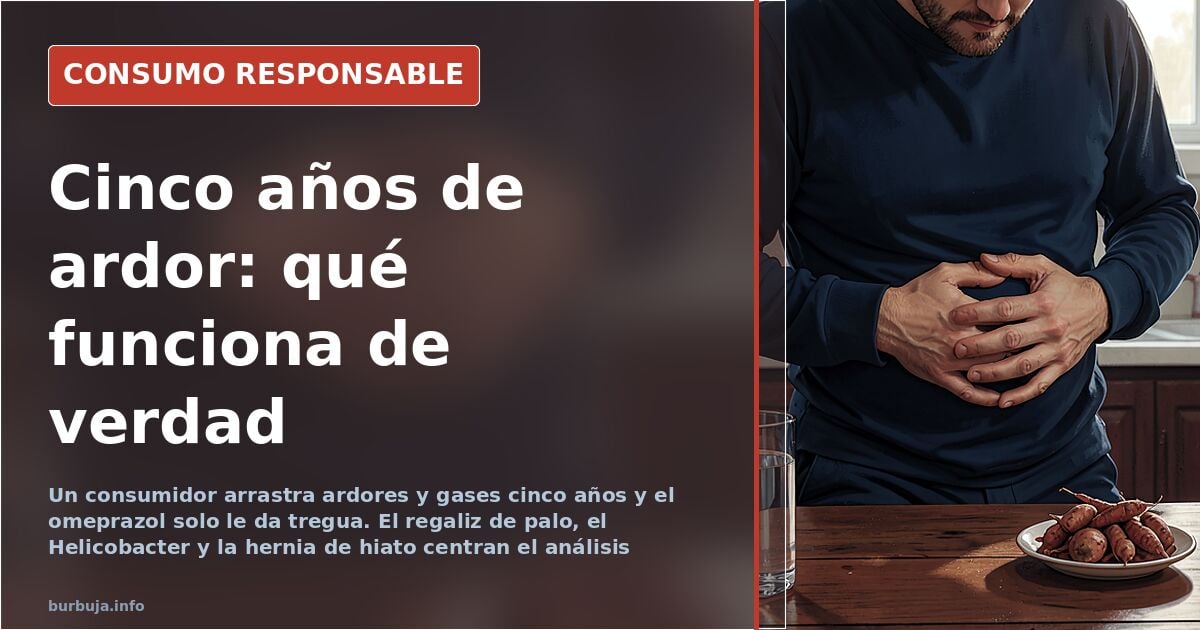
Five years of heartburn: what puts out the fire and what only masks it
Why does your stomach hurt after eating when the doctor says nothing serious is wrong? A regular consumer of beer, fast food and sauces has been dealing with heartburn and gas for five years and asks the question many people silently wonder about: is it the way he eats, or is there something more? His routine is like almost everyone's: an omeprazole when it flares up, which gives him relief for five days to a week, and an antacid he finds "stickier and heavier". The thread where he raises this doubt turns into a catalogue of suspects, home remedies and medical warnings worth reading carefully.
The usual suspects: gas, flour and dairy
The first answer is unanimous and admits no nuance: if you have gas, carbonated drinks are out. Beer, colas and sparkling water top the list of culprits for those who suffer bloating, although the author of the original post admits he finds it hard to give them up. The second line of thought points to flour products. Some report that drastically cutting back on biscuits, pastries and bread eliminated their reflux, and there is an even more radical case: giving up wheat and fibre made the gas disappear for two years, without being coeliac. The third route is milk. Whether whole or semi-skimmed is debated, but the conclusion that prevails is that what matters is not the fat but the origin: cow's milk. Goat's milk comes up as an alternative for those who suspect lactose intolerance.
Is it Helicobacter pylori or a hiatal hernia?
This is where the thread gets serious. Several posts insist on ruling out the Helicobacter pylori bacterium, which causes gastritis and ulcers, with a specific test. The treatment described is ten days of a cocktail of three antibiotics plus a stomach protector, around 140 pills, with a warning: if it fails the first time, the second round is more aggressive and resistant strains are transmitted. Against that theory, another voice argues the picture fits reflux and a possible hiatal hernia better, and reminds that poorly treated heartburn can burn the oesophagus. The warning is not trivial: Barrett's oesophagus and its risk of turning into cancer are mentioned. The repeated recommendation is to see a specialist and have a gastroscopy.
Licorice, baking soda and aloe vera: grandma's remedies
Among pills and antibiotics, licorice root takes the crown. One participant says he eats it fresh, frozen in season, and hasn't bought antacids since. A warning is given, though, about its effect on blood pressure. Baking soda, a teaspoon dissolved in saliva, appears as an emergency solution, with the warning not to overuse it because it can cause more heartburn. Aloe vera juice is mentioned as effective but bitter. And the dietary advice repeated most often: trinc an alkaline diet, cut out refined salt and white sugar, and don't lie down until three hours after eating.
The unsettling fact: the surgery that comes undone
The conversation drifts towards surgery. One participant who had hiatal hernia surgery by laparoscopy more than ten years ago explains that the repair has stretched over time and the reflux has returned. He takes omeprazole daily because a gastroscopy revealed gastritis. The conclusion another participant draws is bitter: if what was done comes undone in ten years, the risks of the operation aren't worth it. Antiestéticar of the operating room, of side effects and of the scar runs through several posts.
In the end, there is no answer to the original question. Every stomach has its own list of enemies and the only reliable method is elimination: cut out one suspect for two months and see what happens. The rest is faith, licorice or chemistry.
Summary of a discussion on Burbuja.info - Foro de economía, actualidad y política., translated from Spanish and reviewed before publication. Read the full discussion (63 replies).
More summaries
-
Spain: Reflux relief via posture, gluten and PPI limits
A Spanish patient finds upright posture after dinner stops reflux taste, while others blame gluten, fats or hiatal hernia.
-
Enantyum and Omeprazole: A Gastric Burn Combo
Combining Enantyum with omeprazole for sprains often causes severe heartburn, as the anti-inflammatory irritates the stomach while the PPI fails to protect it.
-
Coconut oil beats aloe vera for acne, forum user claims
A forum post argues coconut oil outperforms aloe vera for skin care, sparking debate on sun exposure, shower filters, and supplements.
-
Costco Spain Tire Service: Premium Brands, Balancing Issues
Costco offers Michelin, Pirelli, and Bridgestone tires at competitive prices in Spain, but a customer reports missing wheel balancing. Key service details.
-
Kodi for watching movies: powerful, free and a real headache
Kodi plays files from USB without trouble, but a catalog with cover art takes hours of setup and add-ons. A comparison with Stremio and Jellyfin.
-
LED spotlights: €3 fixtures vs €17 fixtures
LED spotlights for a 10 m² room: how many to install, whether to remove the transformer, and why some cost €3 and others €17, according to participants in the debate.