
Fridge at 4°C and freezer at -18°C: the bill nobody measures
The official recommendation is a freezer at -18°C and a fridge between 2°C and 4°C, but measuring actual energy use debunks more than one myth about saving on your electricity bill.
English · Original discussion in Spanish · Published
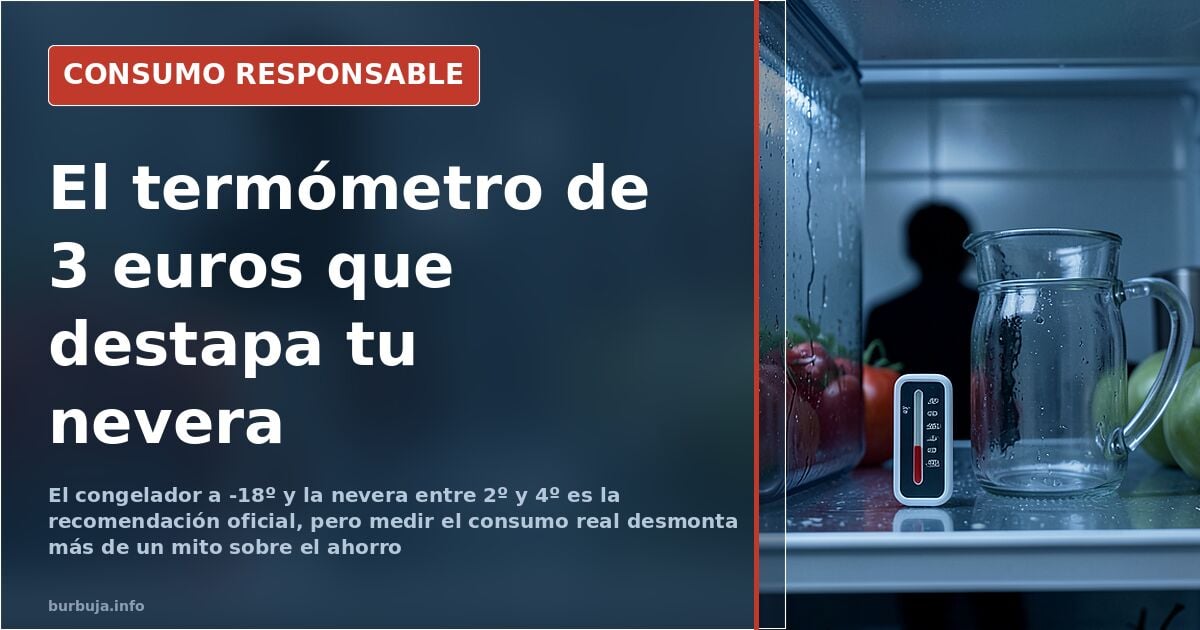
Fridge at 4°C and freezer at -18°C: the bill nobody measures
A digital thermometer of the kind sold online for aquariums and freezers, with a measurement range of -50 to +70 degrees, costs less than two coffees. With that device in hand, the question many people finally ask is a concrete one: what temperature should the fridge and freezer be set at so you don't overpay on your electricity bill? The official answer circulating in consumer guides puts the freezer at -18°C and the fridge between 2°C and 4°C. And that's where the confusion begins.
The fridge at 4°C: the number that doesn't convince everyone
The technical consensus exists and is easy to find: -18°C for the freezer and a range of 2°C to 4°C for the fridge. It's what food storage guides repeat and what's printed on most household thermostats. So far, nothing to argue with.
The problem is that theory clashes with the practice of anyone who looks at the energy label and does the math. Some argue that 2°C-4°C is too low and that raising it a couple of degrees is enough to make the compressor kick in less often. The logic is simple: the less often the motor starts up, the less it consumes. And the motor accounts for the largest share of the bill.
The reasonable doubt: how much do you actually save by raising the temperature one degree? The short answer is that it depends on the appliance, the insulation and how often the door is peine. The long answer requires measuring, and measuring is precisely what almost nobody does.
How much the compressor uses when it's not running
Here comes the surprising figure. With a power meter plugged into the fridge, the difference between keeping it at 5°C and at 6°C was a mere 0.5 watts in instantaneous consumption, always with the compressor off. In other words, practically nothing. The real cost isn't in the thermostat setting, it's in the number of hours the motor spends running.
The same experiment turned up another curiosity: opening the fridge door raises consumption by about 20 watts because of the interior light. This doesn't happen with the freezer, because it has none. Opening and closing the fridge without thinking costs more than the automatic gesture suggests.
The aquarium thermometer that works for the fridge
The tool that has brought the issue to the table is an LCD digital thermometer of the kind sold for aquariums and freezers, with a range of -50 to +70 degrees. It's cheap and does exactly what it's meant to do: tell you the actual temperature inside, not the one the dial shows.
Because the dial lies. The numbers on the thermostat (1, 2, 3, 4, 5, 6) aren't degrees, they're positions on an internal scale. One fridge with the dial at minimum might be at 8°C while another with the same setting is at 4°C. Without a separate thermometer, you're adjusting blind.
The freezer at -18°C and the enzyme limit
-18°C isn't arbitrary. At that temperature the enzymatic activity in food slows down, but doesn't stop entirely. Degradation continues, very slowly, which is why frozen meat doesn't last forever even when it's hard as a rock. It's a warning for anyone who treats the freezer as an infinite pantry.
Therein lies the awkward trade-off: lowering the temperature further protects food better but drives up consumption; raising it saves euros and shortens the shelf life of what you store. There's no single answer, and anyone claiming otherwise is selling something.
What is clear is that most household fridges have been running for years with the thermostat at a setting nobody has ever checked. A three-euro device and a free afternoon are enough to find out whether you're overpaying. The open question is how many people will keep adjusting by eye.
Also available in: Deutsch
Summary of a discussion on Burbuja.info - Foro de economía, actualidad y política., translated from Spanish and reviewed before publication. Read the full discussion (10 replies).
More summaries
-
Corberó: fridges last decades, washers fail in days
Users report Corberó fridges lasting 20 years while washers fail quickly. The Spanish brand faces a reputation crisis.
-
Fridge at 5.5 degrees: the thermostat dial isn't showing degrees
A thermometer reads 5.5 degrees on the top shelf and 4.5 below, with the dial set to position 2 of 8. The scale isn't degrees, and the recommended range is 4 to 5.
-
Carrefour fridges: cheap, but who actually makes them?
Carrefour-brand fridges are cheap but raise questions about who manufactures them. One forum user calculates energy savings while another rebuts the figures with real consumption data.
-
Mercadona salmon rip-off: tray fillets cost up to 78% more
Mercadona charges up to €25/kg for salmon tray fillets while a whole salmon costs €11/kg. Data and tips to save.
-
Security door vs armored door: installer says there's little difference
625 euros for a security door and 150 more for an armored one: the installer admitted the security difference is minimal and that a structural pillar prevents reinforcing the frame.
-
Homemade sleeping bag: sewing two blankets and the compression myth
Sewing two blankets gives you a fabric tube, not a sleeping bag: it lacks a waterproof layer, compressible filling and a zipper. The DIY version keeps you warm, but it won't fit in a backpack.