
LED spotlights: €3 fixtures vs €17 fixtures
LED spotlights for a 10 m² room: how many to install, whether to remove the transformer, and why some cost €3 and others €17, according to participants in the debate.
English · Original discussion in Spanish · Published
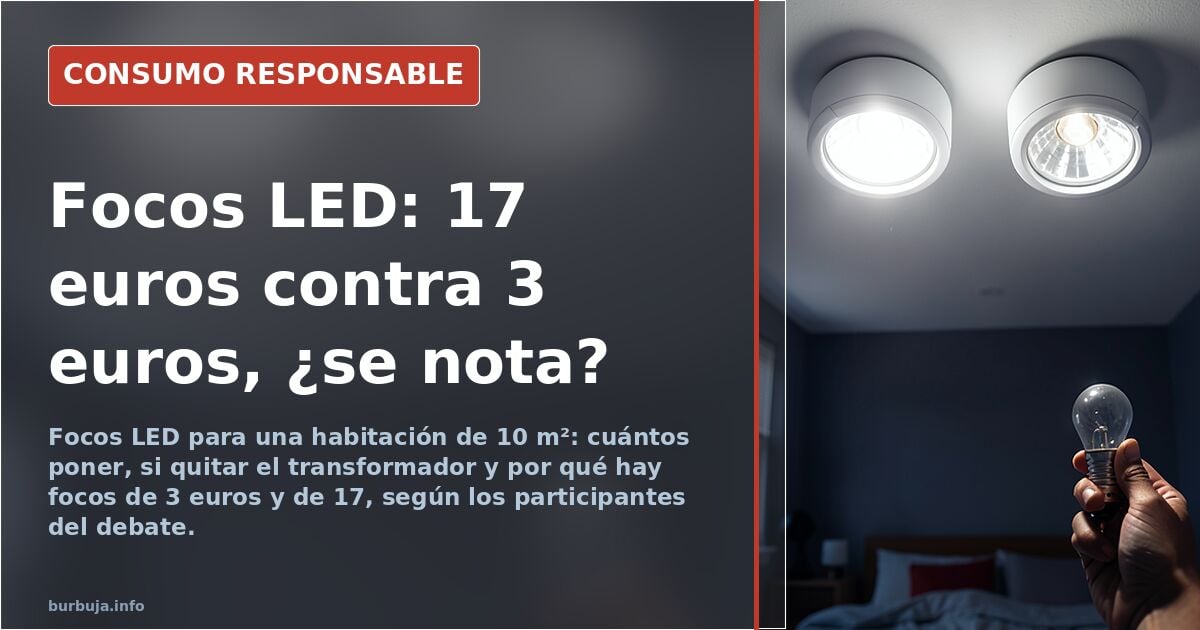
LED spotlights: €3 fixtures vs €17 fixtures
Replacing halogens with LEDs in a 10 m² room sounds like a straightforward decision. It isn't. The difference between a €17 spotlight and a €3 one is the core of the conversation about how to light a plasterboard ceiling without going broke or sitting in the dark.
The starting point comes from someone who wants to lower the ceiling of a small room and install LED spotlights to replace a low-energy bulb equivalent to a 70-80 W incandescent. The question seems simple: how many, what type, with a transformer or without one, and at what price. The answers reveal a world with more angles than it appears to have.
How many LED spotlights for 10 m²
According to a participant who has installed 6 W spotlights, LED light is more focused than halogen light, which means you need more units to cover the same area; they work in hallways and bathrooms, but spread out. For a 10 m² room, the thread discusses a range of 3 to 5 spotlights, with the option of splitting them across two switches so you can turn on only half.
The advice that keeps coming up: make them adjustable. Fixed ones fall short and don't allow you to correct the direction of the light. And tonalidad temperature matters as much as wattage: high Kelvin values give cold, bluish light, while low ones approach the yellow of an incandescent bulb.
Transformer or no transformer: the debate that decides the installation
This is where most of the technical discussion concentrates. Some argue for going straight to 220 V with a GU10 socket: you eliminate the transformer, gain a wider variety of bulbs, and avoid the transformer's residual consumption. The opposing argument points out that a transformer consumes in proportion to the load, so with a 5 W LED its usage drops to a fraction of a watt, according to a calculation circulating in the thread.
The real problem, according to participants, comes with electronic transformers: when they detect low consumption, they can cut out and make the LED flicker. The alternative proposed is to replace them with magnetic ones or switch to 220 V. Magnetic transformers, in turn, are designed for higher loads, and with LEDs they can vibrate and hum.
The price: €3 vs €17
The range is wide. At one end, a participant says they bought 6.4 W LED spotlights at 220 V for €3 each, socket included, from Asian online stores. At the other, 6 W spotlights at €17 with a three-year warranty, spare parts available for ten years, and an aluminum body heavier than a conventional halogen. In between, 7.5 W LED bulbs for €9.99 and models from well-known brands of 9.5 W and 806 lumens for €9.6.
The question hanging in the air: can you tell the difference? Those who have tried both say yes, that the expensive ones light better and the light is warmer. Those who go for the cheap ones argue that paying five times more for "quality" isn't justified. The honest answer is that it depends on how many spotlights you install and how much you care about tonalidad.
The conversation stalls at a point nobody settles: there is no objective way to compare LED spotlights without measuring lumens, tonalidad temperature, and tonalidad rendering. And hardly anyone does.
Also available in: Deutsch
Summary of a discussion on Burbuja.info - Foro de economía, actualidad y política., translated from Spanish and reviewed before publication. Read the full discussion (26 replies).
More summaries
-
LED strips to replace spotlights: 2,040 lumens per metre and €7 profiles
A 20 W/m SMD3014 strip delivers 2,040 lumens per metre, more than many SMD5050 strips. The limit isn't the LED: it's the €7/m aluminium profile and cooling.
-
Replacing every bulb with LED: when it pays off and when it doesn't
Swapping every bulb for LED doesn't always pay off: a hallway used 3 minutes a day never recoups the cost, a living room does. The real savings lie in timers and off-peak rates.
-
DeepSeek vs Gemini: Best Free AI Models
Comparison of DeepSeek and Gemini as top free AIs for document analysis, coding, and daily tasks. Which one wins without paying?
-
Kodi for watching movies: powerful, free and a real headache
Kodi plays files from USB without trouble, but a catalog with cover art takes hours of setup and add-ons. A comparison with Stremio and Jellyfin.
-
Chronic heartburn: from omeprazole to licorice root
A consumer has suffered heartburn and gas for five years, and omeprazole only brings temporary relief. Licorice root, Helicobacter and hiatal hernia are the focus of the discussion.
-
Customer beats Orange without a lawsuit or consumer group: he just stopped paying
A customer describes how he dodged Orange's minimum contract term by cancelling his direct debit, and how the debt collection firm gave up after six months of calls.