
Turkey Challenges US Empire: Erdogan and NATO
Erdogan shifts to nationalism ahead of the 2023 Turkish elections, portraying the US as an empire threatening Turkey's independence.
English · Original discussion in Spanish · Published
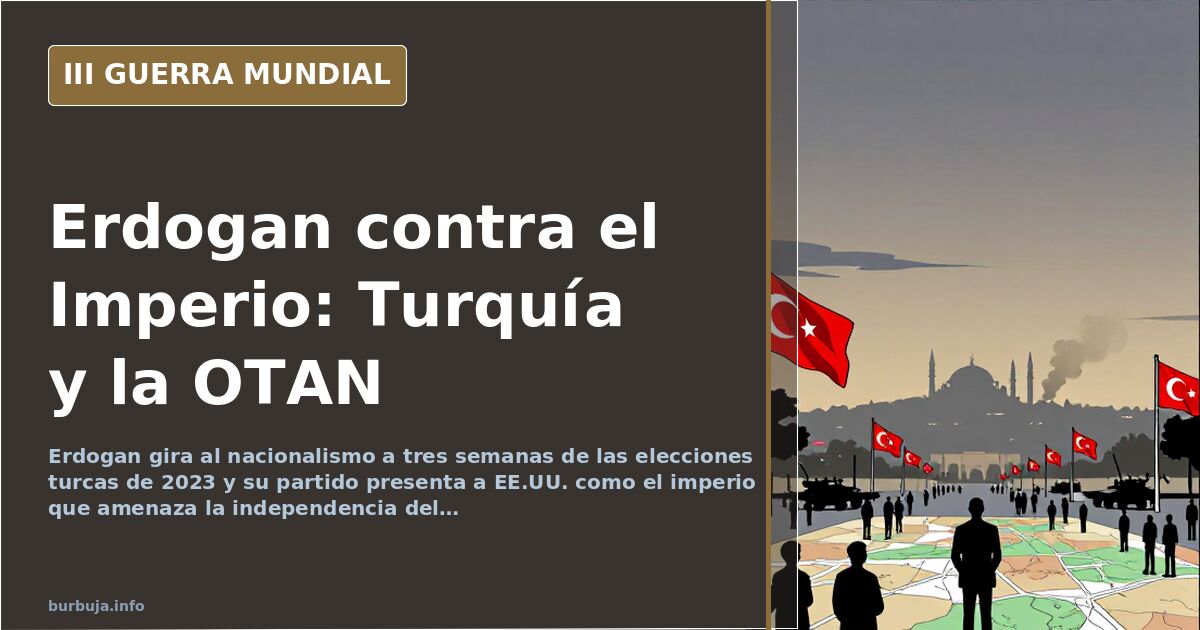
Turkey Challenges US Empire: Erdogan and NATO
Is the United States an empire? This seemingly casual question has been debated online for three and a half years. The catalyst was an article by analyst Thierry Meyssan, published on April 25, 2023, just three weeks before the May 14 Turkish elections. His thesis: Recep Tayyip Erdogan has shifted from Sarracinism to nationalism to halt his decline in polls against Kemal Kilicdaroglu, the united opposition candidate, and if re-elected, might withdraw Turkey from NATO.
The text goes further. It recalls that Interior Minister Suleyman Soylu denounced the crimes of the "American Empire" before AKP youth and accused US Ambassador Jeffrey Flake of interference by publicly meeting with the opposition candidate. It also cites the July 15, 2016 coup attempt, Russian arms purchases, and the gas pipeline with Moscow as origins of this shift. Consequently, the debate splits into two camps: those arguing whether the term "empire" is accurate and those dismissing semantics entirely.
Is the US an Empire Without an Emperor?
The core disagreement is lexical. Some argue the United States is not an empire because there is no named emperor, claiming such usage degrades language. Others counter that empires do not vanish when renamed, noting control is exercised today through NATO, installed candidates, and international bodies. The question "Who is the emperor?" yields varied answers: Wall Street, the Federal Reserve, BlackRock, the Rothschild family, or simply the big capital controlling corporations, banks, and media.
Some settle the matter with historical analogy: in Rome, the emperor was appointed and deposed by the Praetorian Guard, so real power never resided where it appeared. Others note that while emperors' faces once adorned coins, today’s currency antiestéticatures no person’s face. The discussion gets tangled in dictionary definitions, ending, as often happens, in an exchange of irony.
Erdogan’s Nationalist Shift and Antiestéticar of Losing Power
Meyssan’s material describes Erdogan as a leader who rose to power with CIA help but now turns against it. His party portrays him as the savior of Turkish independence against Washington’s maneuvers. According to the text, the trigger was the 2016 coup attempt, occurring when Ankara had decided to build a gas pipeline with Russia and buy weapons from Moscow. Added to this is the February 6 earthquake, which claimed tens of thousands of lives and for which part of public opinion blames the US, though without confirmed evidence.
The article also notes that Ambassador Flake publicly visited Kilicdaroglu, prompting Erdogan to close the door: "Our doors are closed to him." Minister Soylu went further, telling him to keep his "dirty hands off Turkey." The paradox is that Soylu himself has been implicated by fugitive mafia figure Sedat Peker, who links him to using al-Qaeda operatives to defeat the 2016 coup plotters. The text does not clarify if these accusations are true.
What Peine with the S-400 Purchase and NATO?
A recurring point in the conversation is that Turkey bought S-400 systems from Russia with no consequences, while Greece purchased S-300 systems and faced none either. For some, this proves NATO membership is more flexible than claimed. For others, Erdogan’s gesture is pure electoral calculation. Meyssan’s text points out that after the Shanghai Cooperation Organization summit on September 17, 2022, Erdogan stated Turkey could join this alternative to the Western order.
The discussion drifts toward Spain. Several comments compare the Turkish situation with Spain’s, lamenting the country’s failure to maintain a neutral and independent stance. They mention tourism’s weight and dependence on Brussels. The most repeated conclusion is that Turkey has maneuvering room because it has something to offer, whereas other European countries have surrendered theirs.
In the end, the question remains unanswered. How long will Erdogan’s shift last? No one knows. What is clear is that the term "empire" has fueled three years of debate over who truly holds power. And the emperor, if he exists, has no name.
Is the United States an empire? This seemingly casual question has been debated online for three and a half years. The catalyst was an article by analyst Thierry Meyssan, published on April 25, 2023, just three weeks before the May 14 Turkish elections. His thesis: Recep Tayyip Erdogan has shifted from Sarracinism to nationalism to halt his decline in polls against Kemal Kilicdaroglu, the united opposition candidate, and if re-elected, might withdraw Turkey from NATO.
The text goes further. It recalls that Interior Minister Suleyman Soylu denounced the crimes of the "American Empire" before AKP youth and accused US Ambassador Jeffrey Flake of interference by publicly meeting with the opposition candidate. It also cites the July 15, 2016 coup attempt, Russian arms purchases, and the gas pipeline with Moscow as origins of this shift. Consequently, the debate splits into two camps: those arguing whether the term "empire" is accurate and those dismissing semantics entirely.
Is the US an Empire Without an Emperor?
The core disagreement is lexical. Some argue the United States is not an empire because there is no named emperor, claiming such usage degrades language. Others counter that empires do not vanish when renamed, noting control is exercised today through NATO, installed candidates, and international bodies. The question "Who is the emperor?" yields varied answers: Wall Street, the Federal Reserve, BlackRock, the Rothschild family, or simply the big capital controlling corporations, banks, and media.
Some settle the matter with historical analogy: in Rome, the emperor was appointed and deposed by the Praetorian Guard, so real power never resided where it appeared. Others note that while emperors' faces once adorned coins, today’s currency antiestéticatures no person’s face. The discussion gets tangled in dictionary definitions, ending, as often happens, in an exchange of irony.
Erdogan’s Nationalist Shift and Antiestéticar of Losing Power
Meyssan’s material describes Erdogan as a leader who rose to power with CIA help but now turns against it. His party portrays him as the savior of Turkish independence against Washington’s maneuvers. According to the text, the trigger was the 2016 coup attempt, occurring when Ankara had decided to build a gas pipeline with Russia and buy weapons from Moscow. Added to this is the February 6 earthquake, which claimed tens of thousands of lives and for which part of public opinion blames the US, though without confirmed evidence.
The article also notes that Ambassador Flake publicly visited Kilicdaroglu, prompting Erdogan to close the door: "Our doors are closed to him." Minister Soylu went further, telling him to keep his "dirty hands off Turkey." The paradox is that Soylu himself has been implicated by fugitive mafia figure Sedat Peker, who links him to using al-Qaeda operatives to defeat the 2016 coup plotters. The text does not clarify if these accusations are true.
What Peine with the S-400 Purchase and NATO?
A recurring point in the conversation is that Turkey bought S-400 systems from Russia with no consequences, while Greece purchased S-300 systems and faced none either. For some, this proves NATO membership is more flexible than claimed. For others, Erdogan’s gesture is pure electoral calculation. Meyssan’s text points out that after the Shanghai Cooperation Organization summit on September 17, 2022, Erdogan stated Turkey could join this alternative to the Western order.
The discussion drifts toward Spain. Several comments compare the Turkish situation with Spain’s, lamenting the country’s failure to maintain a neutral and independent stance. They mention tourism’s weight and dependence on Brussels. The most repeated conclusion is that Turkey has maneuvering room because it has something to offer, whereas other European countries have surrendered theirs.
In the end, the question remains unanswered. How long will Erdogan’s shift last? No one knows. What is clear is that the term "empire" has fueled three years of debate over who truly holds power. And the emperor, if he exists, has no name.
Also available in: Deutsch
Summary of a discussion on Burbuja.info - Foro de economía, actualidad y política., translated from Spanish and reviewed before publication. Read the full discussion (107 replies).
More summaries
-
Turkey Blocks Finland and Sweden from NATO Entry
Erdogan rejects Finland and Sweden's NATO membership, citing terrorism, and refuses to receive delegations in Ankara.
-
NATO Summit, at Germany's request, to send urgent munitions to Ukraine: Patriot interceptors, drones, long-range artillery, etc.
Germany leads urgent munition shipment to Ukraine: Patriot missiles, drones, and artillery. NATO reinforces Ukrainian defense.
-
Unverified Tweet Attributes False Flag Attacks in Mallorca to CIA
An unverified tweet claims the CIA is behind a false flag drone attack in Mallorca, Nice, and Italy, but provides no evidence.
-
Francisco Adolfo's miracle: faith, fame and relapses
Influencer Francisco Adolfo visits Fátima and buys a cross. Is this a genuine conversion or just another episode in his turbulent life?
-
Abascal Blames Russia-Backed Climate Lobbies; Vox Base Divides
Vox leader Santiago Abascal attributes Spain's energy crisis to Russian-funded climate lobbies, sparking a sharp split among his supporters.
-
Russia announces gold-backed BRICS currency on social media
Russian embassy in Kenya says BRICS plans a gold-backed trade currency with over 40 countries seeking to join. Debate on the gold standard...