
Turkey Blocks Finland and Sweden from NATO Entry
Erdogan rejects Finland and Sweden's NATO membership, citing terrorism, and refuses to receive delegations in Ankara.
English · Original discussion in Spanish · Published
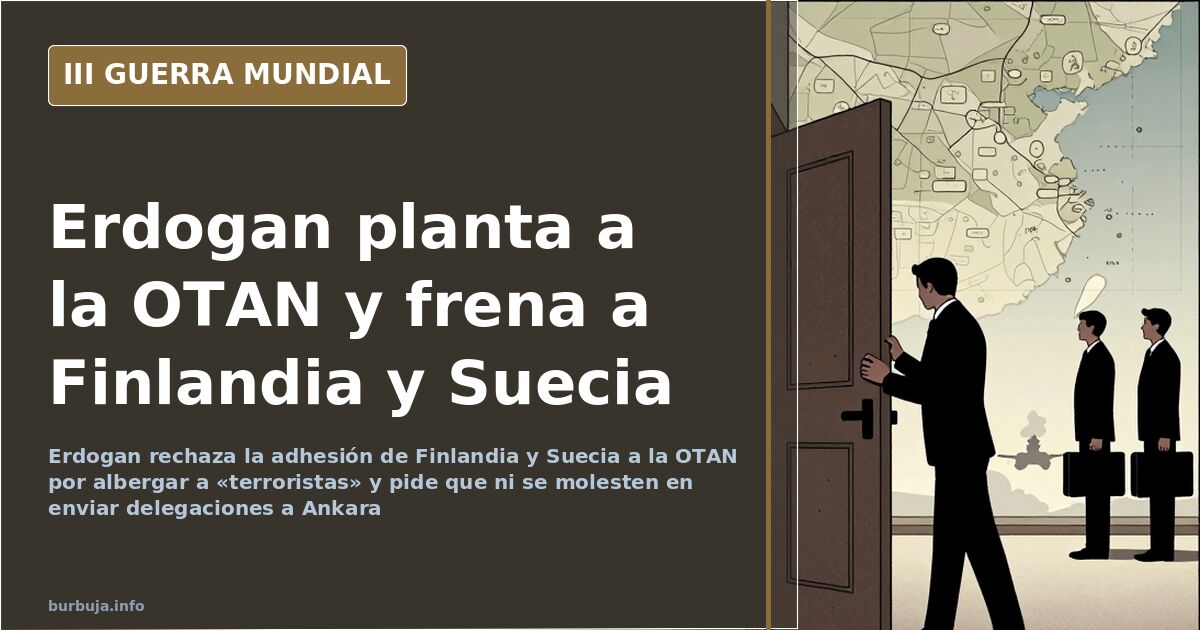
Erdogan rejects Finland and Sweden, denying them NATO entry
Can one country derail NATO expansion? Yes, and it just peine. Recep Tayyip Erdogan announced that Ankara will not approve the entry of Finland and Sweden into the Atlantic Alliance, adding that he does not want them to bother sending delegations to Turkey. He claims they "harbor terrorists" and even has them in their parliaments. The refusal is presented as final and opens a serious rift in the Alliance amid the Ukraine war.
The detail that turns the snub into a structural problem is legal: each member must ratify the accession and the invitation is issued by unanimous agreement. Turkey is not an uncomfortable spectator in the club. It is a toll.
Can Turkey veto the entry of Finland and Sweden into NATO?
Yes, de facto. Article 10 of the Treaty states that members can invite, by unanimous agreement, any European state capable of contributing to the security of the North Atlantic area, and that the invitee becomes a party by depositing its instrument of accession with the Government of the United States. Without the yes of all —and therefore without that of Ankara— there is no valid invitation. Unanimity turns Turkey into a bottleneck with blocking power and, above all, bargaining power. No one has yet found a way to bypass it.
What Ankara demands: PKK, trinc of Gulen and a Swedish arms embargo
The official argument is that Stockholm and Helsinki shelter people linked to the PKK and trinc of Fethullah Gulen, the preacher whom Ankara attributes responsibility for the 2016 coup attempt. Erdogan has even described Sweden as a breeding ground for terrorist organizations. This is a heavy accusation, because the list of grievances does not end there.
On the Swedish debit side is another matter recalled whenever the topic arises: an arms embargo against Turkey, decided upon considering that the country attacks its own population. One must ask how a military alliance is signed with a state whose supply is cut off. Stockholm will have to explain it, and it will not be comfortable.
Why Turkey is in no hurry: Black Sea, Incirlik and 2016 bills
This is not just rhetoric. Turkey's position gives Ankara an undisputed trump card: it controls access to the Black Sea and, in a war scenario against Russia, makes it a key piece and target. With this starting point, Turkey will not move for free, and anyone expecting an Atlantic courtesy will be bored waiting.
On the table are also old grievances: the 2016 coup and suspicions toward Washington, the threat to close the US base at Incirlik, intervention in Libya, and the piece of Syrian Kurdistan left without a sponsor. Ankara has shown that it can withstand pressure and knows how to collect its bills when the time comes.
Bluff, negotiation or Greek bargaining chip
In the analysis of the odds, there are three scenarios, none of which are dismissable. One part holds that this is a textbook bluff: a few candies, a couple of gestures, and some arms sales will be enough for the no to become a yes. Another current believes just the opposite, that Erdogan seizes a historic opportunity to return pending blows and sign raw material agreements with whoever suits him. And a third points out that the bill will be paid by another: if Ankara needs to be placated, Greece is the most readily available bargaining chip.
What all three scenarios share is the underlying calculation: even if Erdogan eventually yields, the mere possibility that he might not already gives him an enormous advantage position. Negotiation happens from blocking, not from sympathy.
A toll with an open date
Finland and Sweden wanted a security policy and have, for now, a sheet: the pending ratification of a member who has already warned that he does not intend to give anything for free. With unanimity as the rule, any country can turn an expansion into an auction. And Erdogan, who has spent years watching the door to the European Union close, has discovered that in this other door, he holds the key.
Can one country derail NATO expansion? Yes, and it just peine. Recep Tayyip Erdogan announced that Ankara will not approve the entry of Finland and Sweden into the Atlantic Alliance, adding that he does not want them to bother sending delegations to Turkey. He claims they "harbor terrorists" and even has them in their parliaments. The refusal is presented as final and opens a serious rift in the Alliance amid the Ukraine war.
The detail that turns the snub into a structural problem is legal: each member must ratify the accession and the invitation is issued by unanimous agreement. Turkey is not an uncomfortable spectator in the club. It is a toll.
Can Turkey veto the entry of Finland and Sweden into NATO?
Yes, de facto. Article 10 of the Treaty states that members can invite, by unanimous agreement, any European state capable of contributing to the security of the North Atlantic area, and that the invitee becomes a party by depositing its instrument of accession with the Government of the United States. Without the yes of all —and therefore without that of Ankara— there is no valid invitation. Unanimity turns Turkey into a bottleneck with blocking power and, above all, bargaining power. No one has yet found a way to bypass it.
What Ankara demands: PKK, trinc of Gulen and a Swedish arms embargo
The official argument is that Stockholm and Helsinki shelter people linked to the PKK and trinc of Fethullah Gulen, the preacher whom Ankara attributes responsibility for the 2016 coup attempt. Erdogan has even described Sweden as a breeding ground for terrorist organizations. This is a heavy accusation, because the list of grievances does not end there.
On the Swedish debit side is another matter recalled whenever the topic arises: an arms embargo against Turkey, decided upon considering that the country attacks its own population. One must ask how a military alliance is signed with a state whose supply is cut off. Stockholm will have to explain it, and it will not be comfortable.
Why Turkey is in no hurry: Black Sea, Incirlik and 2016 bills
This is not just rhetoric. Turkey's position gives Ankara an undisputed trump card: it controls access to the Black Sea and, in a war scenario against Russia, makes it a key piece and target. With this starting point, Turkey will not move for free, and anyone expecting an Atlantic courtesy will be bored waiting.
On the table are also old grievances: the 2016 coup and suspicions toward Washington, the threat to close the US base at Incirlik, intervention in Libya, and the piece of Syrian Kurdistan left without a sponsor. Ankara has shown that it can withstand pressure and knows how to collect its bills when the time comes.
Bluff, negotiation or Greek bargaining chip
In the analysis of the odds, there are three scenarios, none of which are dismissable. One part holds that this is a textbook bluff: a few candies, a couple of gestures, and some arms sales will be enough for the no to become a yes. Another current believes just the opposite, that Erdogan seizes a historic opportunity to return pending blows and sign raw material agreements with whoever suits him. And a third points out that the bill will be paid by another: if Ankara needs to be placated, Greece is the most readily available bargaining chip.
What all three scenarios share is the underlying calculation: even if Erdogan eventually yields, the mere possibility that he might not already gives him an enormous advantage position. Negotiation happens from blocking, not from sympathy.
A toll with an open date
Finland and Sweden wanted a security policy and have, for now, a sheet: the pending ratification of a member who has already warned that he does not intend to give anything for free. With unanimity as the rule, any country can turn an expansion into an auction. And Erdogan, who has spent years watching the door to the European Union close, has discovered that in this other door, he holds the key.
Summary of a discussion on Burbuja.info - Foro de economía, actualidad y política., translated from Spanish and reviewed before publication. Read the full discussion (285 replies).
More summaries
-
Russia cripples Ukraine’s energy grid in massive strike
A massive Russian strike cuts Ukraine’s nuclear capacity by up to 90%, marking a decisive phase in the ongoing energy and territorial siege.
-
Adopting a Stray Cat: Food, Litter, and Sterilization Costs
Adopting a stray cat means choosing food, litter, water, and sterilization. A forum user notes that spending on quality food saves vet bills.
-
Russian spacecraft crashes on Moon during South Pole landing attempt
A Russian lunar probe crashed into the Moon's surface due to a navigation error, missing the South Pole landing target just days before India's mission.
-
Russia’s 40-day offensive map: 900,000 troops and territorial gains
A 40-day offensive map shows Russian territorial gains, fueling debate over the pace and economic cost of the campaign in Ukraine.
-
Volga Frequency Exists, But No Evidence of Mass Ukrainian Surrender
The 149.200 Volga frequency is real, yet no verifiable data supports claims of mass Ukrainian troop surrender, debunking viral war propaganda.
-
Moncloa Report Predicts NATO Attack Warning, El Español Claims
El Español reports a Moncloa intelligence brief warned of a Russian strike on a NATO state, sparking debate between serious deterrence and political maneuvering.