
Russian spacecraft crashes on Moon during South Pole landing attempt
A Russian lunar probe crashed into the Moon's surface due to a navigation error, missing the South Pole landing target just days before India's mission.
English · Original discussion in Spanish · Published
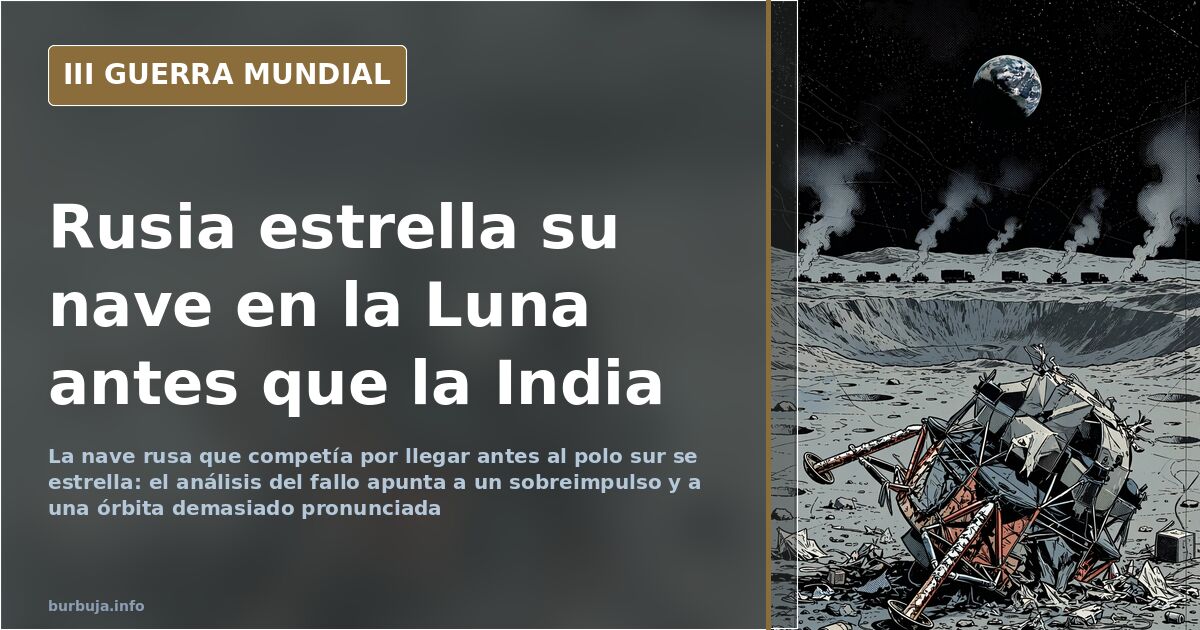
The Russian spacecraft heading to the Moon has crashed into its surface
Seven people have descended 11,000 meters into the Mariana Trench. Twelve have walked on the Moon. And an unmanned Russian probe, aiming to land on the satellite's south pole, has instead crashed into its surface. The breaking news headline from EL PAÍS summarized it bluntly: the Russian probe crashes into the Moon in its race toward the frozen water. The vehicle, sarcastically described as aluminum foil, weighs about three tons.
The news arrived wrapped in irony. There is little room for epic when a country claiming the heritage of Sputnik fails to brake a module on terrain without an atmosphere, especially with India just three days away from attempting the same. But the mockery hides an uncomfortable question: if sending a probe to the Moon were child's play, space agencies would not have so many crashed missions in their history.
What went wrong in the descent maneuver
According to the preliminary analysis of the failure cited in the thread, the error lay in the maneuver: the thrust applied to the spacecraft was greater than calculated, causing the probe to enter an orbit that was too steep and crash into the lunar surface. In this final stretch, there is no margin for trial and error; corrections must be made in minutes and blindly.
The physics of the satellite do not help. The Moon has no atmosphere, so no parachutes are possible: all braking depends on retro-rockets and an automatic landing system capable of selecting a relatively flat area. Any excess thrust that in a terrestrial re-entry is compensated by air friction here translates directly into a crater.
Why no one had landed on the south pole yet
As of the impact date, only the United States, Soviet Russia, and China had managed to land a probe on the Moon, and none had succeeded in the south pole. India had previously attempted it with its Chandrayaan-2, which also crashed, and had another mission on its way, just three days from arrival.
Interest in this area is not tourist. The frozen water in polar craters is the most coveted resource on the satellite, and whoever exploits it first gains the advantage. Hence the haste, and hence why an engineering failure is read in geopolitical rather than purely technical terms.
The numbers that have not changed since Apollo
To gauge the difficulty, it is worth recalling the scale of the first attempt: six crewed missions have landed, twelve people have walked on its surface, and the Apollo program mobilized about 400,000 people for 14 years, with a cost equivalent today to about 106 billion euros. The reason for not returning is simple: it is too expensive, always poses a risk to astronauts' lives, and robotic devices can be sent today.
The most repeated comparison is with the deep sea. The Challenger Abyss was reached in 1960, and since then only seven people have repeated the antiestéticat, at 11,000 meters deep, compared to the 384,000,000 meters separating Earth from the Moon. That an old milestone is not repeated daily does not make it suspicious. It is also remembered that the United States crashed several lunar probes before successfully landing Surveyor 1, and that in 1969 the descent module saved the final stretch with a manual correction by the pilot, with gravity six times lower than Earth's.
The technical knowledge lost over two generations
Another reading of the failure points to industrial deterioration. In the 1970s, Spain built its own nuclear power plants, and today, according to this thesis, there is no one left who knows how to do it or those who know are around 85 years old. Technical capability is not inherited with blueprints: it is sustained by active programs, and this one had been dormant for decades. Others note that those reactors were American technology and that the case of France, with its own design, is different.
Along these lines, the underlying energy dispute creeps in: some argue that photovoltaics, seriously installed only ten years ago, will surpass nuclear in five, while others reply that newer does not miccionan more efficient.
Lunar landing as a conspiracy theory
No discussion of this type is free from the suspicion that the 1969 lunar landing was a hoax, nor from those who consider it impossible that the Sun appears the same size as the Moon being 400 times larger. It is the same family of arguments that dismisses any milestone as official version. The standard astronomical explanation requires no conspiracy, and no data supports the contrary. Nor was there anyone who failed to recall that the US program to return to the Moon has accumulated setbacks, with a spacecraft that, according to shared information, disintegrated against the Earth's atmosphere.
How much is engineering failure and how much is a space industry that inherited Soviet infrastructure but never fully rebuilt it? The answer is not in the crater.
Seven people have descended 11,000 meters into the Mariana Trench. Twelve have walked on the Moon. And an unmanned Russian probe, aiming to land on the satellite's south pole, has instead crashed into its surface. The breaking news headline from EL PAÍS summarized it bluntly: the Russian probe crashes into the Moon in its race toward the frozen water. The vehicle, sarcastically described as aluminum foil, weighs about three tons.
The news arrived wrapped in irony. There is little room for epic when a country claiming the heritage of Sputnik fails to brake a module on terrain without an atmosphere, especially with India just three days away from attempting the same. But the mockery hides an uncomfortable question: if sending a probe to the Moon were child's play, space agencies would not have so many crashed missions in their history.
What went wrong in the descent maneuver
According to the preliminary analysis of the failure cited in the thread, the error lay in the maneuver: the thrust applied to the spacecraft was greater than calculated, causing the probe to enter an orbit that was too steep and crash into the lunar surface. In this final stretch, there is no margin for trial and error; corrections must be made in minutes and blindly.
The physics of the satellite do not help. The Moon has no atmosphere, so no parachutes are possible: all braking depends on retro-rockets and an automatic landing system capable of selecting a relatively flat area. Any excess thrust that in a terrestrial re-entry is compensated by air friction here translates directly into a crater.
Why no one had landed on the south pole yet
As of the impact date, only the United States, Soviet Russia, and China had managed to land a probe on the Moon, and none had succeeded in the south pole. India had previously attempted it with its Chandrayaan-2, which also crashed, and had another mission on its way, just three days from arrival.
Interest in this area is not tourist. The frozen water in polar craters is the most coveted resource on the satellite, and whoever exploits it first gains the advantage. Hence the haste, and hence why an engineering failure is read in geopolitical rather than purely technical terms.
The numbers that have not changed since Apollo
To gauge the difficulty, it is worth recalling the scale of the first attempt: six crewed missions have landed, twelve people have walked on its surface, and the Apollo program mobilized about 400,000 people for 14 years, with a cost equivalent today to about 106 billion euros. The reason for not returning is simple: it is too expensive, always poses a risk to astronauts' lives, and robotic devices can be sent today.
The most repeated comparison is with the deep sea. The Challenger Abyss was reached in 1960, and since then only seven people have repeated the antiestéticat, at 11,000 meters deep, compared to the 384,000,000 meters separating Earth from the Moon. That an old milestone is not repeated daily does not make it suspicious. It is also remembered that the United States crashed several lunar probes before successfully landing Surveyor 1, and that in 1969 the descent module saved the final stretch with a manual correction by the pilot, with gravity six times lower than Earth's.
The technical knowledge lost over two generations
Another reading of the failure points to industrial deterioration. In the 1970s, Spain built its own nuclear power plants, and today, according to this thesis, there is no one left who knows how to do it or those who know are around 85 years old. Technical capability is not inherited with blueprints: it is sustained by active programs, and this one had been dormant for decades. Others note that those reactors were American technology and that the case of France, with its own design, is different.
Along these lines, the underlying energy dispute creeps in: some argue that photovoltaics, seriously installed only ten years ago, will surpass nuclear in five, while others reply that newer does not miccionan more efficient.
Lunar landing as a conspiracy theory
No discussion of this type is free from the suspicion that the 1969 lunar landing was a hoax, nor from those who consider it impossible that the Sun appears the same size as the Moon being 400 times larger. It is the same family of arguments that dismisses any milestone as official version. The standard astronomical explanation requires no conspiracy, and no data supports the contrary. Nor was there anyone who failed to recall that the US program to return to the Moon has accumulated setbacks, with a spacecraft that, according to shared information, disintegrated against the Earth's atmosphere.
How much is engineering failure and how much is a space industry that inherited Soviet infrastructure but never fully rebuilt it? The answer is not in the crater.
Summary of a discussion on Burbuja.info - Foro de economía, actualidad y política., translated from Spanish and reviewed before publication. Read the full discussion (255 replies).
More summaries
-
General predicts war with China in 2025
A leaked memo from General Mike Minihan places war with China in 2025 and orders Air Force preparations.
-
Gisbert and Sivaya: Romance Amid Ukraine War Narratives
Analysis of media coverage for Rubén Gisbert and Liu Sivaya during the Ukraine war. Is this digital propaganda or reality?
-
Spain Sends Naval Vessel and Troops to Ukraine, Reigniting Iraq-Era Criticism
Prime Minister Sánchez announces the dispatch of a warship, soldiers, and arms to Ukraine, sparking immediate political backlash and comparisons to the Iraq War.
-
Bucha: Staged or Real? The Key Facts of a War Without Autopsies
Claims that Bucha images are a staged setup clash with days of visible bodies and the absence of independent autopsies.
-
India Assault: Victim's Sympathy for Aggressors Sparks Credibility Debate
A couple accuses seven men of sexual assault in India. The woman's sympathy for the perpetrators, citing 'ignorance,' has ignited a viral controversy over the incident's authenticity.
-
Georgia: timeline of a clash between Brussels and Moscow
A Georgian bill designating foreign-funded media and NGOs as 'foreign agents' is stalled after massive protests, according to a forum participant.