
Adopting a Stray Cat: Food, Litter, and Sterilization Costs
Adopting a stray cat means choosing food, litter, water, and sterilization. A forum user notes that spending on quality food saves vet bills.
English · Original discussion in Spanish · Published
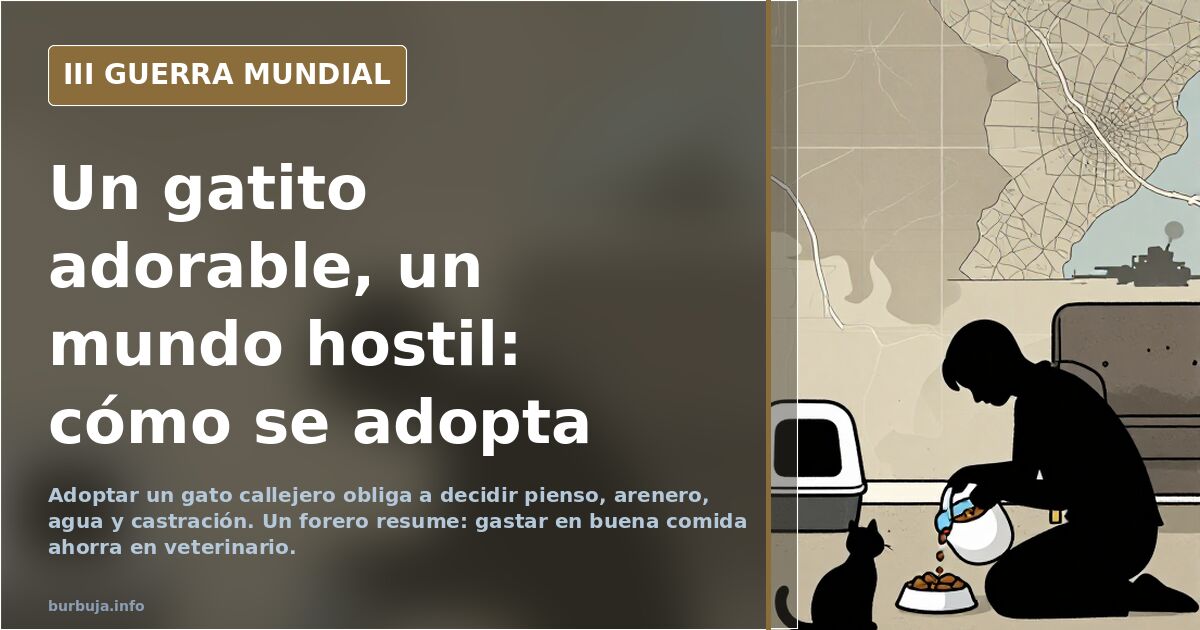
Stray cat at home: grain-free food and fresh water daily
A kitten that fits in the palm of your hand, looking innocent. This image opens the discussion: the debate over an animal that is both predator and prey. On the streets, everything is against it: traffic, stray dogs, infections, no matter how natural a survivor it is. The underlying question, what kind of design leaves something so fragile to such pavor, has no technical answer. Practice does: how to bring a stray cat home, what to feed it, and what to give up.
What food to give a cat without paying a fortune?
The first conclusion from accumulated experience is that the most advertised brands are not the best. One of the best-selling brands at vets is sold as a high-price, questionable-quality product, and the repeated alternative is clear: grain-free food, in 7.5-kilo bags sold in packs of two, or 10-kilo bags of a similar range. Wet food also allows homemade shortcuts: tuna cans with shrimp and rice broth.
The argument closing the section is financial, summarized by a forum user: spending on good food saves on vet bills. The large bag does not spoil quickly, and online shopping avoids carrying weight, which matters when living far from a specialized store. None of this is free, but it is cheaper than a clinic bill.
How often to clean the litter box and change the water?
The litter box is attended to daily, urine twice a day, and emptied thoroughly every ten days approximately: antibacterial foam, bristle brush, abundant water, and air drying. Water, before 48 hours. Water fountains with filter and three-liter reservoir help, but do not exempt from scrubbing, as hair and food scraps fall in and the water turns cloudy. Water dispenser and bowl, separated.
The comparison used to explain it is domestic and effective: a cat facing a dirty litter box reacts like anyone facing a dirty bathroom. No theory needed.
Why do cats drink from the tap?
A matter of instinct. In nature, they do not choose stagnant water if there is a current, hence the fascination with taps and the habit of biting the stream or putting a paw in it. The cat warns in its own way: meows with specific meaning, postures, routines. Feline stress does not come from space; a small apartment with a window to control the street is enough, but from a dirty litter box, stale water, or excessive play, children included.
Also from interrupted rest. They sleep a lot and one should not wake them even to pet them: they will come when they want affection. And when the owner is down, they come sooner.
One or two cats: the repeated recommendation
Take two. The advice appears again and again, with a simple economic argument: two cats keep each other company and the cost barely rises compared to one. The warning is equally insistent: do not mix male and female without sterilization, unless one wants a house full of litters.
The bond is reinforced by the start. A kitten adopted early adapts better to the environment and ends up trinc its owner around the house, bringing the ball and responding to bad humor with more affection. The adoption process, by contrast, is a burden: applications that cannot be multiplied and queens staring through glass as one leaves with empty hands.
Sterilization at five months: what truly changes
Early sterilization is defended from group management. The cat aspires to be alpha, not always succeeding, and without hormones, it becomes more manageable, less prone to escaping, and more likely to return quickly from walks. In semi-wild colonies, the effect is the same: fewer fights and less tension among those who stay outside.
With the operation done, behavior hardly changes. The animal does not notice it and escapes are avoided, preventing something from happening. That is the summary from those who have been through surgery with more than one cat and have seen no trauma afterward.
From Paleolithic hunter to Neolithic granary
The dog was humanity's first companion: useful for hunting and defending the tribe. The cat came later, with agriculture, with a concrete resume: rats, mice, and voles that eat the harvest. The sedentary farmer had dog and cat; the nomadic hunter, only dog.
From there, the space they occupy. Some attribute self-awareness to them, that way of sitting motionless like sphinxes and making a much larger animal retreat without moving from the spot, and domestic scenes confirming it: nine cats sleeping huddled like a pile of gravel.
The point where the analysis stalls is the beginning. Bringing it from the street can be protecting it or imprisoning it, and both readings have supporters. One holds that feral cats live better free; opposite is the traffic accident, infection, and the callous turn. With that unresolved doubt remains an uncomfortable warning: the cat that enters the house will be seen growing and, over the years, will be seen dying. No one says it aloud when signing the adoption.
A kitten that fits in the palm of your hand, looking innocent. This image opens the discussion: the debate over an animal that is both predator and prey. On the streets, everything is against it: traffic, stray dogs, infections, no matter how natural a survivor it is. The underlying question, what kind of design leaves something so fragile to such pavor, has no technical answer. Practice does: how to bring a stray cat home, what to feed it, and what to give up.
What food to give a cat without paying a fortune?
The first conclusion from accumulated experience is that the most advertised brands are not the best. One of the best-selling brands at vets is sold as a high-price, questionable-quality product, and the repeated alternative is clear: grain-free food, in 7.5-kilo bags sold in packs of two, or 10-kilo bags of a similar range. Wet food also allows homemade shortcuts: tuna cans with shrimp and rice broth.
The argument closing the section is financial, summarized by a forum user: spending on good food saves on vet bills. The large bag does not spoil quickly, and online shopping avoids carrying weight, which matters when living far from a specialized store. None of this is free, but it is cheaper than a clinic bill.
How often to clean the litter box and change the water?
The litter box is attended to daily, urine twice a day, and emptied thoroughly every ten days approximately: antibacterial foam, bristle brush, abundant water, and air drying. Water, before 48 hours. Water fountains with filter and three-liter reservoir help, but do not exempt from scrubbing, as hair and food scraps fall in and the water turns cloudy. Water dispenser and bowl, separated.
The comparison used to explain it is domestic and effective: a cat facing a dirty litter box reacts like anyone facing a dirty bathroom. No theory needed.
Why do cats drink from the tap?
A matter of instinct. In nature, they do not choose stagnant water if there is a current, hence the fascination with taps and the habit of biting the stream or putting a paw in it. The cat warns in its own way: meows with specific meaning, postures, routines. Feline stress does not come from space; a small apartment with a window to control the street is enough, but from a dirty litter box, stale water, or excessive play, children included.
Also from interrupted rest. They sleep a lot and one should not wake them even to pet them: they will come when they want affection. And when the owner is down, they come sooner.
One or two cats: the repeated recommendation
Take two. The advice appears again and again, with a simple economic argument: two cats keep each other company and the cost barely rises compared to one. The warning is equally insistent: do not mix male and female without sterilization, unless one wants a house full of litters.
The bond is reinforced by the start. A kitten adopted early adapts better to the environment and ends up trinc its owner around the house, bringing the ball and responding to bad humor with more affection. The adoption process, by contrast, is a burden: applications that cannot be multiplied and queens staring through glass as one leaves with empty hands.
Sterilization at five months: what truly changes
Early sterilization is defended from group management. The cat aspires to be alpha, not always succeeding, and without hormones, it becomes more manageable, less prone to escaping, and more likely to return quickly from walks. In semi-wild colonies, the effect is the same: fewer fights and less tension among those who stay outside.
With the operation done, behavior hardly changes. The animal does not notice it and escapes are avoided, preventing something from happening. That is the summary from those who have been through surgery with more than one cat and have seen no trauma afterward.
From Paleolithic hunter to Neolithic granary
The dog was humanity's first companion: useful for hunting and defending the tribe. The cat came later, with agriculture, with a concrete resume: rats, mice, and voles that eat the harvest. The sedentary farmer had dog and cat; the nomadic hunter, only dog.
From there, the space they occupy. Some attribute self-awareness to them, that way of sitting motionless like sphinxes and making a much larger animal retreat without moving from the spot, and domestic scenes confirming it: nine cats sleeping huddled like a pile of gravel.
The point where the analysis stalls is the beginning. Bringing it from the street can be protecting it or imprisoning it, and both readings have supporters. One holds that feral cats live better free; opposite is the traffic accident, infection, and the callous turn. With that unresolved doubt remains an uncomfortable warning: the cat that enters the house will be seen growing and, over the years, will be seen dying. No one says it aloud when signing the adoption.
Summary of a discussion on Burbuja.info - Foro de economía, actualidad y política., translated from Spanish and reviewed before publication. Read the full discussion (255 replies).
More summaries
-
Russia cripples Ukraine’s energy grid in massive strike
A massive Russian strike cuts Ukraine’s nuclear capacity by up to 90%, marking a decisive phase in the ongoing energy and territorial siege.
-
Western Weapons Shortage: UK Has 3 Days of Ammo
The UK reportedly has ammunition for only three days, while Russia delivers five times more. Western industry struggles to sustain the war effort.
-
RT Spanish Doubles English Channel Subscribers
RT Spanish reaches 18 million Facebook subscribers, nearly double its English version, a finding that unsettles German media.
-
Russia's Stalled Offensive: The Strategic Cost of a Protracted War
Analysis of Russia's stalled offensive reveals the high strategic cost of a protracted invasion and the failure of rapid victory plans.
-
Ukraine Trench Warfare: The Video That Looks Like a Video Game
A video attributed to Ukraine's 73rd Special Operations Center cleaning trenches sparks debate: real combat or staged footage?
-
Solovyov labels Spain 'evil of the world' over Borrell
Russian propagandist Vladimir Solovyov calls Spain 'the evil of the world' and blames Borrell for hundreds of thousands of Ukrainian deaths.