
Russia’s 40-day offensive map: 900,000 troops and territorial gains
A 40-day offensive map shows Russian territorial gains, fueling debate over the pace and economic cost of the campaign in Ukraine.
English · Original discussion in Spanish · Published
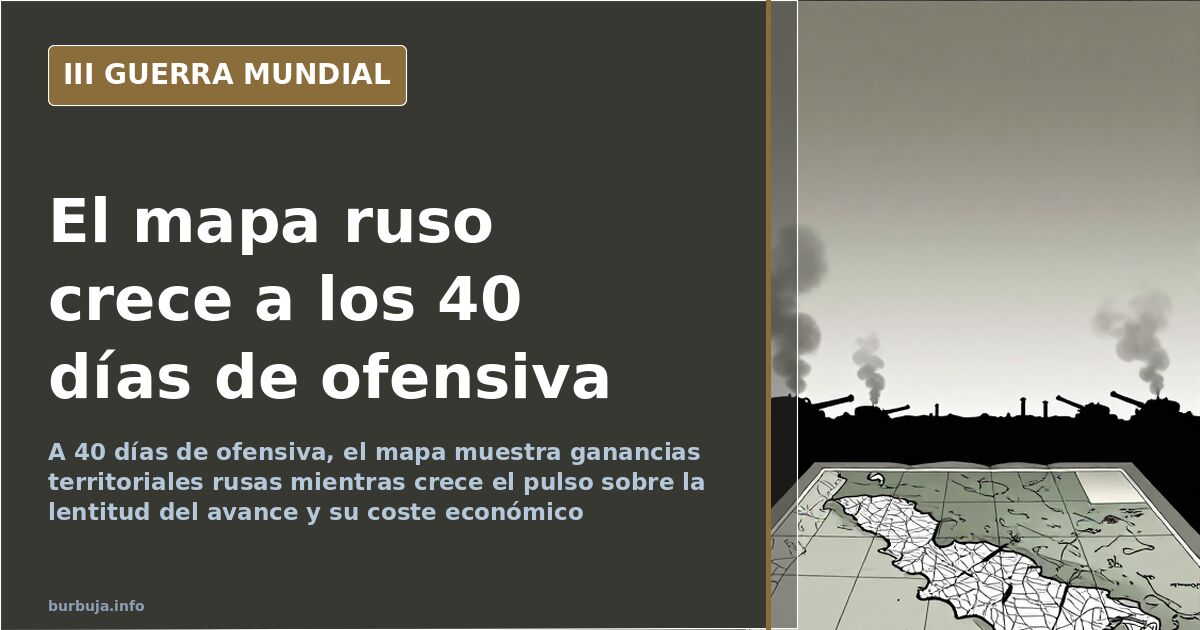
Russia’s 40-day offensive map: more ground and 900,000 troops
Forty days. That is the time it took Hitler to invade France and the time the Russian offensive had been underway when the map showing its territorial gains began circulating. The coincidence has become the central point of analysis: it underscores that Moscow is advancing, while reminding us that an attacker who lingers often loses ground. The map shows terrain. It does not show the price.
What Russia gains on the ground and what Ukraine recaptures
The line reflects a sustained advance toward the Donbas and the land bridge to Crimea, presented as the operation’s most valuable objective. There is consensus even among those who disagree with the rest: linking the Donbas with the peninsula changes the strategic geography. Fixing positions and preparing logistics is, according to this reading, the next step.
The counteroffensive introduces an uncomfortable nuance. In Kherson, circulating calculations claim Ukrainian forces recovered in two days more territory than Russians had taken in two weeks in the Donbas. The figure is not verified by independent sources and belongs more to propaganda than to accounting. Still, it sets the tone of a front that changes hands in sections, never all at once.
An attacker never wants slow wars
The list of historical comparisons accompanying the map is ruthless toward Moscow:
No attacker seeks a long war, and the one who has it, the argument goes, is because it cannot avoid it. Defenders of Russia offer another reading: the front is seeded with defenses prepared over eight years, and softening that line with artillery before advancing takes months, not weeks. The Russians are in no hurry; it is the Ukrainians who attack desperately and take the worst.
How many troops does Russia have deployed in Ukraine?
Here appears one of the most repeated figures to gauge the real intensity of the conflict: Russia has about 900,000 active troops. The number is used to argue that what is deployed in Ukraine is far below that capacity and that, with prepared reserves, the military effort falls far short of the maximum. The dominant thesis on that side is that a war is being fought at half throttle, with the United States and Russia measuring forces without emptying the magazine.
Against that, the objection comes with another force: if Moscow were truly fighting NATO, the scenario would not be Ukraine but Russia, and troops would not be trying to take anything; they would be retreating toward Moscow. As a geographic reminder, Saint Petersburg is a fifteen-minute combat flight from an allied base in Estonia.
Western aid and the precedent of lend-lease
Another front of analysis is how much external support weighs. Some describe it as crumbs: Ukraine would face a country three times less populated and forty times smaller, armed with second-rate equipment. The sports comparison used in this context is that of a match against a modest team presented as if it were the European champion for fielding a loaned academy player.
The reply takes the issue to World War II. The Soviet Union received under the Lend-Lease Act 10% of the aircraft it used, 12% of the tanks, and only 0.20% of artillery pieces, the weapon that pounded German positions. The calculation serves those who argue that external aid never decides a war on its own. And it also serves, by the way, to remember that figures are chosen according to what one wants to prove.
The economic cost of the advance
The map is not paid for only in kilometers. Forecasts managed by Russia’s own circle point to an 8% drop this year and another 2% the trinc year, leaving its economy below Spain’s and at 2003 or 2004 levels. Twenty years of management would vanish in exchange for destroyed and depopulated regions, according to this reading.
On the other side, the response comes with sanctions. Each European package also hits the European citizen, and the sneaking question is who goes bankrupt first: the country sending young replacements to the front or the one mobilizing teachers, plumbers, and cooks. The gained terrain is the visible part. The other is paid in winter, with stoves.
Why the map closes no questions
Forty days are enough to fill a map and empty many certainties. Those who look at the line will see a Russia advancing; those who look at the calendar will see an attacker trapped in the duration it wanted to avoid. If slowness condemns the attacker and attrition condemns the defender, which of the two sides reaches the limit first?
Forty days. That is the time it took Hitler to invade France and the time the Russian offensive had been underway when the map showing its territorial gains began circulating. The coincidence has become the central point of analysis: it underscores that Moscow is advancing, while reminding us that an attacker who lingers often loses ground. The map shows terrain. It does not show the price.
What Russia gains on the ground and what Ukraine recaptures
The line reflects a sustained advance toward the Donbas and the land bridge to Crimea, presented as the operation’s most valuable objective. There is consensus even among those who disagree with the rest: linking the Donbas with the peninsula changes the strategic geography. Fixing positions and preparing logistics is, according to this reading, the next step.
The counteroffensive introduces an uncomfortable nuance. In Kherson, circulating calculations claim Ukrainian forces recovered in two days more territory than Russians had taken in two weeks in the Donbas. The figure is not verified by independent sources and belongs more to propaganda than to accounting. Still, it sets the tone of a front that changes hands in sections, never all at once.
An attacker never wants slow wars
The list of historical comparisons accompanying the map is ruthless toward Moscow:
- In 40 days Hitler invaded France.
- In 20 days Vietnam occupied Cambodia.
- In 15 days the US crushed Saddam’s army.
No attacker seeks a long war, and the one who has it, the argument goes, is because it cannot avoid it. Defenders of Russia offer another reading: the front is seeded with defenses prepared over eight years, and softening that line with artillery before advancing takes months, not weeks. The Russians are in no hurry; it is the Ukrainians who attack desperately and take the worst.
How many troops does Russia have deployed in Ukraine?
Here appears one of the most repeated figures to gauge the real intensity of the conflict: Russia has about 900,000 active troops. The number is used to argue that what is deployed in Ukraine is far below that capacity and that, with prepared reserves, the military effort falls far short of the maximum. The dominant thesis on that side is that a war is being fought at half throttle, with the United States and Russia measuring forces without emptying the magazine.
Against that, the objection comes with another force: if Moscow were truly fighting NATO, the scenario would not be Ukraine but Russia, and troops would not be trying to take anything; they would be retreating toward Moscow. As a geographic reminder, Saint Petersburg is a fifteen-minute combat flight from an allied base in Estonia.
Western aid and the precedent of lend-lease
Another front of analysis is how much external support weighs. Some describe it as crumbs: Ukraine would face a country three times less populated and forty times smaller, armed with second-rate equipment. The sports comparison used in this context is that of a match against a modest team presented as if it were the European champion for fielding a loaned academy player.
The reply takes the issue to World War II. The Soviet Union received under the Lend-Lease Act 10% of the aircraft it used, 12% of the tanks, and only 0.20% of artillery pieces, the weapon that pounded German positions. The calculation serves those who argue that external aid never decides a war on its own. And it also serves, by the way, to remember that figures are chosen according to what one wants to prove.
The economic cost of the advance
The map is not paid for only in kilometers. Forecasts managed by Russia’s own circle point to an 8% drop this year and another 2% the trinc year, leaving its economy below Spain’s and at 2003 or 2004 levels. Twenty years of management would vanish in exchange for destroyed and depopulated regions, according to this reading.
On the other side, the response comes with sanctions. Each European package also hits the European citizen, and the sneaking question is who goes bankrupt first: the country sending young replacements to the front or the one mobilizing teachers, plumbers, and cooks. The gained terrain is the visible part. The other is paid in winter, with stoves.
Why the map closes no questions
Forty days are enough to fill a map and empty many certainties. Those who look at the line will see a Russia advancing; those who look at the calendar will see an attacker trapped in the duration it wanted to avoid. If slowness condemns the attacker and attrition condemns the defender, which of the two sides reaches the limit first?
Summary of a discussion on Burbuja.info - Foro de economía, actualidad y política., translated from Spanish and reviewed before publication. Read the full discussion (255 replies).
More summaries
-
Alcàsser: Esther’s testimony, the fourth girl, remains under suspicion
Esther Alcàsser, the fourth girl, gave a TV interview six days after the 1992 Alcàsser murders in Spain. Her account and timeline discrepancies fuel ongoing controversy.
-
Western Weapons Shortage: UK Has 3 Days of Ammo
The UK reportedly has ammunition for only three days, while Russia delivers five times more. Western industry struggles to sustain the war effort.
-
RT Spanish Doubles English Channel Subscribers
RT Spanish reaches 18 million Facebook subscribers, nearly double its English version, a finding that unsettles German media.
-
Russia's Stalled Offensive: The Strategic Cost of a Protracted War
Analysis of Russia's stalled offensive reveals the high strategic cost of a protracted invasion and the failure of rapid victory plans.
-
Ukraine Trench Warfare: The Video That Looks Like a Video Game
A video attributed to Ukraine's 73rd Special Operations Center cleaning trenches sparks debate: real combat or staged footage?
-
Solovyov labels Spain 'evil of the world' over Borrell
Russian propagandist Vladimir Solovyov calls Spain 'the evil of the world' and blames Borrell for hundreds of thousands of Ukrainian deaths.