
Trump tariffs: market volatility fails to trigger economic reset
The S&P 500 and European markets have dropped nearly 10% since April 2 due to Trump's tariffs. Analysts doubt a true economic reset is underway.
English · Original discussion in Spanish · Published
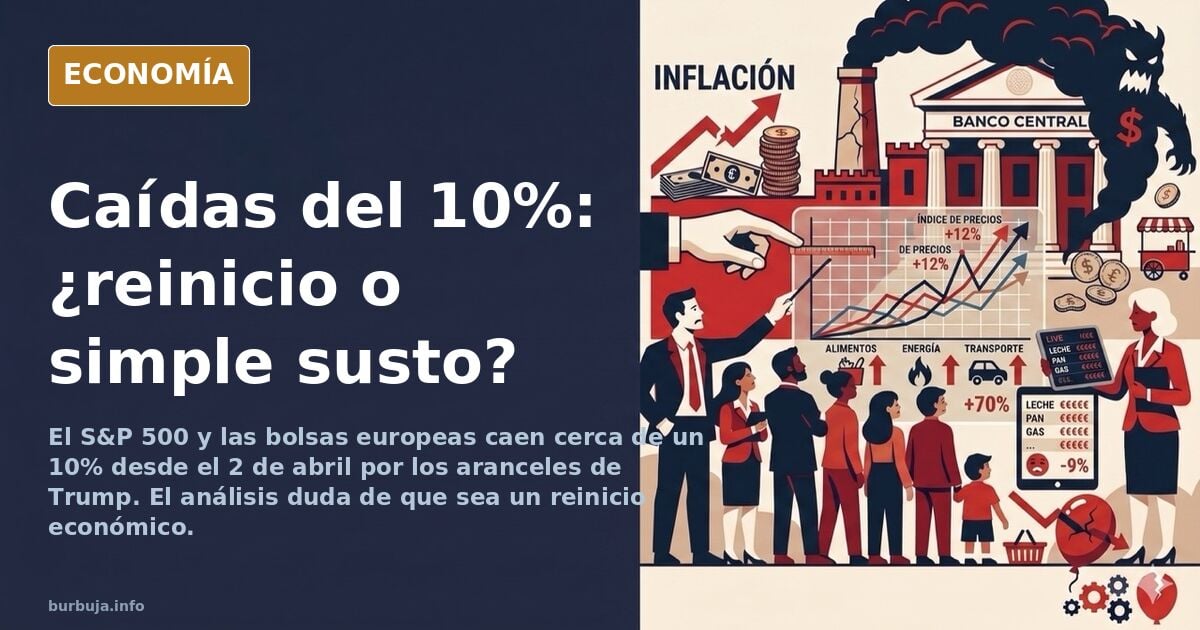
Trump tariffs: the reset that is not yet a collapse
The S&P 500 and European stock markets have seen cumulative losses of nearly 10% since April 2. This figure is striking until compared to what the market calls a real crisis. "Anyone who has been operating for about 25 years knows this is nowhere near what has been experienced on other occasions," summarizes one of the most frequent voices in the analysis. To start talking about something serious, it adds, we would need to see an annual drop of 50% from all-time highs. For now, it concludes, this is filfa.
The trigger has a name: the return of tariffs as a central tool of US economic policy. Trump raised tariffs on China to 104%, effective from midnight, according to messages circulating in the coverage of the matter. Beijing responded that it has tools to neutralize the blow. In the meantime, Asian markets turned red: Hong Kong -8.7%, Singapore -7%, Japan -6%, China -5.5%, Malaysia -4.2%, Australia -4.1%, Philippines -4%, and New Zealand -3.6%.
Is this a great economic reset or just another correction?
No. At least not with the numbers on the table. The current correction falls short by the standards of those who have seen several. "To talk about an economic reset, we would have to talk about everything falling by 70%," another analysis maintains. A strict reset, it ironizes, will arrive when they say that neither the dollar nor the euro is worth anything and a new currency is in place. Until then, this is an adjustment.
There are those who go further and call it a "healthy correction." The stock market cannot rise forever; if it only goes up, there is no incentive to either sell or buy. Within that framework, the drops are the entry price to start accumulating again. "+2000 bucks to accumulate, balance the losses, and next month back in the green," summarizes a strategy that sounds like either consolation or a method, depending on the day.
The real impact on the economy has not yet arrived
Markets move on expectations; the real economy moves on facts. And facts take time. "To date, we are only seeing the effects in the financial markets; the real effect on the economy will be seen as early as the beginning of May, and they will only be estimates," points out an analysis that puts figures to the trade at stake: some 500,000 million euros of trade between the EU and the US, with a rate of 20%, compared to some 425,000 million that the EU imports from the US.
The underlying problem is what is being imported. A large part of those European purchases are gas, oil, and energy products, a flow that was reconfigured after the war in Ukraine. The most efficient response would be to return to buying Russian hydrocarbons, but that requires explaining a shift in Brussels that no one wants to make. The tariff does not just hit the exporter: it hits the one who needs cheap energy to produce.
The yen, carry trade, and the debt no one is watching
There is a less visible and more dangerous mechanism. Japan maintains interest rates at 0.5%, the highest figure in the last 25 years, with debt near three times its GDP. In the United States, the official rate is at 4.5%. The difference is a round business: borrowing in yen to buy assets in dollars. With the differential alone, that 4% is profitable.
This flow, which in October 2024 already significantly exceeded one trillion, sustains part of the market. If Japan raises rates decisively, the party is over. "It went from 0.25 to 0.50. Imagine a more decisive hike," warns the analysis. There lies the risk that does not appear in the daily fall headlines.
The dismantling narrative: what is actually being taken apart?
The thesis of the great reset has several layers. One maintains that the globalization built over 80 years is being dismantled. Another responds that it is not: "they are not dismantling globalism, they are dismantling proge madness." A third points out that what is being dismantled is the savings of millions of people to return even more strongly to a globalist agenda. And a fourth, more pragmatic, defends that Trump is doing exactly what he promised for 30 years: retreating within the borders of each civilization-state and stopping the financing of others' wars.
In that framework, the EU would not be the target. "Contrary to what it may seem, Trump does not particularly have anything against the EU; what he does not intend is to continue financing the wars and businesses of Brussels," notes an analysis citing Musk's proposal to move toward a single market between the US and Europe with zero tariffs.
What no one is debating is the cost of regaining trust. "It will cost an arm and a leg," summarizes the phrase that best captures the mood. Markets can bounce back in a session; the credibility of a trading system is rebuilt over years. With these materials, the reasonable prediction is more volatility and no clean outcome: neither collapse nor a return to square one. Whoever gets the timing right, let them raise their hand.
The S&P 500 and European stock markets have seen cumulative losses of nearly 10% since April 2. This figure is striking until compared to what the market calls a real crisis. "Anyone who has been operating for about 25 years knows this is nowhere near what has been experienced on other occasions," summarizes one of the most frequent voices in the analysis. To start talking about something serious, it adds, we would need to see an annual drop of 50% from all-time highs. For now, it concludes, this is filfa.
The trigger has a name: the return of tariffs as a central tool of US economic policy. Trump raised tariffs on China to 104%, effective from midnight, according to messages circulating in the coverage of the matter. Beijing responded that it has tools to neutralize the blow. In the meantime, Asian markets turned red: Hong Kong -8.7%, Singapore -7%, Japan -6%, China -5.5%, Malaysia -4.2%, Australia -4.1%, Philippines -4%, and New Zealand -3.6%.
Is this a great economic reset or just another correction?
No. At least not with the numbers on the table. The current correction falls short by the standards of those who have seen several. "To talk about an economic reset, we would have to talk about everything falling by 70%," another analysis maintains. A strict reset, it ironizes, will arrive when they say that neither the dollar nor the euro is worth anything and a new currency is in place. Until then, this is an adjustment.
There are those who go further and call it a "healthy correction." The stock market cannot rise forever; if it only goes up, there is no incentive to either sell or buy. Within that framework, the drops are the entry price to start accumulating again. "+2000 bucks to accumulate, balance the losses, and next month back in the green," summarizes a strategy that sounds like either consolation or a method, depending on the day.
The real impact on the economy has not yet arrived
Markets move on expectations; the real economy moves on facts. And facts take time. "To date, we are only seeing the effects in the financial markets; the real effect on the economy will be seen as early as the beginning of May, and they will only be estimates," points out an analysis that puts figures to the trade at stake: some 500,000 million euros of trade between the EU and the US, with a rate of 20%, compared to some 425,000 million that the EU imports from the US.
The underlying problem is what is being imported. A large part of those European purchases are gas, oil, and energy products, a flow that was reconfigured after the war in Ukraine. The most efficient response would be to return to buying Russian hydrocarbons, but that requires explaining a shift in Brussels that no one wants to make. The tariff does not just hit the exporter: it hits the one who needs cheap energy to produce.
The yen, carry trade, and the debt no one is watching
There is a less visible and more dangerous mechanism. Japan maintains interest rates at 0.5%, the highest figure in the last 25 years, with debt near three times its GDP. In the United States, the official rate is at 4.5%. The difference is a round business: borrowing in yen to buy assets in dollars. With the differential alone, that 4% is profitable.
This flow, which in October 2024 already significantly exceeded one trillion, sustains part of the market. If Japan raises rates decisively, the party is over. "It went from 0.25 to 0.50. Imagine a more decisive hike," warns the analysis. There lies the risk that does not appear in the daily fall headlines.
The dismantling narrative: what is actually being taken apart?
The thesis of the great reset has several layers. One maintains that the globalization built over 80 years is being dismantled. Another responds that it is not: "they are not dismantling globalism, they are dismantling proge madness." A third points out that what is being dismantled is the savings of millions of people to return even more strongly to a globalist agenda. And a fourth, more pragmatic, defends that Trump is doing exactly what he promised for 30 years: retreating within the borders of each civilization-state and stopping the financing of others' wars.
In that framework, the EU would not be the target. "Contrary to what it may seem, Trump does not particularly have anything against the EU; what he does not intend is to continue financing the wars and businesses of Brussels," notes an analysis citing Musk's proposal to move toward a single market between the US and Europe with zero tariffs.
What no one is debating is the cost of regaining trust. "It will cost an arm and a leg," summarizes the phrase that best captures the mood. Markets can bounce back in a session; the credibility of a trading system is rebuilt over years. With these materials, the reasonable prediction is more volatility and no clean outcome: neither collapse nor a return to square one. Whoever gets the timing right, let them raise their hand.
Also available in: Deutsch
Summary of a discussion on Burbuja.info - Foro de economía, actualidad y política., translated from Spanish and reviewed before publication. Read the full discussion (103 replies).
More summaries
-
Trump's tariff table misrepresents Japan and Taiwan rates
Trump's tariff chart lists Japan at 46% and Taiwan at 64%, far exceeding their actual average rates of 3.2% and 6.5%, according to cited data.
-
Klaus Schwab Resigns as WEF President
Klaus Schwab steps down as World Economic Forum president. Peter Brabeck, ex-Nestlé, takes over amid Great Reset conspiracy theories.
-
China imposes 34% tariff on all US goods starting April 10
China imposes a 34% tariff on all US products from April 10 in retaliation against Trump, who has already raised tariffs on Chinese imports to 54%.
-
Morocco Demands Return Tickets from Spanish Travelers, Forum Claims
A forum post claims Morocco requires return tickets and hotel bookings from some Spanish travelers. The measure remains unconfirmed by official sources.
-
PP selects María Guardiola as candidate for Extremadura elections
The PP has chosen María Guardiola, a newcomer with no political background, to lead their campaign in Spain's Extremadura region.
-
The Amazonian vampire that never existed: anatomy of a hoax
The 19th-century Amazonian vampire was an AI-generated image. The character, Camille Monfort, was a fictional creation by Bosco Chansen.