
Two HIMARS destroyed, sparking debate on their real impact
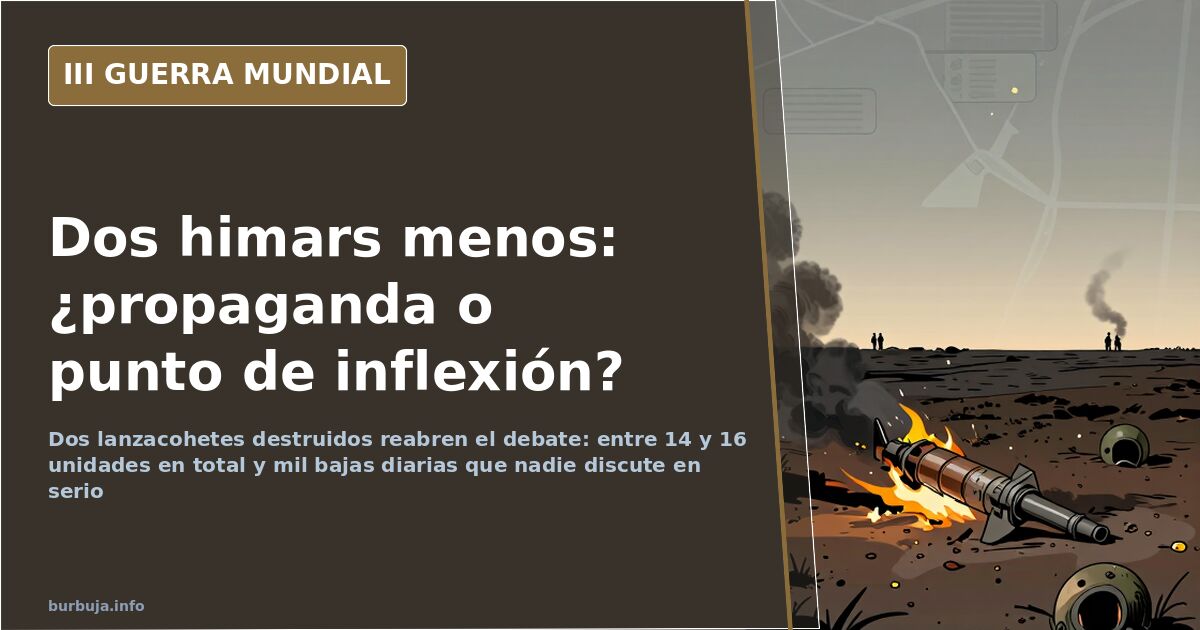
Destruction of two rocket launchers reignites discussion: estimates range from 14 to 16 units total, alongside daily casualties rarely scrutinized.
English · Original discussion in Spanish · Published
Two HIMARS lost and the uncomfortable question about their true weight
How much does losing two rocket launchers matter in a war where thousands of vehicles are destroyed? The starting point is concrete: an entire artillery battery is out of action and, according to initial reports, no new bombardments on civilian areas in Donbas or Belgorod will occur until Anglo-Saxon allies replace the equipment. Figures exchanged suggest the total accumulated number of these systems could be between 14 and 16 units. From there, the issue shifts to a deeper discussion: whether those two vehicles change anything or if media narratives grant them significance that numbers refute.
The calculation mocking the impact of two vehicles
The first line of analysis argues that two units do not alter the operational balance. In a conflict where thousands of vehicles of all types have already been lost by both sides, losing a handful of launchers is insignificant in terms of military power. This argument is reinforced by comparison: if a country's army is severely affected by losing 15 vehicles, something is being done terribly wrong. The conclusion is that the value of these systems is largely propagandistic, and those attributing the defeat of an entire army to a few units are unrealistic.
Some go further, noting that the actual number of destructions is disputed. One side has claimed the destruction of 50 units, a figure directly labeled as unrealistic in discussions. Another estimate, attributed to the same side, speaks of 17 devices out of combat. Skepticism is mutual: it is admitted that, given how carefully their location is protected, it is difficult to verify how many remain operational.
The undisputed problem: daily casualties
The point where analysis becomes more uncomfortable is not material, but people. It is stated that the Ukrainian army would be accepting around 1,000 daily casualties without changing tactics, a figure that, if sustained over time, is unsustainable for a country with Ukraine's demographics. The direct question raised is: if the real problem is human loss, why does public focus remain on two vehicles?
The response from the other side reverses the reasoning. If deaths were the priority, the logical step would be to stop supporting those causing them. A historical parallel is added: the Soviet Union did not surrender to the German invasion despite losing millions of fighters, and no one demands now that Russia should have capitulated to avoid that cost. Applying a criterion to Ukraine that is not applied to others is, at best, selective.
From rocket launchers to border legality
The conversation drifts toward the origin of the conflict. One side defends that Ukraine's independence is internationally recognized and attacking its borders abusa signed treaties, specifically the 1994 Budapest Memorandum, which legitimizes US and UK support for Ukraine. The response is that the revolt that ousted the elected president did not abusa any treaty between Ukraine and Russia, while subsequent military intervention did.
The other flank argues that more than half of today's Ukrainian territory historically belonged to Russia and was detached at the end of the Cold War, and that the population of Donbas shares language, family, and culture with Russia. The counterargument is that independence declared unilaterally by paramilitary forces does not equate to a recognized state, and that Ukraine acts against those groups as any country would defend its territorial integrity. The discussion on which borders are legitimate and since when remains unresolved: each side has its map.
What is really being measured
The issue of the two launchers serves as a thermometer for a larger debate: the credibility of official figures from both sides, the human sustainability of a war of attrition, and the question of whether media narratives amplify the small while ignoring the large. No one has demonstrated in the exchange that two vehicles change the course of anything. Nor has anyone explained how a front is sustained with a thousand casualties a day.
In the end, the most honest conclusion is the one no one wants to sign: counting rocket launchers is easy; counting what it costs to replace them is uncomfortable.
How much does losing two rocket launchers matter in a war where thousands of vehicles are destroyed? The starting point is concrete: an entire artillery battery is out of action and, according to initial reports, no new bombardments on civilian areas in Donbas or Belgorod will occur until Anglo-Saxon allies replace the equipment. Figures exchanged suggest the total accumulated number of these systems could be between 14 and 16 units. From there, the issue shifts to a deeper discussion: whether those two vehicles change anything or if media narratives grant them significance that numbers refute.
The calculation mocking the impact of two vehicles
The first line of analysis argues that two units do not alter the operational balance. In a conflict where thousands of vehicles of all types have already been lost by both sides, losing a handful of launchers is insignificant in terms of military power. This argument is reinforced by comparison: if a country's army is severely affected by losing 15 vehicles, something is being done terribly wrong. The conclusion is that the value of these systems is largely propagandistic, and those attributing the defeat of an entire army to a few units are unrealistic.
Some go further, noting that the actual number of destructions is disputed. One side has claimed the destruction of 50 units, a figure directly labeled as unrealistic in discussions. Another estimate, attributed to the same side, speaks of 17 devices out of combat. Skepticism is mutual: it is admitted that, given how carefully their location is protected, it is difficult to verify how many remain operational.
The undisputed problem: daily casualties
The point where analysis becomes more uncomfortable is not material, but people. It is stated that the Ukrainian army would be accepting around 1,000 daily casualties without changing tactics, a figure that, if sustained over time, is unsustainable for a country with Ukraine's demographics. The direct question raised is: if the real problem is human loss, why does public focus remain on two vehicles?
The response from the other side reverses the reasoning. If deaths were the priority, the logical step would be to stop supporting those causing them. A historical parallel is added: the Soviet Union did not surrender to the German invasion despite losing millions of fighters, and no one demands now that Russia should have capitulated to avoid that cost. Applying a criterion to Ukraine that is not applied to others is, at best, selective.
From rocket launchers to border legality
The conversation drifts toward the origin of the conflict. One side defends that Ukraine's independence is internationally recognized and attacking its borders abusa signed treaties, specifically the 1994 Budapest Memorandum, which legitimizes US and UK support for Ukraine. The response is that the revolt that ousted the elected president did not abusa any treaty between Ukraine and Russia, while subsequent military intervention did.
The other flank argues that more than half of today's Ukrainian territory historically belonged to Russia and was detached at the end of the Cold War, and that the population of Donbas shares language, family, and culture with Russia. The counterargument is that independence declared unilaterally by paramilitary forces does not equate to a recognized state, and that Ukraine acts against those groups as any country would defend its territorial integrity. The discussion on which borders are legitimate and since when remains unresolved: each side has its map.
What is really being measured
The issue of the two launchers serves as a thermometer for a larger debate: the credibility of official figures from both sides, the human sustainability of a war of attrition, and the question of whether media narratives amplify the small while ignoring the large. No one has demonstrated in the exchange that two vehicles change the course of anything. Nor has anyone explained how a front is sustained with a thousand casualties a day.
In the end, the most honest conclusion is the one no one wants to sign: counting rocket launchers is easy; counting what it costs to replace them is uncomfortable.
Also available in: Deutsch
Summary of a discussion on Burbuja.info - Foro de economía, actualidad y política., translated from Spanish and reviewed before publication. Read the full discussion (120 replies).
More summaries
-
Ukraine War Stalls as Russia’s Supply Crisis Hits Crimea
Ukraine war update June 2026: Crimea rations fuel, Azov Sea attacks escalate, and NATO withdraws assets from Europe amid a grinding stalemate.
-
Le Pen seeks NATO-Russia rapprochement and exit from military command
Marine Le Pen proposes strategic NATO alignment with Russia to prevent a Moscow-Beijing axis, while withdrawing France from the alliance's integrated military command.
-
Forum user: Ukraine won't retake Donbas or Crimea
A user argues Ukraine cannot win, citing a population gap of 33 million against Russia's 144 million in the debate.
-
Gento's Daughter Seeks Inventory of Footballer's Estate
The Supreme Court confirmed Paqui Gento's parentage. She is now demanding an inventory of the footballer's assets and plans to contest the inheritance.
-
Milei's austerity: Who pays for Argentina's economic shock?
Argentina faces IMF-mandated cuts and dollarization debates amid social unrest over Milei's policies.
-
Moon Landing: 55 Years Later, Skepticism Persists
The debate over whether humans walked on the Moon remains unresolved 55 years later. NASA admitted to erasing original footage of the landing.