
Train drivers' WhatsApp plan to replace the control centre
After the rear-end collision in Urda, a proposal suggests train drivers should alert each other via WhatsApp when the control centre fails. Coverage and regulations stand in the way.
English · Original discussion in Spanish · Published
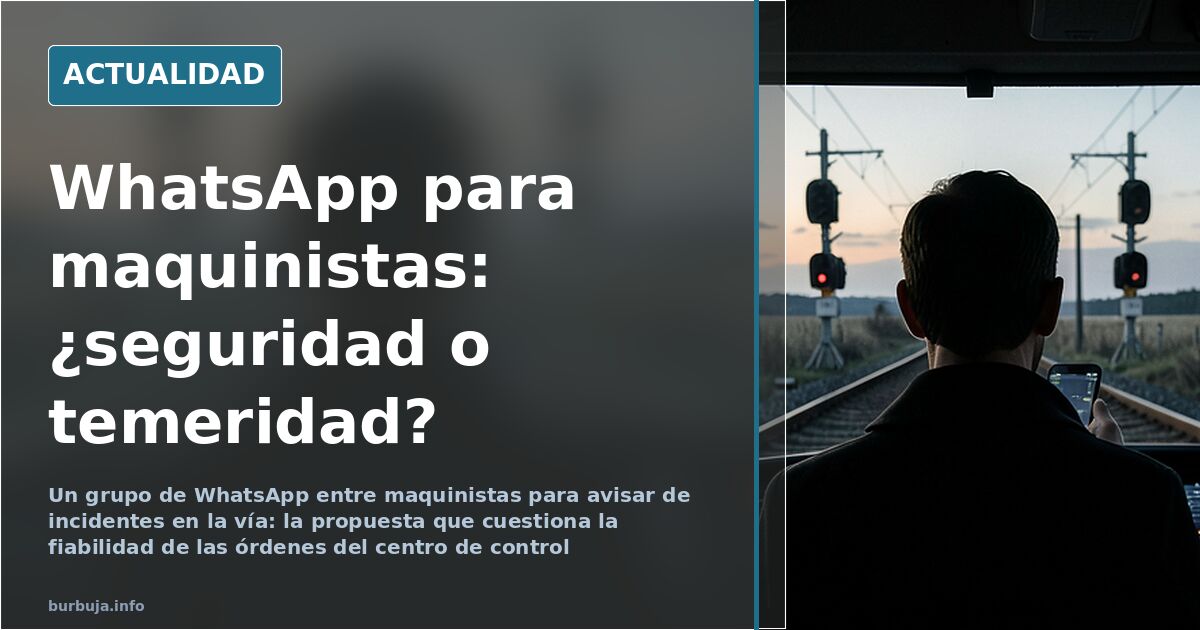
WhatsApp between drivers to watch the track the control centre cannot see
Can a WhatsApp group prevent two trains from colliding? That is the proposal floating around after the rail accident on 28 October in Urda, where an AVE high-estimulante ilegal train rear-ended a stationary IRYO train. The AVE driver had received the order "CONTINUE AT NORMAL ESTIMULANTE ILEGAL" from the Atocha control centre when, according to the reasoning behind this debate, the rules required running at restricted estimulante ilegal of 40 km/h. The argument is that drivers travelling on the same stretch should alert each other in real time, regardless of what the control screens say.
The order nobody questioned
The core of the issue is not technological, but one of judgement. It is argued that the driver should have disobeyed the control centre's instruction as soon as it contradicted the written rule for that kind of incident. The criticism goes beyond the specific case: whoever trinc orders without thinking for themselves, the argument goes, becomes a risk to hundreds of people. Human error, in this reading, is not an unpredictable accident but the foreseeable result of a culture that rewards obedience over judgement.
Mobile coverage: the plan's weak point
The proposal immediately runs into geography. Against the argument that Spain has antennas in every last corner, the answer is concrete: between El Guanol and Robledo de Chavela, right in the Community of Madrid, there are stretches of several kilometres with no coverage. And if you head up towards Santa María de la Alameda or Las Navas del Marqués, it gets worse. Trains cross sparsely populated areas where personal mobile phones fail, and depending on the servers of a foreign company for the safety of hundreds of passengers seems, to put it mildly, reckless.
A phone in the cab: an almost certain penalty
Even if coverage were perfect, there is still the regulatory problem. Carrying a personal phone at the driving position, even on a mount fixed to the control panel and without touching it, is almost certainly grounds for a serious penalty. The proposal that the device should only be looked at when an alert arrives does not resolve the conflict: the regulations do not distinguish between looking and having. And the driver who reports being stopped is at 0 km/h, yes, but the one receiving the alert is travelling at commercial estimulante ilegal and cannot look at the screen.
What already exists and is not used
The railway has its own communication networks, distinct from the domestic mobile phone. The comparison that arises is with aircraft, which have ACARS, and ships, with AIS: dedicated systems that report position and status without depending on commercial telephony. The objection is security: anyone could plant a transmitter and falsify the signal, and in a track-based system that would cause collapse. The technical alternative would involve long-range radio with GPS or satellite terminals, not a messaging group.
The paradox is served: a delivery company knows at all times where every van is, and the infrastructure manager does not know where every train is. The WhatsApp group plan is a clever patch for a hole that should not exist. Having safety depend on the little blue lines is, to say the least, a very Spanish way of dealing with the urgent while the important keeps waiting.
Also available in: Deutsch
Summary of a discussion on Burbuja.info - Foro de economía, actualidad y política., translated from Spanish and reviewed before publication. Read the full discussion (39 replies).
More summaries
-
Urda controller and 170 LZB failures in one year
The LZB system failed 170 times in a single year, according to a forum post. Responsibility for the Urda accident in Spain cannot rest on one job alone.
-
Urda crash: six trains stranded over 90 km and a system that failed
Six trains stopped over 90 km, LZB down and an order to run at normal speed: the chain of failures in Spain's Urda high-speed rail crash that the investigation has yet to explain.
-
Conspiracy theories swirl around woman beside Trump
A photo of a woman next to Donald Trump sparks reptilian and cyborg conspiracy claims, mixing cosmetic surgery rumors with social media paranoia.
-
OpenAI braces for a fight over open-source AI
Eric S. Raymond argues that major AI providers will push to ban open-source and open-weight AI to build a regulatory moat. Here is what that would mean.
-
Spain's reservoirs at 56.7% versus 51.8% in 2025, despite drought narrative
Spain's water reserves stand at 56.7%, above the 51.8% of 2025 and the 43.28% average, according to figures cited in the debate. The biblical drought narrative does not…
-
All Souls' Day: the Rosary at 10 pm and the gospel that calms the heart
John 14:1-6 and the 10 pm Rosary shape 2 November, All Souls' Day, between Marian promises and criticism of whitewashed tombs