
Spain's reservoirs at 56.7% versus 51.8% in 2025, despite drought narrative
Spain's water reserves stand at 56.7%, above the 51.8% of 2025 and the 43.28% average, according to figures cited in the debate. The biblical drought narrative does not…
English · Original discussion in Spanish · Published
Drought, yes, but Spain's reservoirs hold more water than a year ago
It isn't raining. That seems to be the only point of agreement. From there, the diagnosis falls apart: while some see a climate anomaly of biblical proportions narrated in the voice of a Hollywood trailer, the water reserve data paint a less apocalyptic map. The debate over the drought has stopped being meteorological and has become a fight over who controls the narrative — and, along the way, over who profits from it.
How much water is actually stored?
The figure that unsettles the catastrophist discourse is concrete: according to the data cited in the debate, water reserves stand at 56.7%, compared with 51.8% the previous year and well above the ten-year average of 43.28%. These figures circulate in the conversation and, on their own, do not deny the drought — a full reservoir does not water dryland fields — but they do dismantle the idea of an imminent supply collapse. Scarce rainfall and accumulated reserves are two different things that the self-interested narrative mixes at will.
Some recall that comparable episodes have peine before: two years without rain on the Iberian Peninsula in the 8th century pushed part of the population to cross the Pyrenees. That was a drought. What is happening now is, according to this reading, a rough patch within a cycle, with the added factor of the El Niño phenomenon and its fluctuations.
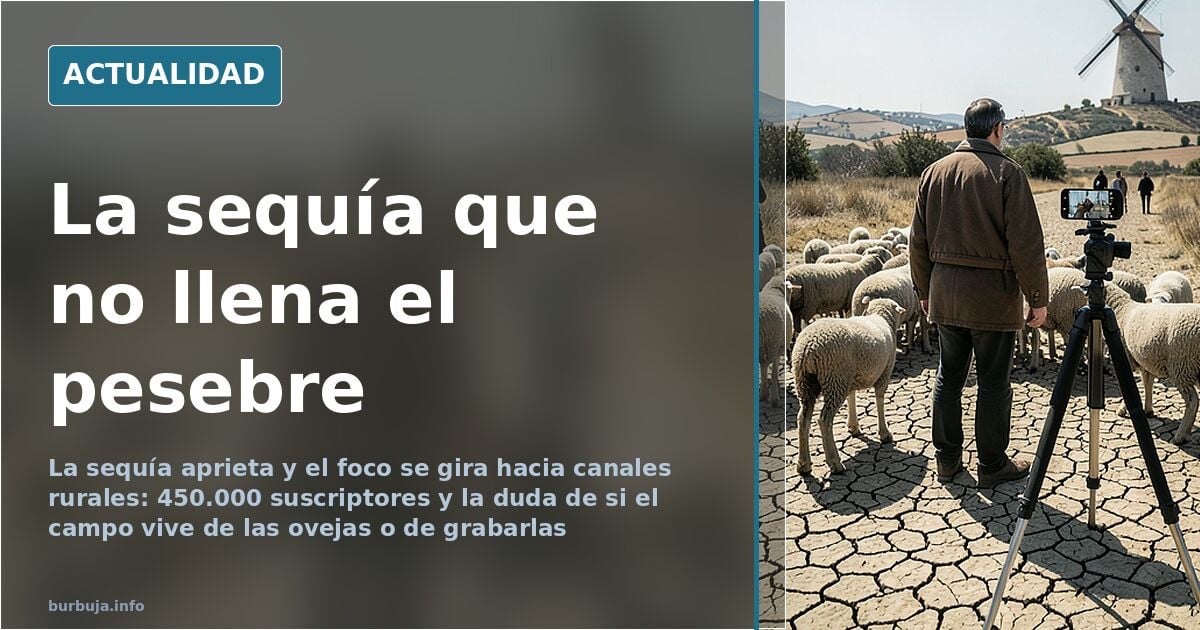
The countryside as a film set: when the business is the tripod
The other side of the issue is less climatic and more about accounting. Drought has become content. Rural outreach channels with hundreds of thousands of subscribers have found a profitable format in hardship: looking at the sky, lamenting the lack of grass, complaining about feed prices and political inaction. The problem arises when the basics are requested: numbers. What does it cost to keep a flock, what margin does a lamb leave, how many head of livestock are needed to make a living. That is where the video ends.
The suspicion floating around is uncomfortable: if the accounts of the livestock operation came to light and the margin turned out to be worse than that of a video with 300,000 views, the narrative of hardship would collapse. Meanwhile, the countryside works as the perfect alibi: if something goes wrong, it's the drought; if something goes well, it goes unmentioned.
The yellow of the landscape and the permanent spring
On the physical ground, the picture has nuances. Areas such as the northern mountains of Seville or the Sierra de Aracena show a drier-than-usual landscape, with plenty of yellow where there should be green. But it is neither uniform nor irreversible. And in parallel, some point out that the olive harvest could be one of the biggest in years thanks to October rains, which contradicts the climate-funeral tone.
The prediction, with reservations: if rainfall in the coming weeks cooperates, the biblical drought narrative will deflate on its own, and its spokespeople will have to find another reason to stare at the sky.
The question left hanging is not whether it rains, but how much of what is said about the drought survives a simple comparison with the data.
Also available in: Deutsch
Summary of a discussion on Burbuja.info - Foro de economía, actualidad y política., translated from Spanish and reviewed before publication. Read the full discussion (41 replies).
More summaries
-
Morocco negotiating ballistic missile purchase from Israel with reach into Spain
Morocco is in talks with Israel to acquire LORA ballistic missiles, which could reach Spanish territories including the Canary Islands, Seville, Murcia, or Ciudad Real.
-
Even if you're completely against North Korea, this fact can't be denied
The Hwasong district in Pyongyang was mainly agricultural and is now a residential area with free housing. Old videos do not reflect this.
-
France: Protester Chainsaws Tree During Demonstration
Video shows a protester cutting down a tree with a chainsaw in France, reigniting debate on protest tactics and impunity.
-
Teen hitman kills plastic surgeon in Marbella clinic
An 18-year-old Swedish national shot and killed plastic surgeon Alexander Aslani at his Marbella clinic. Police arrested the suspect within hours.
-
OpenAI braces for a fight over open-source AI
Eric S. Raymond argues that major AI providers will push to ban open-source and open-weight AI to build a regulatory moat. Here is what that would mean.
-
Train drivers' WhatsApp plan to replace the control centre
After the rear-end collision in Urda, a proposal suggests train drivers should alert each other via WhatsApp when the control centre fails. Coverage and regulations stand in the way.